By Mike Stone and Aishwarya Jain
Jan 29 (Reuters) – Lockheed has reached a profit-sharing agreement with the U.S. government related to the production of much-needed air defense missiles, the biggest U.S. defense contractor by output said on Thursday, while announcing results welcomed by investors.
Lockheed said it has a deal with the Pentagon to more than quadruple production of its Terminal High Altitude Area Defense, or THAAD, missile interceptors to 400 per year, from 96. This month, Lockheed clinched a seven-year agreement with the Department of Defense to boost production of Patriot PAC-3 missile interceptors to 2,000 units annually, from 600.
If Lockheed exceeds production and profit goals in its Patriot and THAAD contracts, CEO Jim Taiclet said, “we start to share some of the increased profits with the U.S. government by plowing some of those increased profits back” into spare production or the factory.
LOCKHEED STOCK JUMPS
Shares of the company shot up 5.4% on the news and after it forecast 2026 profit and revenue above Wall Street expectations, citing continued demand for its fighter jets and weapons systems.
The U.S. has been taking extraordinary measures to encourage defense contractors to produce more of the most widely used weaponry, more quickly. L3Harris announced this month a first-of-its-kind partnership with the Department of Defense, which invested $1 billion in the defense contractor’s rocket motor business.
U.S. Commerce Secretary Howard Lutnick said in August the Trump administration was weighing equity stakes in major defense contractors, including Lockheed Martin.
Conflicts in the Middle East and Russia’s protracted war in Ukraine have led to a surge in demand for arms, especially missiles and rockets, driving sales for defense contractors.
Geopolitical tensions have been further heightened by the capture of the Venezuelan president by U.S. forces.
Lockheed’s F-35 and F-22 fighter jets, RQ-170 stealth drones and Sikorsky Black Hawk helicopters were used in that operation, Taiclet told investors on a post-earnings conference call.
CONTRACT PROVISIONS PROTECT LOCKHEED
If congressional appropriations do not support the planned multi-year munitions buys, management said there are “make-whole” provisions in the contracts to help Lockheed Martin avoid losses.
During the fourth quarter, the company’s missiles business, maker of the Patriot system, posted the fastest sales growth among Lockheed’s units, up 17.8% from a year ago.
Quarterly sales for its aeronautics segment, which is the leading segment by revenue and makes the F-35 jets, rose 6.4%.
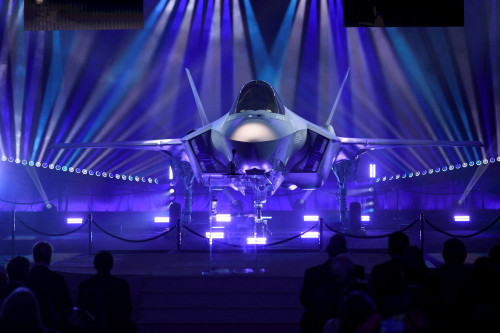
In January, Lockheed said it delivered a record 191 F-35 fighter jets in 2025, up from 110 jets in 2024.
The F-35 is the Pentagon’s largest acquisition program, with lifetime costs estimated at more than $2 trillion for purchasing, operating and maintaining the aircraft.
Trump in January signed an order for defense firms linking dividends, share buybacks and executive pay to weapons delivery schedules, introducing uncertainty around capital returns.
Peers RTX and Northrop Grumman have reaffirmed their commitments to dividends, although Northrop said it would pause buybacks beyond January.
In 2025, Lockheed paid $3.13 billion in dividends, a rise from $3.06 billion the previous year.
Lockheed forecast 2026 revenue of $77.5 billion to $80 billion, above analysts’ estimates of $77.83 billion, according to LSEG-compiled data.
It expects profit per share between $29.35 and $30.25, versus expectations of $29.28.
The Maryland-based company reported quarterly revenue of $20.32 billion, up from $18.62 billion.
(Reporting by Aishwarya Jain in Bengaluru and Mike Stone in Washington; Editing by Vijay Kishore, Louise Heavens, Chizu Nomiyama, Rod Nickel)