Active Trader Daily | March 27, 2026 | Institutional Edition
Bullet Summary
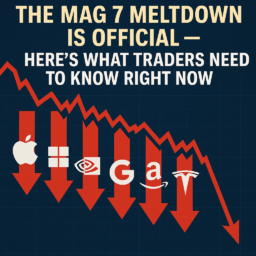
- The Roundhill Magnificent Seven ETF (MAGS) has declined approximately 17% from the Nasdaq’s October 29 high, with the group now officially in correction territory — down more than 10% from 52-week highs.
- Tesla (TSLA) closed at $167.12 (-4.9%), ahead of Q1 2025 delivery numbers that have since confirmed a 13% YoY decline to 336,681 units — well below analyst consensus of 377,592.
- Nvidia (NVDA) closed at $170.45 (-4.1%); trailing P/E has compressed from a 12-month average of ~46.7x to approximately 36.5x, with forward P/E at roughly 20.8x — a 21%+ valuation de-rating in the current cycle.
- Meta (META) closed at $542.11 (-2.2%) but faces compounding legal pressure: a Los Angeles jury found Meta 70% liable in a landmark social media addiction case, with a separate New Mexico ruling ordering $375 million in civil penalties the prior week.
- Analysts estimate total industry-wide legal exposure from addiction-related litigation could range from $10 billion to $50 billion, depending on appellate outcomes.
- The S&P 500 is on track for its fifth consecutive weekly decline, and the Nasdaq has confirmed correction status — down nearly 8% year-to-date.
- Capital rotation is accelerating out of large-cap tech and into financials, energy, and domestic manufacturers — a structural shift that institutional desks are increasingly pricing as durable, not tactical.
Market Context Analysis: Why This Moment Is Different
For the better part of two years, the Magnificent Seven were the market. They were the growth engine, the liquidity magnet, the narrative anchor that justified stretched multiples across the entire index. That regime is now under structural pressure — and the price action of the past several sessions is not noise. It is signal.
The Nasdaq Composite confirmed correction status, logging a decline of 10% or more from its October 29, 2025 record high. The index is down nearly 8% in 2026 and trading at its lowest level since early September 2025. The S&P 500 is on pace for its fifth straight weekly loss — a streak that, historically, demands respect as a macro regime indicator rather than a mean-reversion opportunity.
The macro backdrop compounds the technical deterioration. U.S. crude prices rose 4% on Thursday as geopolitical risk in the Middle East escalated, raising the specter of an oil-driven inflation resurgence. For a Federal Reserve already navigating a complex path between growth softness and sticky services inflation, this is an unwelcome development. Energy price spikes reduce the probability of near-term rate relief — and in a market where big-cap tech valuations remain elevated relative to the rest of the index, the cost of capital matters.
Simultaneously, capital expenditure commitments from the hyperscalers continue to stun the market. The four major tech players — Google, Microsoft, Amazon, and Meta — are expected to exceed $650 billion in aggregate capex in 2026, a 60% surge from 2025. Investors who were enthusiastic about AI infrastructure spending twelve months ago are now asking a harder question: when does it monetize, and what is the appropriate discount rate? That uncertainty is the root cause of the multiple compression cycle now underway.
Hedge funds are responding. Institutional gross exposures to Mag 7 names are being reduced for the first time in over a year. Company insiders are selling shares at rates not seen since 2021 — a behavioral signal that sophisticated participants are not buying this dip at current levels. Four of the seven components are trading below their 50-day moving averages, a configuration that historically precedes extended consolidation or further drawdown phases.
|
|
$758B in ‘AI Tolls’ Will Be Paid. Here’s How To Tap In… Oracle says it will owe up to $16B in ‘AI Tolls’ this year. Meta is looking at up to $72B. And Microsoft is on track to pay $80B. Here’s how practically anyone can open a virtual ‘AI Tollbooth’ using just a broker account and an internet connection… |
Sector Breakdown: Where Capital Is Moving
The Mag 7 correction is not occurring in a vacuum. It is the visible manifestation of a broader earnings convergence thesis that structural investors have been positioning for since late 2024. Mag 7 earnings growth for 2025 came in lower than 2024, while the S&P 500 ex-Mag 7 has seen the opposite trajectory — accelerating relative earnings improvement. The gap in growth rates between mega-cap tech and the rest of the market is narrowing, and markets are repricing accordingly.
Technology / Semiconductors: The sector that led the AI bull run is now leading the retreat. The technology sector lagged the broader index in January by the widest margin since 2016. Nvidia and Meta bore the brunt of Thursday’s session, while Alphabet fell 3.4% on the same addiction-liability headlines that hit META. The concentration risk that amplified returns on the upside is now working in reverse — strong index-level declines driven by a handful of names whose combined weight in the S&P 500 remains historically elevated.
Energy: WTI crude’s 4% single-session surge is attracting rotation capital. Energy equities — historically a natural hedge against geopolitical risk and inflation re-acceleration — are benefiting from relative strength as tech deflates. Institutional flows into energy names, domestic manufacturers, and financials are accelerating. These sectors offer valuation support, dividend yield, and lower correlation to AI capex risk — a combination that risk-adjusted allocators find increasingly attractive in the current environment.
Financials and Healthcare: Both sectors are in relative leadership positions. The effects of prior Fed rate cuts continue to support net interest margin expansion for financials, while healthcare provides defensive positioning with earnings visibility less sensitive to macro volatility. Mid-cap growth and European equities are also drawing institutional attention as the geographic and size-factor rotation continues to broaden.
Capital Rotation Framework: The playbook that worked from 2023 through mid-2025 — overweight Mag 7, underweight everything else — is being unwound at scale. The equal-weight S&P 500 (RSP) is demonstrably outperforming its market-cap-weighted counterpart. This divergence is a structural signal, not a short-term anomaly.
Stock-Specific Financial Breakdown
Tesla (TSLA) — $167.12 | -4.9%
Tesla’s close at $167.12 is disastrous in context. The stock shed 36% in Q1 2025 alone — its steepest quarterly decline since Q4 2022 — wiping out approximately $460 billion in market capitalization in a single quarter. The delivery data that followed confirmed the bear thesis: Q1 2025 deliveries came in at 336,681 units, a 13% YoY decline against a consensus of 377,592 (per Tesla’s own company-compiled analyst survey) and FactSet estimates as high as 407,900. That is a miss of historic proportions.
The structural deterioration is broad-based. In Europe, Tesla’s market share collapsed from 17.9% in Q1 2024 to 9.3% in Q1 2025. In Germany specifically — Europe’s largest auto market — Tesla’s BEV share fell from 16% to 4%. China March deliveries slid 11.5% year-over-year to 78,828 units as BYD and domestic rivals continue to erode market position. The inventory build — approximately 26,000 units added in Q1 — raises additional questions about near-term demand elasticity.
Q1 EPS estimates have been revised down to $0.48 per share from $0.74 late last year, per FactSet data. Full-year 2025 consensus EPS is now $2.74, down from $3.31 prior to Q4 earnings. The combination of delivery misses, margin compression risk, brand damage from CEO political activity, and a valuation that remains elevated relative to an auto peer group makes TSLA technically and fundamentally challenged at current levels. The Q1 financial results due April 22 represent the next major catalyst window.
Nvidia (NVDA) — $170.45 | -4.1%
Nvidia’s session loss is notable less for the magnitude and more for what it represents: the market’s former undisputed AI leader is now leading the group lower. The valuation derating tells the story with precision. NVDA’s trailing P/E has compressed from a 12-month average of approximately 46.7x to a current reading near 36.5x — a 21%+ contraction. Against the stock’s 3-year average P/E of approximately 66.5x and 5-year average near 70.4x, the current multiple represents a historically significant valuation reset.
The fundamental picture remains robust in isolation. Over the last 12 months, Nvidia generated $215.94 billion in revenue with net income of $120.07 billion. Return on equity stands at 101.49%, and the company carries $62.56 billion in cash against only $11.41 billion in debt — a net cash position of approximately $51 billion. Revenue growth of 65.47% year-over-year remains the envy of the semiconductor industry. The forward P/E of approximately 20.8x is actually below the semiconductor sector median of 28.75x, suggesting that on a forward earnings basis, NVDA is not obviously expensive.
Yet the market is discounting something fundamental: consensus analyst targets average $265.97 — implying approximately 55% upside from current levels. The disconnect between fundamental strength and price action reflects institutional uncertainty around the sustainability of hyperscaler AI capex, competitive pressure from custom silicon (Google TPUs, Amazon Trainium, domestic Chinese development), and the general risk-off rotation away from high-beta growth. Until there is clarity on AI monetization timelines, NVDA may remain subject to continued multiple compression regardless of the earnings quality.
Meta Platforms (META) — $542.11 | -2.2%
Meta’s situation has shifted qualitatively. This is no longer just a valuation or capex story — it is now a legal regime change story. On March 25, 2026, a Los Angeles jury found Meta 70% liable for social media addiction in a landmark bellwether case. The jury awarded $3 million in compensatory damages and an additional $3 million in punitive damages against Meta and Alphabet’s YouTube — the first such verdict in history. One day earlier, a New Mexico jury ordered Meta to pay $375 million in civil penalties for failing to protect children from exploitation on its platforms.
The immediate financial exposure is immaterial relative to Meta’s scale — the company generated $201 billion in revenue in 2025. However, analysts estimate total industry-wide legal exposure from addiction-related litigation could range from $10 billion to $50 billion depending on appellate outcomes. Meta has already disclosed in its 2026 10-K filing that youth addiction lawsuits and mass arbitration demands could “significantly impact” financial results. With thousands of similar pending cases and this verdict establishing the “addictive-by-design” legal theory as jury-validated, the liability tail risk is now structural, not episodic.
The technical picture reinforces the concern. META shares are down approximately 20% year-to-date and 18% over the trailing month. The 2026 capex guidance of $115–$135 billion, combined with $19.2 billion in Reality Labs operating losses in full-year 2025, creates a capital efficiency question that the market is actively debating. The addiction verdict compounds this by introducing the possibility that the engagement-maximizing architecture powering Meta’s advertising revenue — infinite scroll, algorithmic recommendation, notification clustering — may require costly redesign to mitigate future legal liability.
|
|
| Trump Did What!?!?
“I recently visited Mar-a-Lago… And now I’m prepared to put my reputation on the line. One investment I just uncovered could be my biggest winner of all… It involves President Trump, Elon Musk, trillions of dollars, China… And a MAJOR upgrade to the artificial intelligence revolution. If you buy just one stock in 2026, I urge you to make it this one.” – Louis Navellier Click here to see the name and ticker symbol of the company at the center of it all. |
Technical / Trading Framework
The technical structure across Mag 7 components is deteriorating in a coordinated fashion that warrants systematic respect rather than reflexive contrarian positioning.
TSLA ($167.12): The stock is trading well below its 200-day moving average and has established a pattern of lower highs since the December peak. The $160 level represents a psychologically and technically significant support zone, while the $180–$185 range — former support, now resistance — is the first meaningful overhead structure. Volume on down days has been consistently above average, confirming distribution rather than passive drift. VWAP on weekly charts is trending sharply lower. The April 22 earnings date is the next event-driven inflection point. A delivery-miss-plus-margin-compression scenario would likely test sub-$150 territory.
NVDA ($170.45): Nvidia is consolidating in a range bounded by approximately $165 on the downside and $185–$190 on the upside. The 50-day moving average has crossed below the 200-day in what technicians identify as a death cross formation — historically a bearish intermediate-term signal. RSI on the daily chart is approaching oversold territory near 35, which may support tactical bounce attempts. However, in a high-beta growth selloff, oversold conditions can remain oversold. Key support at $155–$160 must hold to prevent a more significant structural breakdown. Resistance above $190 is well-defined.
META ($542.11): Meta’s chart shows a stock in a confirmed downtrend with no clear base formation. The $520 level is the next significant support zone, corresponding to a prior consolidation range from late 2024. A breach of $520 would bring $490–$500 into focus. On the upside, the $570–$580 range represents near-term resistance. Momentum indicators are negative, and the legal catalyst calendar is now a recurring overhang — the next wave of bellwether trials is expected throughout 2026, creating a recurring news-risk environment that will limit upside conviction.
Scenario Modeling
Bull Case — Stabilization and Relief Rally
Conditions Required: Geopolitical de-escalation in the Middle East reduces oil price pressure and inflation expectations. Tesla April 22 earnings deliver a credible margin defense narrative and FSD/robotaxi timeline clarity. Nvidia confirms sustained hyperscaler order momentum, validating the AI capex cycle. Meta appeals result in favorable early rulings that contain the litigation tail risk. The Federal Reserve signals renewed dovish flexibility.
Price Targets: TSLA back to $200–$210 range; NVDA reclaims $200+ and tests $220; META recovers toward $600. The Roundhill MAGS ETF stabilizes above $32–$34 and begins constructive accumulation. Nasdaq recovers 50-day moving average, and the correction is framed as an orderly consolidation rather than a regime change.
Base Case — Extended Consolidation With Sector Rotation
Most Probable Outcome: The Mag 7 group continues to underperform the broader market on a relative basis as the earnings growth convergence thesis plays out. Valuations compress gradually toward sector-average multiples. TSLA trades in the $155–$180 range, constrained by delivery disappointments and margin pressure. NVDA holds above $160 but struggles to recover meaningfully without a clear AI monetization narrative catalyst. META drifts lower as each new legal development resets sentiment.
Index Implications: The S&P 500 remains rangebound between 5,100 and 5,600, with leadership rotating into energy, financials, and equal-weight exposures. The equal-weight S&P continues to outperform its cap-weighted counterpart. Volatility (VIX) remains elevated in the 22–28 range, suppressing options-selling strategies and requiring wider stops for swing traders.
Bear Case — Structural Breakdown and Accelerated Drawdown
Downside Risks and Failure Points: Oil sustains above $90/barrel, reigniting inflation and forcing the Fed to hold rates higher for longer. Tesla Q1 earnings reveal significant margin compression, triggering a fresh wave of EPS estimate cuts and a test of $130–$140 support. Nvidia faces a demand shock from geopolitical restrictions on chip exports or an abrupt pullback in hyperscaler capex guidance. Meta loses an early appeals ruling on the addiction liability framework, opening the door to consolidated mass litigation on an accelerated timeline.
Index Implications: Nasdaq breaks below October 2024 support levels, extending the correction toward 15–20% from peak. The Mag 7’s outsized index weight — a function of two years of dominance — means this group’s deterioration continues to drag cap-weighted indices disproportionately. TSLA sub-$130; NVDA tests $140–$150; META approaches $450–$480. A macro growth scare, rather than just a tech valuation reset, becomes the dominant narrative.
|
|
Stop Overcomplicating Your Trades Stop staring at charts until your eyes melt. I found one repeatable morning setup that works so well, I’m usually done trading by 10 AM. No drama, no 14-hour sessions. Just real income. |
Active Trader Strategy Framework
This is not a market that rewards conviction for its own sake. It rewards preparation, defined risk parameters, and the discipline to distinguish between signal and noise in a high-volatility, headline-driven environment.
Risk Management Framework: Position sizing in high-beta Mag 7 names should reflect the current elevated VIX environment. Stops placed at prior support levels — rather than percentage-based stops — align risk management with the actual market structure. The beta of Nvidia (2.37) means it will amplify both relief rallies and continuation selloffs. Size accordingly.
Key Levels to Monitor:
— TSLA: $160 support / $185 resistance. April 22 earnings is the binary event.
— NVDA: $155–$160 support zone / $190 resistance. Watch for a 50-day MA reclaim as a signal of stabilization.
— META: $520 as the next major support / $570 near-term resistance. Legal calendar is the recurring overhang.
— Nasdaq Composite: 17,500 is the key support zone. A sustained break below accelerates rotation into defensives.
Volatility Considerations: Options premiums across Mag 7 names are elevated, which inflates the cost of protective puts but also creates opportunity for defined-risk structures. Spreads and collars offer risk-defined exposure for traders who want directional positioning without uncapped downside in a binary-event environment.
Positioning Considerations: The rotation thesis — overweight energy, financials, equal-weight domestic equities, underweight Mag 7 concentration — is supported by both the fundamental and technical evidence. That does not mean abandoning large-cap tech exposure entirely; it means right-sizing it relative to the current risk-reward profile. Averaging into beaten-down Mag 7 names ahead of Q1 earnings, absent fundamental clarity, is a high-risk posture in this environment.
Catalyst Calendar: Tesla April 22 earnings; ongoing Meta appellate proceedings; Federal Reserve next meeting; oil market developments tied to Middle East geopolitics. Each represents a potential inflection point for both individual names and the broader tech complex.
Strategic Conclusion
The Magnificent Seven’s entry into correction territory is not the end of the world for active traders — but it does require an honest reassessment of a market structure that many participants have operated within for two years without meaningful adversity.
What is now underway is a repricing process driven by real, identifiable fundamentals: earnings growth convergence, hyperscaler capex uncertainty, legal regime change for social media platforms, geopolitical risk driving commodity inflation, and institutional de-risking that is measured and deliberate rather than panic-driven. These are not shallow dynamics. They are structural.
The professionals who navigate this environment effectively will do so through preparation, not prediction. They will define risk before entering positions, maintain awareness of the catalyst calendar, resist the urge to size up in high-conviction narratives without technical confirmation, and understand that the correction’s duration and depth are ultimately determined by factors — earnings revisions, legal outcomes, Fed policy, geopolitical developments — that no single analyst or model can forecast with precision.
What can be known is the framework. What can be controlled is the process. The traders who internalize that distinction — especially in markets like this one — are the ones still in position when the next clear opportunity emerges.
— Active Trader Daily Editorial Desk
For informational and educational purposes only. Not investment advice. Trading involves risk, including loss of principal.