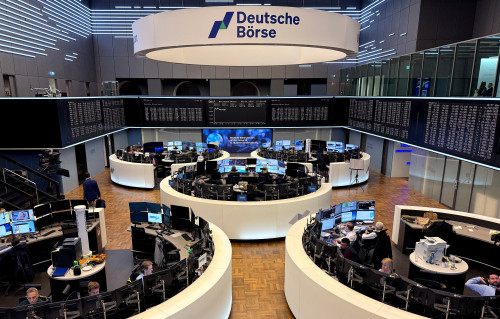
April 9, 2026
The Trade War Reignites: What the Latest U.S.-China Tariff Escalation Means for Your Portfolio
Active Trader Daily | Geopolitical Risk Edition
The Trade War Reignites: What the Latest U.S.-China Tariff Escalation Means for Your Portfolio
Billionaires & Congress Are Quietly Piling Into This One Sector
What do Buffett, Griffin, Koch, and 100+ members of Congress have in common?
They’re all betting on one overlooked $20 stock.
It’s in a sector set to impact $85 trillion globally.
Geopolitical risk is back at the forefront of every serious trader’s calculus. After years of fragile detente, the U.S.-China trade relationship has entered a new and sharper phase of confrontation — one that is already repricing entire sectors, triggering institutional repositioning, and creating the kind of volatility that separates prepared traders from reactive ones. This is not a background story. It is the defining macro variable of the current market environment, and understanding its mechanics is non-negotiable for anyone managing risk capital right now.
Macro Context: Understanding the Escalation Timeline
There is no shortage of SpaceX headlines right now.
But most of them miss the point.
Because the real story is not the noise.
It is the signals.
The signals that tend to appear before a company moves toward a public listing.
Some are already showing up.
Others are not.
And understanding the difference is what separates informed investors from reactive ones.
This Special Report was created to cut through the confusion.
Inside, you will find:
- What is confirmed and what is not
- The signals investors are watching closely
- How pre-IPO positioning actually works
- What to avoid before volatility begins
If you want clarity before the crowd moves, read this now.
The current round of U.S.-China trade tensions traces its most recent acceleration to early 2025, when the Trump administration announced a sweeping tariff structure targeting Chinese goods. Initial tariff rates were set at 10% across a broad range of imports, but subsequent retaliatory exchanges pushed the effective rate on select categories to as high as 145% on the U.S. side, with China matching with tariffs of 125% on American goods entering the mainland. This represents the highest bilateral tariff wall between the two largest economies in modern history.
China absorbed approximately $438 billion in U.S. exports in 2024, while the United States imported roughly $427 billion in Chinese goods — a bilateral trade relationship representing over $865 billion in annual commerce. At effective tariff rates above 100% on key categories, large portions of this trade become economically nonviable. The market is not pricing a trade dispute. It is pricing a structural decoupling — and that distinction carries enormous consequences for equity positioning.
The S&P 500 shed roughly 12% in the 30-day window following the initial April 2025 tariff announcements, its steepest single-month drawdown since the 2022 rate-shock selloff. The Nasdaq Composite, heavily weighted toward technology names with deep China supply chain exposure, fell over 14% in the same window. The VIX — Wall Street’s fear gauge — spiked above 52 intraday on April 8, 2025, a level last seen during the March 2020 COVID shock. These are not routine pullback statistics. These are regime-change numbers.
“The market is not pricing a trade dispute. It is pricing a structural decoupling — and that distinction carries enormous consequences for equity positioning.”
Sector Breakdown: Who Bears the Heaviest Burden
Not all sectors absorb geopolitical shock equally. The current tariff regime creates winners and losers with a precision that active traders can exploit — provided the analysis is grounded in actual supply chain and revenue exposure data, not headline sentiment.
Technology: Maximum Exposure
Technology carries the most acute China exposure of any major S&P 500 sector. Apple (AAPL) manufactures approximately 90% of its iPhone units in China through its Foxconn and Pegatron partnerships. At 145% tariff rates on Chinese imports, the landed cost of an iPhone assembled in China increases by an estimated $150-$250 per unit, depending on component sourcing. Apple’s gross margin for the most recent fiscal year sat at 46.2%. A full pass-through of tariff costs to consumers risks a demand destruction scenario; an absorption of those costs collapses margin structure. Apple has begun accelerating its India and Vietnam manufacturing ramp — but analysts at multiple investment banks estimate that a full supply chain migration away from China will take a minimum of 3-5 years and cost tens of billions of dollars in capital expenditure.
NVIDIA (NVDA) faces a different but equally significant constraint. The U.S. government has imposed export controls on advanced AI chips, specifically prohibiting the sale of its H100 and A100 GPU architectures to Chinese entities. China represented an estimated 20-25% of NVIDIA’s data center revenue before the restrictions. The company has attempted to navigate controls with downgraded chip variants (H800, A800), but subsequent tightening of export rules has closed those workarounds. NVIDIA’s trailing twelve-month revenue was approximately $113 billion; the China revenue gap represents a structural headwind that does not resolve quickly regardless of domestic AI demand momentum.
Qualcomm (QCOM) derives an estimated 63% of its annual revenue from China-based customers. Skyworks Solutions (SWKS) and Qorvo (QRVO) — both semiconductor suppliers deeply embedded in the Chinese smartphone and consumer electronics supply chain — carry similar concentration risk. These are not marginal exposures. They are existential revenue dependencies that institutional investors are actively stress-testing in their models.
Consumer Discretionary: Retail and Apparel Under Pressure
The consumer discretionary sector faces a dual threat: rising input costs from Chinese manufacturing and deteriorating consumer sentiment from inflationary pressure. Nike (NKE) sources approximately 18% of its footwear from China, while also managing a significant China retail revenue stream that accounted for roughly 14.5% of total fiscal 2024 revenue. Target (TGT) and Dollar Tree (DLTR) — both highly dependent on low-cost Chinese goods for their private-label and general merchandise categories — have flagged tariff exposure as a material earnings risk in recent 10-Q filings. Dollar Tree’s management noted in their most recent earnings call that tariffs could pressure their core $1.25 price point model, a statement that carries significant implications for the stock’s valuation thesis.
Agriculture and Industrials: The Collateral Damage
China’s 125% retaliatory tariffs hit U.S. agricultural exports with surgical precision — soybeans, corn, pork, and wheat are all targeted. U.S. soybean exports to China peaked at $26 billion annually before the first trade war; that market share has never fully recovered and now faces renewed disruption. Caterpillar (CAT), with approximately 5-8% of revenue tied to China construction and infrastructure equipment demand, and Deere & Company (DE), which faces both agricultural end-market weakness in China and tariff cost pressures on component sourcing, are both names institutional desks are running sensitivity models on in the current environment.
Defense and Domestic Infrastructure: Relative Beneficiaries
Geopolitical escalation historically benefits defense contractors and domestic infrastructure plays. Lockheed Martin (LMT), Northrop Grumman (NOC), and Raytheon Technologies (RTX) carry minimal China revenue exposure while benefiting from accelerated government defense spending catalyzed by geopolitical threat perceptions. The 2025 defense budget exceeded $886 billion — a record allocation — and further supplemental spending is likely if tensions escalate beyond trade into direct military posturing around Taiwan. On the domestic infrastructure side, companies with onshoring tailwinds — steel producers like Nucor (NUE), domestic semiconductor fabricators like Intel (INTC) in the context of CHIPS Act funding, and industrial automation names — occupy a structural growth narrative that geopolitical decoupling actively reinforces.
Stock-Level Analysis: Key Names and Metrics to Monitor
| Company | Ticker | China Revenue Exposure | Key Risk Factor |
|---|---|---|---|
| Apple | AAPL | ~17% revenue, ~90% mfg. | Margin compression + supply chain cost |
| NVIDIA | NVDA | ~20-25% data center rev. | Export controls on advanced AI chips |
| Qualcomm | QCOM | ~63% of total revenue | Revenue concentration, licensing risk |
| Nike | NKE | ~14.5% of revenue | Sourcing costs + China consumer demand |
| Lockheed Martin | LMT | Minimal | Defense budget tailwind beneficiary |
| Nucor | NUE | Minimal | Domestic steel onshoring beneficiary |
Technical Framework: Reading the Charts in a Geopolitical Tape
Geopolitical shock events produce identifiable technical patterns that active traders can use to define risk and opportunity. The initial selloff phase — which occurred in the first two weeks of April 2025 — was characterized by heavy-volume capitulation bars, multiple gap-down opens, and the obliteration of key moving average support levels across major indices. The S&P 500 broke its 200-day moving average with conviction, closing multiple sessions below that level on above-average volume. This is a technically significant development: institutional models that use the 200-DMA as a risk-on/risk-off trigger began systematically reducing equity exposure, creating self-reinforcing selling pressure.
Following the initial shock phase, the tape entered a reflexive bounce pattern. The April 9 announcement of a 90-day tariff pause on non-China trading partners catalyzed one of the largest single-day percentage gains in S&P 500 history — an approximately 9.5% surge on that session. This type of violent counter-trend move is a hallmark of geopolitically-driven markets: news flow, not earnings fundamentals, is driving price action. Traders who sized positions based on technical levels rather than news predictions were better positioned to participate in the reversal without being destroyed by the preceding leg down.
Key technical levels to monitor on the S&P 500 going forward: The 5,200-5,250 zone represents a critical resistance band where multiple failed rally attempts have stalled — this aligns closely with the 50-day moving average on a rebounding tape. The 4,800 level represents meaningful structural support dating back to the 2024 consolidation range. Below 4,800, the next significant support cluster sits near 4,500-4,550, a level that would represent approximately a 25% drawdown from the February 2025 highs. On individual names with China exposure, VWAP-anchored analysis from key news dates — specifically the April 2 and April 9 announcement dates — provides actionable intraday reference levels for momentum and mean-reversion setups.
Volume analysis adds an important layer. Days when the S&P 500 advances on below-average volume while retreating on above-average volume are a distribution signal — institutional sellers are using strength to reduce exposure. The inverse pattern (advancing on heavy volume, retreating on light volume) is the accumulation signal active traders watch for as a potential trend-change indicator. In a geopolitical tape, these patterns are frequently interrupted by news catalysts, which is precisely why defined stop levels and position sizing discipline are more important than directional conviction.
Three-Scenario Modeling: Base, Bull, and Bear Cases
Base Case (Probability: ~50%)
Negotiations between the U.S. and China resume under the 90-day pause framework, producing a partial agreement that rolls back the most extreme tariff levels (above 100%) while maintaining a structurally elevated baseline (30-50% range). Markets stabilize with the S&P 500 trading in a 4,900-5,300 range through Q3 2025. Technology names with China exposure recover partially but remain capped by earnings estimate revisions that embed permanently higher supply chain costs. Sector rotation into domestic industrials, defense, and onshoring beneficiaries continues as a structural theme. The Federal Reserve holds rates steady, unwilling to cut into a tariff-driven inflationary environment — a critical constraint on the magnitude of any equity recovery.
Bull Case (Probability: ~25%)
A comprehensive trade framework agreement is reached within the 90-day window, with tariffs reduced to the 10-15% range across most categories. Markets interpret this as a resolution of the binary tail risk that has been suppressing equity multiples. The S&P 500 re-rates toward 5,600-5,800, technology names recover sharply on multiple expansion, and the Federal Reserve gains room to consider rate cuts as inflationary tariff pressure dissipates. This scenario requires meaningful political will from both governments and is complicated by the structural nature of the dispute — semiconductors, rare earth materials, and technology transfer are not easily resolved in a 90-day negotiating window. But the market’s reaction function to even partial positive signals has been demonstrated clearly: the April 9 single-day 9.5% surge showed exactly how aggressively markets will reprice on de-escalation signals.
Bear Case (Probability: ~25%)
Negotiations collapse. Tariffs remain above 100% on both sides through Q3 and Q4 2025. China accelerates strategic countermeasures — restricting rare earth exports (China controls approximately 60% of global rare earth production), placing additional U.S. companies on its Entity List, and reducing treasury bond purchases to apply financial pressure. U.S. corporate earnings guidance for Q3 and Q4 is revised sharply lower as supply chain disruptions and demand destruction in China materialize in reported numbers. The S&P 500 tests the 4,400-4,500 support zone, representing a 28-30% drawdown from peak levels. The Federal Reserve faces a stagflation dilemma — slowing growth accompanied by tariff-driven inflation — that limits its ability to provide the monetary backstop that arrested previous selloffs. This is the scenario that institutional risk managers are stress-testing most aggressively right now.
Active Trader Strategy Framework
Given the scenario distribution above, the actionable framework for active traders centers on several core principles:
- Trade the news reaction, not the news itself. In geopolitically-driven markets, the first price move on a headline is frequently not the sustainable move. The April 2 tariff announcement saw initial panic selling followed by a short-covering bounce, followed by renewed selling as the market processed the full scope of the tariff structure. Waiting for the second and third price reaction — and using technical levels to define entry risk — is more reliable than trading the initial headline print.
- Define exposure duration explicitly. Geopolitical trades have different holding period characteristics than earnings or economic data trades. A tariff negotiation framework that extends 90 days means the fundamental catalyst for resolution is not imminent — which means trend-following positions need wider time horizons and commensurately larger stop distances, or they need to be actively managed around news flow windows.
- Monitor sector rotation signals with institutional-grade precision. The relative performance divergence between technology (heavy China exposure) and defense/domestic infrastructure (minimal China exposure, geopolitical tailwind) is one of the cleanest sector rotation trades in the current environment. Using sector ETFs — XLK for technology, XLI for industrials, ITA for aerospace and defense — to express this relative value view without single-stock binary risk is a framework many institutional traders employ.
- Watch the currency markets for leading signals. The USD/CNY exchange rate is a real-time barometer of trade tension. A Chinese yuan depreciation beyond the psychologically significant 7.30 level would signal that Beijing is allowing currency adjustment to partially offset tariff costs — a move that has historically been interpreted as an escalation signal by equity markets. Dollar index (DXY) weakness — counterintuitively — has also accompanied the recent tariff volatility as markets question the U.S.’s reserve currency status in a deglobalization scenario.
- Respect the VIX term structure. When near-term VIX futures trade at a significant premium to longer-dated contracts (a condition called backwardation), it signals acute near-term fear — and historically, these conditions precede sharp mean-reversion bounces as volatility normalizes. Conversely, when VIX backwardation persists for multiple weeks, it often signals that the market is pricing in a sustained elevated-risk environment rather than a single shock event. Monitor this structure weekly.
The Rare Earth Wildcard: China’s Most Potent Leverage
One dimension of this conflict that has not yet been fully priced by equity markets is China’s potential weaponization of rare earth mineral exports. China processes approximately 85-90% of the world’s rare earth elements — materials that are essential inputs for electric vehicle motors, wind turbines, defense guidance systems, semiconductor manufacturing equipment, and advanced battery technology. The United States currently has limited domestic rare earth processing capacity, with MP Materials (MP) operating the only significant U.S. rare earth mine at Mountain Pass, California — but it still ships the majority of its concentrate to China for processing.
China has already signaled its willingness to use this leverage: export controls on gallium and germanium — critical semiconductor manufacturing materials — were announced in 2023 and tightened in 2024. A broader restriction on rare earth exports would represent an escalation that the U.S. defense and technology industrial base is poorly positioned to absorb in the short term. Companies like RTX (which uses rare earths in guidance systems), General Motors (GM) (which needs neodymium for EV motors), and the entire U.S. semiconductor equipment supply chain (Applied Materials (AMAT), Lam Research (LRCX)) would face acute input supply disruptions. This is the tail risk that is underrepresented in current consensus equity models — and it is the scenario that would most rapidly accelerate the bear case.
Conclusion: Preparation Over Prediction
The reignited U.S.-China trade war is not a temporary headline risk. It is a structural repricing event with multi-quarter implications for corporate earnings, supply chain architecture, sector leadership, and the global trade order. The traders who will extract value from this environment are not the ones who correctly predict the outcome of negotiations — no one can do that with reliable accuracy. They are the ones who have mapped the scenario distribution with precision, defined their risk parameters clearly for each scenario, and built a tactical framework that allows them to respond to evolving conditions without abandoning discipline.
The VIX above 30, bilateral tariffs above 100%, and an S&P 500 that has experienced a regime-change drawdown are not conditions that reward complacency or directional heroics. They reward preparation. They reward the trader who has already determined — before the next headline drops — exactly what they will do under each scenario, where their stops are, how much capital they have at risk, and which sectors and names represent their highest-conviction risk-adjusted opportunities.
The tape will continue to deliver volatility. The question is whether your framework is ready to receive it.
Active Trader Daily provides market analysis and educational content for informational purposes only. Nothing in this publication constitutes financial advice, investment recommendations, or a solicitation to buy or sell any security. All trading involves substantial risk of loss. Past performance is not indicative of future results. Conduct your own due diligence and consult a licensed financial professional before making any investment decisions.