By Bo Erickson
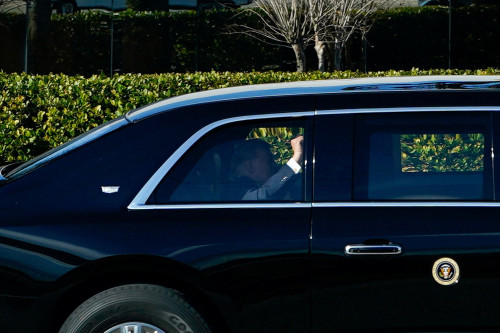
MIAMI, April 12 (Reuters) – U.S. President Donald Trump https://www.reuters.com/world/us/donald-trump/ said on Sunday that the price of oil and gasoline may remain high through November’s midterm elections, a rare acknowledgement of the potential political fallout from his decision to attack Iran https://www.reuters.com/world/iran/ six weeks ago.
“It could be, or the same, or maybe a little bit higher, but it should be around the same,” Trump, who is in Miami for the weekend, told Fox News’ “Sunday Morning Futures With Maria Bartiromo” when asked whether the cost of oil and gas would be lower by the fall.
The average price for regular gas at U.S. service stations has exceeded $4 per gallon for most of April, according to data from GasBuddy. Average U.S. gas prices in February hovered just below $3 per gallon, and over the past year never exceeded $3.25 per gallon, according to GasBuddy.
Trump’s comments on Sunday came after weeks of asserting that the spike in prices is a short-term phenomenon, though his top advisers are cognizant of the war’s economic impacts, officials have said.
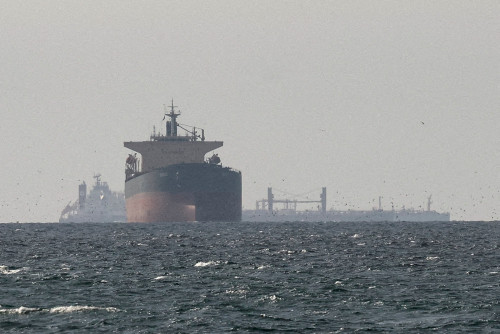
Earlier on Sunday, Trump announced on social media that the U.S. Navy would blockade https://www.reuters.com/world/asia-pacific/us-iran-talks-pause-now-disagreements-remain-2026-04-11/ the Strait of Hormuz and intercept any ship that paid a crossing fee to Iran, after marathon talks between the U.S. and Iran in Pakistan over the weekend did not yield a peace deal.
“No one who pays an illegal toll will have safe passage on the high seas,” he wrote on Truth Social media platform.
Several hours after Trump’s post, U.S. Central Command said the blockade would be limited to ships going to and from Iranian ports. Ships entering and exiting non-Iranian ports will not be stopped by U.S. forces, CENTCOM said.
A U.S. blockade may add more uncertainty to the eventual resolution of the conflict, which is currently subject to a tenuous two-week ceasefire. The new tactic is in response to Iran’s own closure of the strait’s critical shipping lanes, which has caused global oil prices to skyrocket about 50%.
Later on Sunday, Iranian parliament speaker Mohammad Baqer Qalibaf, who led Iran’s delegation in the talks, posted on social media that a blockade would lead to higher U.S. gas prices. “Enjoy the current pump figures,” he wrote on X, alongside a map showing gas prices in Washington. “With the so-called ‘blockade’, Soon you’ll be nostalgic for $4–$5 gas.”
UNPOPULAR WAR HITS TRUMP’S APPROVAL
The war began on February 28, when the U.S. launched a joint bombing campaign with Israel against Iran. The scope quickly expanded as Iran and its allies attacked nearby countries, while Israel targeted Hezbollah with massive strikes in Lebanon.
The war has buffeted global financial markets and caused thousands of civilian deaths, mostly in Iran and Lebanon.
Trump’s political standing at home has suffered, with polls showing the war is unpopular https://www.reuters.com/world/us/americans-weigh-iran-war-gas-prices-their-fears-2026-04-11/ among most Americans, who are frustrated by rising gasoline prices.
The president’s approval rating has hit the lowest levels of his second term in office, raising concern among Republicans that his party is poised to lose control of Congress in the midterm elections. A Democratic majority in either chamber could launch investigations into the Trump administration, while blocking much of his legislative agenda.
U.S. Senator Mark Warner of Virginia, the ranking Democrat on the Senate Intelligence Committee, questioned the strategy behind Trump’s planned blockade.
“I don’t understand how blockading the strait is going to somehow push the Iranians into opening it,” he told CNN’s “State of the Union” on Sunday.
In a separate appearance on CBS’s “Face the Nation,” Warner said the blockade would not undermine Iranian control of the waterway.
“The Iranians have hundreds of speedboats where they can still mine the strait or put bombs against tankers in closing the strait,” he said. “How is that going to ever bring down gas prices?”
Although Trump has repeatedly said that the war would be over soon, Republican U.S. Senator Ron Johnson of Wisconsin told ABC News’ “This Week” on Sunday that achieving U.S. aims in Iran “could take a long time.”
“It’s going to be a long-term project,” said Johnson, who was not asked about Trump’s proposed blockade. “I never thought this would be easy.”
(Reporting by Bo Erickson in Miami, David Ljunggren in Ottawa, Renee Hickman in Chicago, Svea Herbst in New York and Chris Kirkham in Los Angeles; Writing by Joseph Ax;Editing by Bill Berkrot, Sergio Non and Aurora Ellis)