By Susan Heavey and Jonathan Allen
WASHINGTON, Feb 12 (Reuters) – U.S. President Donald Trump has agreed to end his unprecedented and hotly protested deportation surge in Minnesota, White House border czar Tom Homan said on Thursday, with many immigration enforcement agents set to return to their home states over the next week.
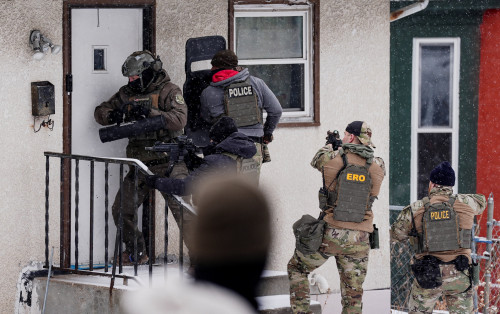
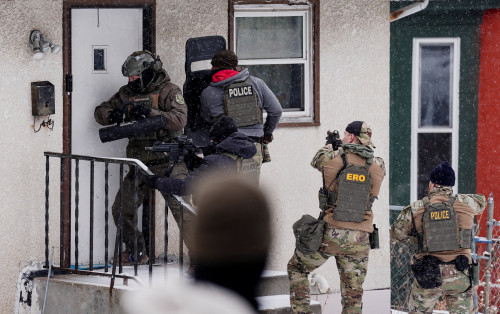
Under Operation Metro Surge, Trump, a Republican, had deployed about 3,000 armed immigration agents by late January to deport migrants in Minnesota. He has touted it as the largest deportation operation in U.S. history, and it came over the objections and condemnations of Governor Tim Walz, a Democrat, and local people who filled the streets of the state’s biggest cities in protest, sometimes by the thousands.
On different days in January, immigration agents fatally shot two U.S. citizens in Minneapolis who had come out to protest or observe the agents, and Trump’s feud with Minnesota boiled over into one of the most fraught political crises he has faced in his presidency.
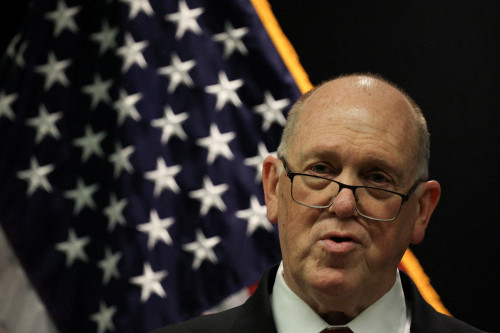
“I have proposed and President Trump has concurred that this surge operation conclude,” Homan told reporters at a news conference at a federal field office outside Minneapolis. “Operation Metro Surge is ending.”
It was a rare retreat by Trump that came after even some fellow Republicans raised questions about the operation. Promises of mass deportations had fueled Trump’s 2024 campaign, but Reuters/Ipsos polls in January found support for Trump’s immigration agenda fell to the lowest point in his presidency as immigration officers were deployed in military-style gear in cities across the country, prompting massive protests.
A week ago, Homan announced that about 700 out of 3,000 immigration agents would be withdrawn. Without giving precise numbers, he said on Thursday that many of the remaining agents deployed from other states would be sent home in the coming week, citing in part what he called “unprecedented levels of coordination” with Minnesota law enforcement. Before January’s surge, about 150 immigration agents worked in Minnesota, according to the Trump administration.
Trump has said the surge was in the interest of public safety, describing many migrants, in sweeping terms, as violent criminals or fraudsters. Walz and other Minnesotans said the sometimes violent federal surge has only degraded public safety, and violated the constitutional rights of both immigrants and Americans.
“The long road to recovery starts now,” Walz said in a statement. “The impact on our economy, our schools, and people’s lives won’t be reversed overnight. That work starts today.”
‘THEY THOUGHT THEY COULD BREAK US’
Minneapolis Mayor Jacob Frey, who last month joined Walz in suing the Trump administration and asked a judge to restrain the surge, said the surge’s impact has been catastrophic.
“They thought they could break us, but a love for our neighbors and a resolve to endure can outlast an occupation,” Frey said in a statement.
Federal judges, including the chief federal judge in Minnesota, have reprimanded Trump administration officials, saying ICE had defied dozens of court orders to free wrongly detained migrants.
Some of Trump’s fellow Republicans have also criticized aspects of the surge, and how Trump’s administration has handled the killings of two Americans in Minnesota by federal agents, Renee Good and Alex Pretti.
The Good family’s legal team issued a statement saying they were “cautiously optimistic about the drawdown.” But the team raised concerns about ICE conduct elsewhere in the country, adding, “the nation will be watching to see if and where these agents are redeployed.”
The local prosecutor, Hennepin County Attorney Mary Moriarty, vowed to continue investigating “multiple actions by federal agents during this occupation.”
She also expressed skepticism over the withdrawal and cast doubt on the Trump administration’s claims of increased cooperation because, she said, state and local officials were already providing all information and cooperation required by law.
Meanwhile, Minnesota Attorney General Keith Ellison was in Washington testifying before a Senate committee that oversees homeland security.
Rand Paul, the committee’s Republican chairman, criticized how the Trump administration had described Good and Pretti after they were killed. Homeland Security Secretary Kristi Noem and other administration officials initially called them “domestic terrorists.”
Paul said the quick rush to judgment hurt the administration’s credibility.
“People aren’t believing there’s going to be an honest investigation,” he said.
In Minnesota, Avonna Starck, who runs an environmental nonprofit and sits on the school board of a Minneapolis suburb, was dissatisfied that some federal officers would remain because “We as a community wanted all of the agents out of Minnesota,” she said in an interview.
Miguel Hernandez, a Minneapolis community organizer and owner of Lito’s Burritos, said there had been no accountability for the surge nor for the killings of Good and Pretti.
“They’re saying it’s over so that people will stop paying attention, but harm was done and the harm continues to be done,” Hernandez said. “Our community is going to continue to be destroyed.”
(Reporting by Susan Heavey in Washington and Jonathan Allen in New York; Additional reporting by Heather Schlitz, Helen Coster, Ted Hesson and Katharine Jackson; editing by Michelle Nichols, Paul Thomasch, Rosalba O’Brien and Aurora Ellis)