
April 21, 2026
Utilities, Copper, Nuclear: The Quiet Tech Trade of the Decade
When compute meets physics, the “boring” sectors start setting the rules.
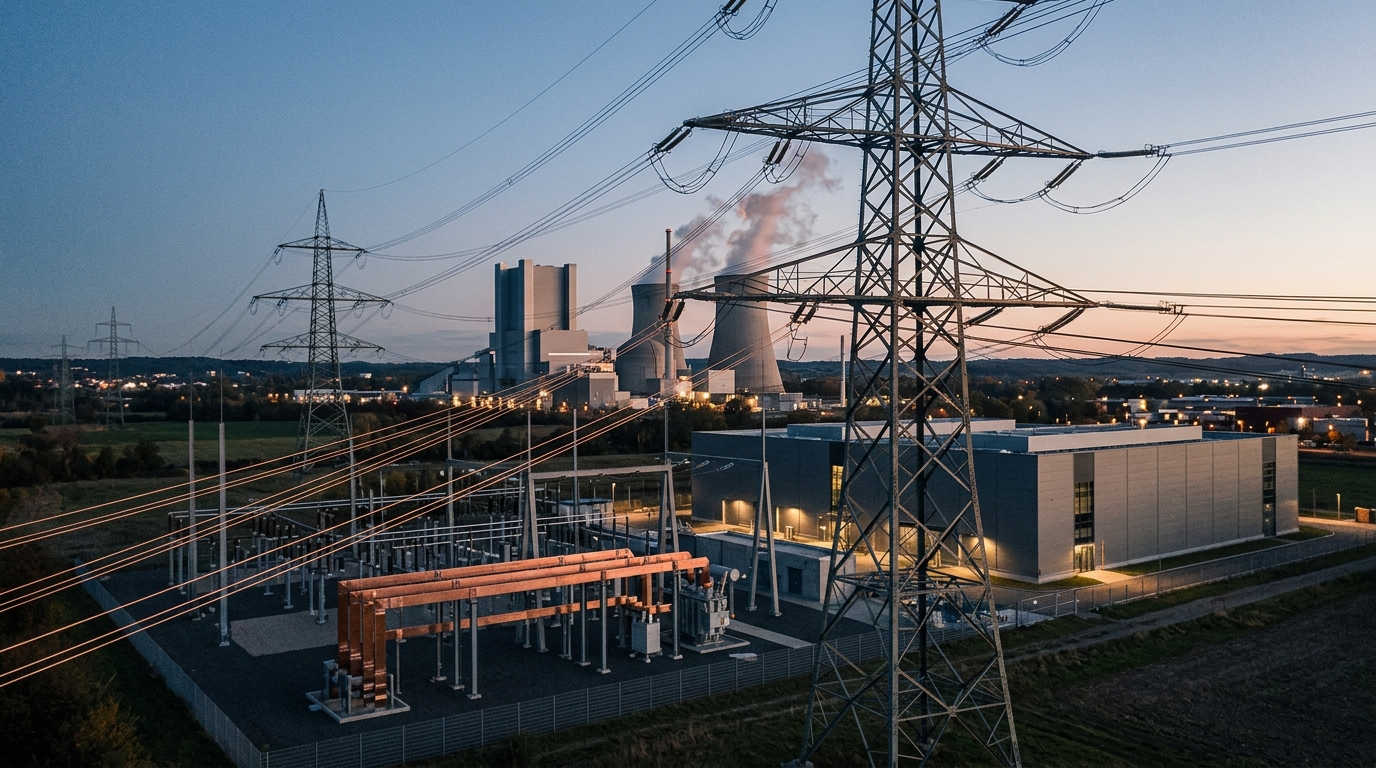
There’s a mislabeling problem in markets right now.
We keep treating “tech” like it’s only semis, hyperscalers, and software margins. But the constraint isn’t another model release or a better GPU. The constraint is electricity, grid capacity, and the raw materials that physically move electrons. Once you accept that, three sectors that used to be filed under “defensive” and “old economy” start behaving like the core technology stack: regulated utilities, copper mining, and nuclear power.
Slight tangent, but it matters: every market regime eventually reveals what it actually can’t live without. In 2020 it was liquidity. In 2022 it was inflation. In 2024–2026 it’s energy and infrastructure. That’s not philosophy – it’s math.
Bullet Summary
- S&P 500 recently printed above 7,000, with a reported close at 7,041.28 in mid-April – the index is still trading like profits matter more than geopolitics, until energy costs force the conversation.
- The 10-year Treasury yield has been hovering around ~4.3% (e.g., 4.31% cited in mid-April), keeping long-duration growth valuations sensitive to any upside inflation surprise.
- March 2026 CPI was reported at 3.3% YoY, with a 0.9% MoM print flagged as the biggest monthly increase since 2022 – energy is still the macro tripwire.
- Global electricity demand growth is running hot: +3% in 2025, with ~3.7% growth projected for 2026 – in absolute terms, average annual demand growth rises from ~450 TWh to ~520 TWh.
- U.S. data centers consumed ~180 TWh in 2024, with demand growth expected to keep U.S. electricity demand elevated versus the prior decade’s pace.
- U.S. nuclear remains a meaningful slice of generation (commonly cited around ~18% of U.S. electricity generation in recent years) – which is exactly why nuclear is back in the conversation when 24/7 power becomes scarce.
- Brent crude was cited near ~$99/bbl during April’s risk flare-up, after trading roughly ~$70 pre-conflict and as high as ~$119 at times – a reminder that “AI capex” still rides on energy inputs and fuel-driven inflation shocks.
The Stock Signal That Called 2008 Just Flashed Red
What does a 100-year-old algorithm know that Wall Street doesn’t? This proprietary signal predicted the Dot-Com bust, the 2008 financial crisis, and the 2020 crash. Now, as Middle East tensions threaten to trigger America’s $38T debt crisis, it just issued its biggest warning yet. Get the 10 popular stocks to avoid – and 3 overlooked stocks you need to buy now.
Market Context Analysis
Index levels and rates are doing that familiar tug-of-war: equities want to look through macro noise, while the bond market keeps reminding everyone that financing costs are not a rounding error.
On the equity side, the S&P 500 has pushed into the 7,000s (7,041.28 cited on an April record close). That level matters less as a “big round number” and more as a signal that the market is still willing to capitalize future earnings at premium multiples even with policy rates not back at zero.
On the rates side, the 10-year Treasury yield has been around 4.3% in April (4.31% cited). When you park the risk-free rate north of 4%, anything that depends on long-dated cash flows gets jerkier – and that’s where the “boring” sectors start to matter. Utilities, miners, and nuclear developers are capital-intensive, but they also sit on bottlenecks the market can’t paper over with hope.
Inflation is the other axis. March 2026 CPI was reported at 3.3% YoY, and the month-over-month print was flagged at 0.9%. Even if you argue the shock is transitory, the point for traders is simpler: energy-driven inflation spikes change the discount rate conversation fast. And they tend to show up first in anything tied to electrons, fuel, and industrial metals.
This is where the utility–copper–nuclear triangle stops being a “value” story and starts being a technology throughput story.
Compute growth pulls power demand. Power demand pulls grid investment. Grid investment pulls copper. And when grids can’t reliably supply 24/7 baseload at scale, nuclear gets dragged back into the center of the policy and corporate capex conversation. That feedback loop is what traders are underweighting when they only watch NVDA, MSFT, AMZN and a handful of mega-cap charts.
How To Collect Up To 69% Yields From ZERO-Dividend Stocks
Did you know some tech giants pay little to no dividends?
A NEW investment lets you collect up to 69.87% yields from these very stocks — without options trading!
Click here to learn how to potentially collect $84,160 per year.
The IEA’s numbers are a clean way to anchor this. Global electricity demand increased 3% in 2025 (after 4.4% in 2024), with forecasts still strong into 2026 and beyond. In the forward view, the 2026–2030 period is expected to run ~3.6% average annual growth. They also frame it in absolute terms: average annual demand growth rising from ~450 TWh to ~520 TWh. That is the kind of increment that doesn’t get solved by “efficiency” alone.
Now zoom into the U.S. In the mid-year framing, U.S. data centers consumed around 180 TWh in 2024. Whatever your exact 2026 number is, the direction is what matters: the marginal demand driver is not just population growth or GDP – it’s server farms that don’t sleep. And U.S. electricity demand growth is expected to stay above 2% in 2025 and 2026, more than double the average growth rate of the past decade.
Here’s where I land as a trader: when the macro regime is “more power, more wires, more baseload,” the market leadership list can change even if the Nasdaq keeps printing highs. You don’t need a recession for that rotation – you just need constraints.
Sector Breakdown
1) Utilities: regulated doesn’t mean irrelevant
Utilities have traditionally been treated like bond proxies: slow growth, steady dividends, and rate sensitivity. That framing is incomplete in an era where the grid has to expand, harden, and connect new load pockets (data centers, EV charging corridors, industrial reshoring) on timelines that aren’t comfortable.
What changes the game is that a meaningful piece of utility capex can become “strategic” rather than “maintenance.” Think transmission upgrades, substation expansions, interconnection queues, and new generation capacity that actually clears permitting and gets built.
From a market mechanics perspective, utilities sit in the crossfire between (a) higher rates raising the cost of capital and pressuring valuation multiples, and (b) a structural demand pull that can support multi-year rate base growth. That’s why you can see utilities act defensive on down days and then act like industrial growth on days when the market starts believing in an “electrification capex cycle.” The same sector can flip personalities depending on which input is dominating: yields or load growth expectations.
Institutional flow angle: utilities are one of the cleaner vehicles for “AI infrastructure” exposure without paying software multiples. That’s not a recommendation – it’s a positioning observation. When investors want a hedge against grid scarcity but don’t want to chase the mega-cap complex after a vertical move, they look for rate base stories with credible capex programs and regulatory visibility.
Tired of Missing Out?
If you missed Amazon at $18… Apple at $22… or Google at $85…
You can still stake a claim in ChatGPT BEFORE their Trillion Dollar IPO.
2) Copper: the hidden input behind “cloud”
If you want the cleanest physical proxy for electrification, copper is high on the list. It’s not fashionable. It’s also not optional.
Every incremental megawatt delivered to a load center needs conductors, transformers, switchgear, and a supply chain that’s already operating in a world of long lead times. The reason traders should care is that copper doesn’t only respond to China stimulus and housing cycles anymore. It’s increasingly tied to grid buildouts and data center footprints, which are less cyclical than the traditional demand buckets.
There’s a second-order market point here: industrial metals can become a policy variable. If governments push for faster grid expansion and domestic manufacturing, the demand impulse is not purely price-driven; it’s policy-driven. That tends to make supply constraints more painful, because mines and refining capacity do not scale on election-cycle timelines.
The trader’s nuance: copper equities and copper itself don’t always move together. Copper prices can grind higher while miners underperform if costs (diesel, labor, royalties) compress margins, or if capex inflation eats free cash flow. That’s why the “copper mining is a tech play” angle lives or dies on unit economics and balance sheet discipline, not just the LME screen.
3) Nuclear: baseload is back because uptime is back
Nuclear’s return isn’t about nostalgia. It’s about capacity factors and reliability.
In the U.S., nuclear has been cited around ~18% of electricity generation in recent years. That share is strategically oversized relative to its percentage of total installed capacity because nuclear plants typically run at high capacity factors and provide steady output. For data centers and critical industrial loads, steady output is not a “nice to have.” It’s what makes the rest of the stack work.
And the corporate angle is getting less theoretical. Recent headlines have explicitly tied advanced nuclear interest to powering AI-era demand growth, including state-level efforts connected to large industrial employers.
What’s tradable here is not “nuclear hype.” It’s the recognition that firm power is becoming a constraint in the same way specialized chips were a constraint. The market is learning, slowly, that you can’t run a modern digital economy on intermittent generation alone without paying for storage, transmission, or backup. Nuclear is one of the few levers that can plausibly provide scale baseload with low operational emissions – and that’s why it keeps resurfacing in policy, corporate procurement, and grid planning discussions.
Stock-Specific Financial Breakdown
Because your angle is “boring sectors are now the key tech plays,” the right way to approach single names is by mapping each company to the bottleneck it controls. Not every ticker needs to be in the same bucket.
Utilities (rate base and grid spend): NextEra Energy (NEE), Duke Energy (DUK), Southern Company (SO), Dominion Energy (D), Exelon (EXC), American Electric Power (AEP).
Copper miners (resource control and optionality): Freeport-McMoRan (FCX), Southern Copper (SCCO), BHP (BHP), Rio Tinto (RIO), Teck Resources (TECK).
Nuclear and uranium fuel cycle exposure: Constellation Energy (CEG) as a U.S. nuclear-heavy operator, Cameco (CCJ) in uranium supply, and related nuclear services and engineering plays depending on your universe.
I’m not going to paste stale financial statements from memory because that’s how you end up trading bad data. If you want the full “revenue, margins, forward multiples, and analyst target dispersion” tables for the above tickers, say the word and tell me which 6–10 names to prioritize. I’ll pull the most recent quarterly results, guidance ranges, and consensus estimates and lay them out cleanly.
That said, we can still do a disciplined, numbers-first framework using the macro inputs we already have:
- Utility earnings sensitivity tends to run through (1) allowed ROE, (2) equity issuance needs vs. internal cash flow, and (3) regulatory recovery timing. When the 10-year is ~4.3%, the market will punish utilities that look like perpetual capital raises.
- Miner cash flow sensitivity runs through realized copper price minus unit costs. When oil is pushing near ~$99 Brent in a risk episode, mining cost inflation becomes non-trivial, particularly for diesel-intensive operations and remote logistics.
- Nuclear operator upside/downside often hinges on power price curves, capacity market constructs, and any policy support. If the macro path implies structurally higher power demand growth (IEA: ~3.7% global in 2026), firm generation tends to gain strategic value even if spot power prices swing.
The part people skip is that these are not “defensive” exposures in the classic sense. They are exposures to the physical layer of the digital economy. When the physical layer tightens, the pricing power and policy attention shifts down the stack.
Technical / Trading Framework
This is where you can stop arguing about stories and start building a repeatable decision process.
1) Start with rates and energy as your “risk knobs.”
If the 10-year is stuck around ~4.3% and inflation prints are jumping (March CPI 3.3% YoY, 0.9% MoM cited), then utilities can trade with a split personality: benefitting from structural load growth, but pressured on valuation on any duration shock.
Practical implementation: keep a simple dashboard – 10-year yield, front-end expectations, Brent, and copper. You’re not forecasting them; you’re monitoring which input is driving factor leadership week-to-week.
2) Use relative strength, not hero calls.
If the S&P is making highs but the “AI infrastructure” complex (utilities + industrial metals + nuclear operators) is also making higher highs on up volume, that’s an institutional rotation signal. If the index is strong but these groups are lagging while rates rise, that’s a warning that the market is drifting back toward pure duration exposure.
3) VWAP and moving averages as discipline tools.
For sector ETFs and the core names, I like to define two regimes:
- Institutional accumulation regime: price above rising 20D and 50D, with pullbacks that hold anchored VWAP (weekly or monthly). That’s where you look for “add on weakness” behavior, not chase days.
- Distribution regime: repeated failures at prior highs, breakdown below 50D with volume expansion, and rebounds that fail near VWAP. That’s where you treat the group as a trade, not an investment theme.
4) Watch the interconnect: utilities and copper should not diverge for long.
If utilities are breaking out on “load growth” headlines but copper miners are rolling over, one of two things is happening: either the utility move is a defensive bid (rates falling, growth scare), or the miner equity market is discounting cost pressure and margin compression. Those divergences are where clean trades show up – because the cross-asset signal is telling you something the headlines aren’t.
The Stock-Picking AI That Could Triple Your Money This Year
Early users could have already tripled their money every single year this AI has been live, based on the average winning trade spotted – WITHOUT having to check the news, WITHOUT watching the Fed, and WITHOUT all the stress most traders have to deal with. For now, you can try this AI yourself, completely free of charge – no email, no credit card.
Scenario Modeling
I’ll keep this anchored to observable catalysts and levels you can actually monitor, not vague “good/bad” language.
Bull Case (upside continuation):
- Rates stabilize: 10-year holds roughly the ~4.1%–4.4% zone rather than trending higher, limiting valuation pressure on capex-heavy utilities. (4.31% cited as a recent reference point.)
- Inflation cools after an energy spike: the market treats March’s CPI impulse (3.3% YoY, 0.9% MoM) as a one-off, and forward inflation expectations stop moving up.
- Power demand visibility improves: the demand trajectory (global ~3.7% in 2026) stays intact and U.S. demand growth remains elevated as data center buildouts continue.
- Market level marker: S&P 500 holds above 7,000 and continues to grind, keeping risk appetite intact while leadership broadens beyond mega-cap growth.
Base Case (most probable):
- Choppy macro prints: inflation oscillates, with energy intermittently lifting headline CPI while core components remain more stable. Markets keep reacting violently to monthly data, then mean-reverting.
- Utilities trade like hybrids: steady enough to catch bids on risk-off days, but not immune to duration selloffs. The winners are the ones with credible, financeable capex plans and constructive regulatory environments.
- Copper and miners separate: copper prices may hold firm on structural demand, while miners differentiate based on cost curves and balance sheets.
- Nuclear stays policy-driven: nuclear-linked names move in spurts around contracts, state announcements, and capacity market dynamics rather than smooth trending.
Bear Case (downside risks and failure points):
- Rates push higher: 10-year breaks above the recent ~4.3% area and trends up, forcing a de-rating in utilities and other capital-intensive infrastructure names.
- Energy keeps feeding inflation: oil remains elevated (Brent cited near ~$99/bbl in April, after ~ $70 pre-conflict and as high as ~$119 at times), keeping headline CPI sticky and putting the Fed path back into question.
- Capex bottlenecks bite: interconnection and equipment lead times delay utility projects; miners face cost inflation; nuclear timelines remain long. The market starts discounting “time-to-cash-flow” risk again.
- Market level marker: S&P 500 fails to hold the 7,000 area and slips into a broader risk reduction phase, dragging even the structural winners lower in sympathy.
Active Trader Strategy Framework
No hero trades. Just process.
1) Position sizing should reflect duration risk.
Utilities and many “grid buildout” beneficiaries can behave like duration when yields gap. If you’re running exposure here, define the risk in yield terms: “What happens to my book if the 10-year moves 25–40 bps in a week?” If you don’t have an answer, you’re not positioned – you’re hoping.
2) Trade the spread between physical demand and equity expectations.
Where I see recurring opportunity is in mismatches:
- Copper strong, miners weak: look for the reason (costs, political risk, capex). If it’s transient, miners can snap back. If it’s structural, the metal may be the cleaner vehicle.
- Utilities strong, rates rising: decide whether it’s a true growth-led bid (rate base expansion) or a defensive rotation. That distinction changes the holding period.
- Nuclear headlines without power-price support: treat pop-and-drop risk as real. Conversely, if power curves firm while nuclear operators hold steady, that can be a coiled spring dynamic.
3) Key levels to monitor (framework, not predictions).
- S&P 500: 7,000 is the psychological and flow level; holding above tends to keep breadth improving, losing it tends to tighten risk.
- 10-year yield: the 4.3% neighborhood is an active pivot in current conditions; higher yields generally tighten the leash on utilities and levered infrastructure.
- Inflation prints: after a 0.9% MoM CPI shock, the next couple of reports matter for expectations and positioning, even if the “trend” looks fine on a 12-month chart.
4) Volatility expectations: assume headline risk is a feature.
Energy is not only an input to inflation; it’s also a volatility transmitter. When Brent can move from roughly ~$70 pre-conflict to ~$99 and higher in short order, it changes cross-asset correlations. That’s when utilities can stop acting “low vol” and start acting like macro instruments.
Louis Navellier: Don’t buy OR sell another AI stock…
Until you’ve heard this urgent AI warning from the man who called Nvidia before its 44,000% rise…
According to Louis, a massive reset is coming in an obscure corner of the AI market.
This $100 trillion disruption could send some of the world’s biggest AI stocks to zero… and one off-the-radar stock soaring… starting now.
What Next?
Here’s the clean takeaway that I think will matter most over the next few years: the market is discovering that the digital economy has a physical floor.
AI, cloud, electrification, reshoring – all of it funnels into electricity demand, grid expansion, and the metals required to build it. The demand numbers (global growth still running ~3%–4% per year, with large absolute TWh adds) are not compatible with underinvestment in the grid.
That’s why utilities, copper mining, and nuclear power are quietly becoming the “picks and shovels” layer of the decade’s biggest growth theme – even if their tickers don’t sit in the Tech sector box.
For active traders, the edge isn’t predicting the next headline. It’s staying prepared: monitoring rates, energy, and power demand signals, and knowing exactly where your risk is wrong before the market tells you.
Worth a closer look: build a watchlist that pairs the obvious AI leaders with the power-and-materials bottlenecks underneath them. If those bottlenecks start trending while mega-cap growth chops, that’s usually not noise.