
May 19, 2026
Home Depot: Flat Comps, Reaffirmed Guide
What Q1 2026 reveals about housing and the consumer
The number that matters this morning isn’t $41.77 billion. It’s 0.6%.
That’s Home Depot’s Q1 2026 comparable sales growth — and it missed. StreetAccount had penciled in 0.8%, and the company came in below that for the third consecutive quarter in a row where comps failed to move more than 0.5% in either direction. And yet shares edged higher in premarket trading. That reaction alone is worth sitting with, because it tells you something important about where expectations have drifted — and what the underlying data is quietly signaling about the broader economy.
The Numbers, Quickly
Net sales came in at $41.77 billion, up 4.8% year over year from $39.86 billion — above analyst estimates of $41.52 billion per LSEG. Adjusted EPS of $3.43 topped Wall Street’s estimate of $3.41. GAAP diluted EPS landed at $3.30, down from $3.45 in the prior-year quarter, as net income slipped 4.2% to $3.29 billion. Gross margin came in at 33.0% — lighter than StreetAccount’s 33.2% expectation. Operating cash flow rose sharply to $6.03 billion, up from $4.33 billion a year earlier. Capital expenditures totaled $844 million.
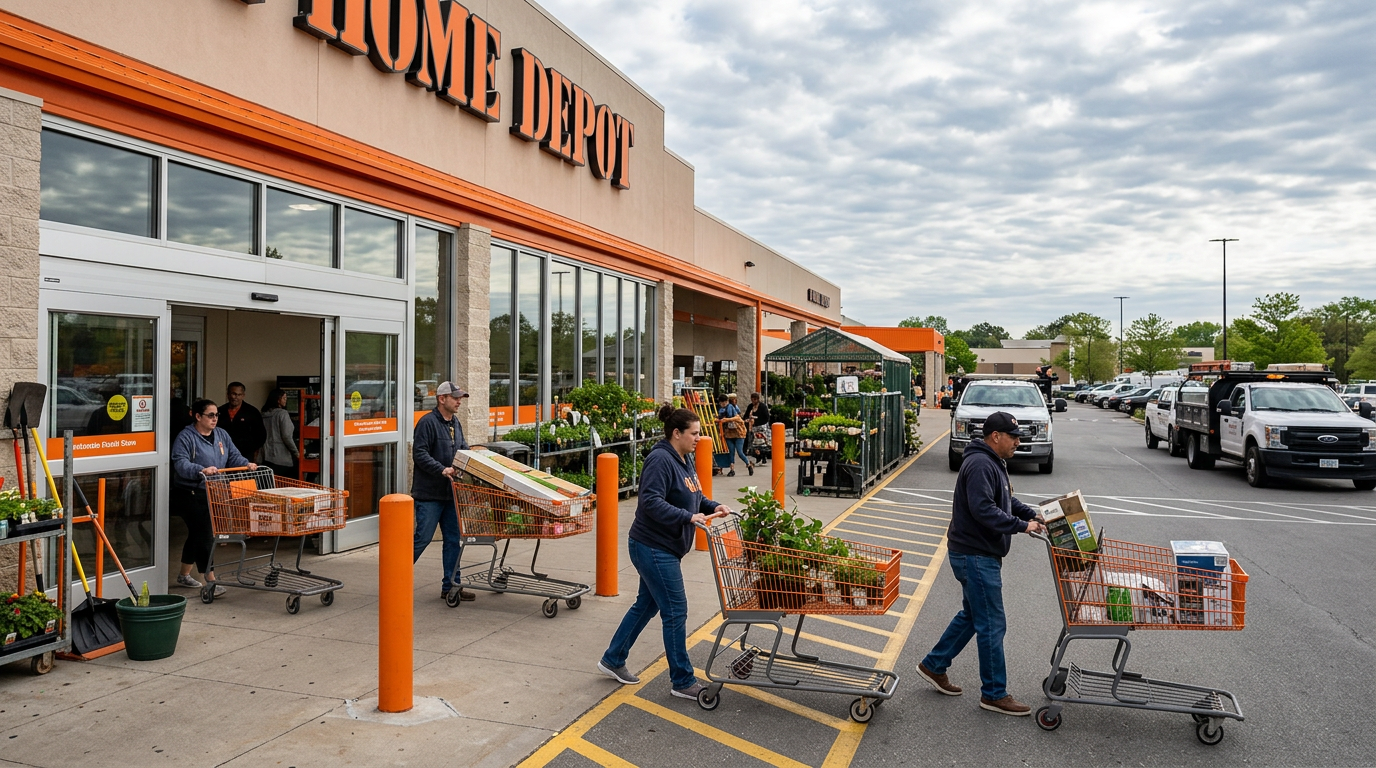
Comparable transactions fell 1.3% — the fourth consecutive quarter of declines. Average ticket rose 2.3% to $92.76. U.S. comps specifically came in at just 0.4%.
Read that again: people are spending more per visit, but fewer people are showing up. That’s not a growth story. That’s a volume problem wearing a price increase as a disguise.
The Defense Choke Point Nobody Is Talking About
When defense budgets grow, most attention goes to big programs – aircraft, hypersonic missiles, and satellites. But history shows the real limits often appear elsewhere.
Testing, scheduling, and access determine how fast new systems actually reach the field. And right now, those systems are under strain.
As hypersonics and space technology move from research into deployment, infrastructure – not funding – is becoming the choke point.
That’s where a small, operational aerospace company is gaining relevance. Not by competing with defense giants, but by helping them move faster.
In every major build-out, the companies that remove bottlenecks often matter long before they become widely known.
What the Guidance Reaffirmation Actually Means
Management held its full fiscal 2026 guidance unchanged — total sales growth of 2.5% to 4.5%, comparable sales growth of approximately flat to 2%, adjusted operating margin of 12.8% to 13.0%, and adjusted diluted EPS of $14.69 to $15.28 (flat to 4% growth from fiscal 2025’s $14.69 base). That reaffirmation is exactly why the stock caught a bid. After a -10.7% move in the trailing month and a share price hovering near its 52-week low of $296.88, investors weren’t looking for acceleration — they were looking for the guide to hold. It did.
But here’s the thing. Holding a conservative guide in a macro environment defined by elevated uncertainty isn’t a bullish statement — it’s a floor. Management is essentially saying: conditions aren’t getting materially worse, but we’re not calling a recovery either. CEO Ted Decker noted that demand was “relatively similar to what we saw throughout fiscal 2025, despite greater consumer uncertainty and housing affordability pressure.” CFO Richard McPhail was more direct, telling CNBC: “They continue to tell us that they are going to defer their spend on larger projects. That’s consistent with what they’ve told us the last few years.”
That’s not a temporary blip. That’s a structural behavior shift — and active traders should treat it as one of the most important data points in this quarter’s release.
The Death of the Nasdaq?
Wall Street legend Marc Chaikin’s award-winning system turned bearish on software stocks two months before they crashed this year. Now, he’s warning that one AI lab’s breakthrough could CRASH the Nasdaq while igniting a $500 trillion wealth transfer. He’s found a little-known $40 “pre-IPO backdoor” into the private startup behind this economic sea change.
The Housing Backdrop — Still Frozen
Home Depot doesn’t operate in a vacuum. It functions, in practical terms, as a real-time gauge for housing turnover, big-ticket remodeling demand, and consumer confidence around the cost of borrowing. Right now, all three of those inputs are constrained.
McPhail addressed this directly at the J.P. Morgan Retail Roundup Forum in April: “We have never seen housing activity this slow for this long.” U.S. existing home sales have been stuck near 3% of all homes changing hands annually for nearly four years — well below the historical norm of 4% to 5%. The 30-year fixed mortgage rate, as of May 14, averaged 6.36% per Freddie Mac, with Bankrate’s survey on May 19 showing 6.58% on purchase loans. Fannie Mae’s May Housing Forecast projects rates holding at 6.3% through Q1 2027 — a materially higher-for-longer stance than earlier in the year. The Federal Housing Finance Agency estimates the average interest rate on existing mortgages is approximately 4.4%, creating a significant lock-in gap that continues to suppress turnover. Homeowners with pandemic-era mortgages simply won’t list.
And when homes don’t change hands, Home Depot doesn’t get the renovation wave that typically follows a purchase. New kitchens, bathroom overhauls, flooring upgrades — that entire demand engine idles. What you’re left with is a consumer doing the minimum: fixing what breaks, handling seasonal maintenance, buying paint and patio furniture. McPhail confirmed this directly, noting that “categories that are more associated with larger projects, like lumber, building materials, millwork, flooring, and lighting… customers continue to defer those larger projects.”
Slight tangent, but it matters: Home Depot now operates 2,361 retail stores and over 1,280 SRS Distribution locations, employing more than 470,000 people. The 2024 SRS acquisition — roofing, landscaping, pool contractor networks — was a deliberate bet on the professional side of the business. The more recent GMS addition extended reach into specialty building products. Professional customers generate roughly half of Home Depot’s revenue. McPhail framed the thesis plainly: “All of the things we’re doing to build out our pro capabilities… is to help us gain more share in the $700 billion pro market.” That acquisition-driven diversification is one reason the total sales figure (up 4.8%) looks far healthier than the organic comp number (up 0.6%). Strip out M&A contributions and the underlying demand picture is considerably more muted.
What This Says About the Economy Broadly
Home Depot is a large-cap bellwether. Four consecutive quarters of declining comparable transactions is not a company-specific problem — it’s a signal about discretionary consumer behavior in a rate-constrained environment. The consumer isn’t in free fall. They’re cautious. Showing up, spending a little more per trip, but pulling back on anything requiring a commitment: large project financing, major structural work, high-ticket categories.
That pattern is consistent with a broader economy running at reduced velocity. Not in recession — but not expanding in any meaningful way either. The housing sector, which typically acts as a transmission mechanism for broader economic activity, remains constrained by affordability dynamics that haven’t materially shifted. Fannie Mae expects rates to hold near 6.3% through early 2027. Home prices, per Fannie Mae’s forecast, will rise approximately 2.4% in 2026 — not crashing, but not stimulative either.
The guidance reaffirmation suggests management doesn’t expect those conditions to improve materially this year. Flat-to-2% comp growth for the full fiscal year implies the rest of 2026 looks roughly like Q1 — steady, cautious, uninspiring.
The Biggest “Millionaire-Maker” Event in History? (Prepare ASAP)
If you knew we were heading into the FINAL – and most explosive – Tech Boom of the last few decades… Would you invest?
Right now, every headline is screaming crash. But listening to that advice could force you to miss the biggest wealth-creation event, in years.
Fortune reports 600,000 NEW millionaires were created from the recent phase of this AI Boom.
But now, three powerful economic forces are about to converge – creating a stock market event that could mint more millionaires than we ever thought possible.
Starting April 29, the FINAL phase could be 2X BIGGER.
This is why Buffett, Bezos, Thiel – alongside 17 other billionaires – are rapidly shifting their money to get positioned.
P.S. Discover the #1 stock pick for 2026 – 100% FREE.
Scenario Framework
Bull Case: Mortgage rates decline meaningfully — toward 6% or below — unlocking the housing turnover that has been suppressed for nearly four years. Any material improvement in affordability, whether through Fed rate cuts, wage growth, or a resolution of geopolitical tensions weighing on bond yields, would disproportionately benefit HD. In this scenario, comps accelerate toward the top of the guided range and the stock reclaims the $395–$454 analyst target zone. Operating cash flow of $6.03 billion in Q1 alone gives management significant flexibility for buybacks and continued M&A. The 52-week range high of $426.75 offers a near-term reference point for upside.
Base Case: The current environment persists. Rates hold in the mid-6% range, housing turnover stays depressed, and consumers continue deferring larger projects. Home Depot delivers results within the guided range — low single-digit comp growth, margin stability in the 12.8–13.0% adjusted operating zone, EPS growth flat to modest. The stock trades in a range around the S&P Global analyst consensus of approximately $395 and the Morningstar fair value of $335, reflecting legitimate disagreement about the timing of any housing recovery.
Bear Case: Macro conditions deteriorate — rising unemployment, a renewed inflation spike, or deepening geopolitical uncertainty triggers a pullback in even small-ticket discretionary spending. Comparable transaction declines steepen beyond the current -1.3% level. Gross margin erodes further below 33.0%. Management is forced to revisit guidance, and the stock tests or breaks below its 52-week low of $296.88. Total debt of approximately $53.5 billion at quarter-end would become a more significant overhang in a higher-for-longer rate environment.
Tactical Framework for Active Traders
The stock’s muted positive reaction this morning reflects a market that had already absorbed the weakness — and is now focused on whether the floor holds. That’s a different positioning consideration than buying into strength.
- Key levels to monitor: Analyst price targets range from $310 to $454 (S&P Global survey of 36 analysts, avg $395.48). Morningstar fair value sits at $335. The 52-week low of $296.88 is the critical technical support. The gap between the low-end and high-end targets reflects real disagreement about the housing recovery timeline — not just valuation noise.
- Transaction trends: Four consecutive quarters of declining comparable customer transactions is the metric to watch most closely heading into Q2. Stabilization or reversal would shift the demand picture. A fifth consecutive decline pushes the bear case toward guidance risk.
- Operating cash flow as a cushion: The jump in operating cash flow to $6.03 billion from $4.33 billion a year earlier is significant — it gives management room for capital returns and continued M&A even if top-line momentum stays soft.
- Pro segment as leading indicator: With professional contractors generating roughly half of revenue, any acceleration in commercial renovation, roofing, or specialty building activity would show up here first. Watch SRS and GMS contribution data specifically as those acquisitions continue to mature.
- Rate sensitivity: HD is one of the most rate-sensitive large-cap names in the consumer discretionary space. Fed policy trajectory and any geopolitical developments affecting bond yields remain the most important near-term macro variables for this stock.
The Bottom Line
Home Depot’s Q1 isn’t a disaster. It’s also not a recovery. It’s a company executing competently in a structurally difficult environment — managing costs, building out its professional ecosystem through acquisitions, and waiting for the one variable it cannot control: housing to move.
The reaffirmed guidance says management doesn’t expect that catalyst to arrive this year. The market’s measured positive reaction says investors are fine with that — for now. What matters next is whether the deferred project cycle ever arrives, or whether this slow grind becomes the new baseline for home improvement demand.
McPhail said housing activity has never been this slow for this long. That’s not a warning. That’s a data point. And data points like that don’t resolve themselves quietly.
For informational and educational purposes only. Not investment advice. Trading involves risk, including loss of principal.