

May 19, 2026
Musk’s Warning Just Revealed a $1T Opportunity
Featured: ServiceNow Surges 5.9%
A note from Mode Mobile
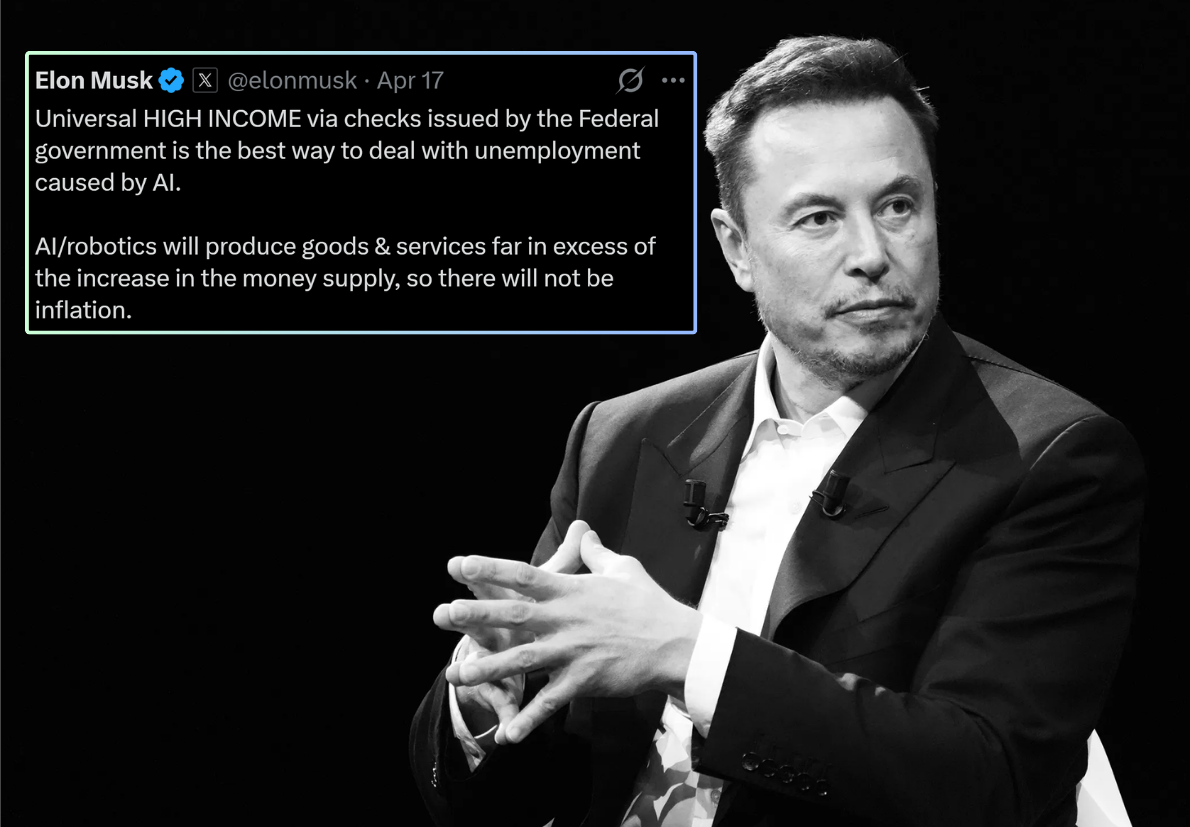
Elon Musk’s latest statement wasn’t subtle.
AI could force governments to introduce universal income.
That’s the future most people are preparing for.
Mode Mobile is already there.
While others debate policy, Mode is already scaling a platform that turns attention into earnings.
They’ve built a system where your phone generates income daily.
Browsing. Listening. Charging. Using apps.
Those same 5 hours people spend on their phones every day… now monetized.
And the traction is hard to ignore:
- 490M+ users globally
- $1B+ earned and saved by users
- $115M+ revenue
- 32,481% growth (#1 fastest-growing software company by Deloitte)
This isn’t a concept.
It’s a working economic model.
Just like Uber turned cars into taxis and Airbnb turned homes into hotels, Mode is turning smartphones into EarnPhones.
And investors can still access pre-IPO shares in this category disruptor at just $0.50.
But that window won’t stay open forever.
With a Nasdaq ticker secured ($MODE), the company is positioning for a potential IPO in the near future.
Get in before the public markets catch up.

ServiceNow Surges 5.9%
ServiceNow opened sharply higher today, posting a +5.9% gain in early trading on volume more than double the daily average, with calls leading puts significantly. That kind of move in a large-cap software name doesn’t happen in a vacuum. And when you look at the actual numbers behind this business — the Q1 2026 results, the AI monetization trajectory, and the analyst activity from this week — the move starts to make sense, even if the magnitude feels abrupt.
Here’s what matters right now.
The Revenue Picture
Full-year 2025 revenue came in at $13.28 billion, up nearly 21% year-over-year from $10.98 billion in 2024. Earnings reached $1.75 billion, advancing 22.67% on the year. That’s not a softening growth profile. That’s a business compounding at institutional scale with no meaningful deceleration in sight.
Then Q1 2026 arrived and accelerated things further. Total revenues hit $3.77 billion in the quarter, up 22% year-over-year. Subscription revenues — which represent roughly 97% of total sales — reached $3.671 billion, also up 22% year-over-year and 19% in constant currency. The consistency across quarters is exactly what drives multiple expansion in enterprise software. Traders focused only on the headline beat miss the more important signal: the repeatability.
Remaining performance obligations (RPO) stood at $27.7 billion as of Q1 2026, up 25% year-over-year. Current RPO — the slice recognized over the next 12 months — came in at $12.64 billion, up 22.5% year-over-year and 21% in constant currency. That’s not backlog noise. That’s a contracted revenue runway that gives institutional buyers visibility others in the sector simply don’t have. For context, cRPO has now exceeded 20% growth for five consecutive quarters.
On the profitability side: non-GAAP operating margin was 32% in Q1, free cash flow margin came in at 44%, and the company generated $1.67 billion in free cash flow in the quarter alone. Non-GAAP subscription gross margin held at 81.5%. These are not the financials of a company losing pricing power.
Louis Navellier: Don’t buy OR sell another AI stock…
Until you’ve heard this urgent AI warning from the man who called Nvidia before its 44,000% rise…
According to Louis, a massive reset is coming in an obscure corner of the AI market.
This $100 trillion disruption could send some of the world’s biggest AI stocks to zero… and one off-the-radar stock soaring… starting now.
AI Monetization — This Is Where It Gets Interesting
A lot of enterprise software companies are still describing AI as a future catalyst. ServiceNow is already booking it.
Now Assist customers spending over $1 million in annual contract value grew more than 130% year-over-year in Q1 2026. The company raised its full-year 2026 AI ACV target to $1.5 billion — a figure confirmed on the Q1 earnings call and reiterated at the Financial Analyst Day held May 5. At Knowledge 2026 in Las Vegas, ServiceNow unveiled Now Otto, a unified AI experience tying together conversational AI, autonomous workflows, enterprise search, and voice agents. The company also broadened its AI Control Tower for multi-cloud AI governance.
Slight tangent, but it’s relevant here: the company’s 2030 ambition is a $30 billion subscription revenue target, with management describing that as a conservative case. Around 30% of annual contract value is expected to come from Now Assist by that point. That projection carries a compounding logic — AI capabilities are being embedded into every SKU, meaning the incremental AI revenue contribution grows alongside the base business, not separately from it.
Whether that flywheel sustains at scale through 2026 and 2027 is the central question. What’s clear from Q1 is that it’s still spinning.
Customer Base & Retention
ServiceNow closed Q1 2026 with 630 customers carrying more than $5 million in annual contract value — up approximately 22% year-over-year. The company recorded 16 transactions with more than $5 million in net new ACV during the quarter, reflecting roughly 80% year-over-year growth in that cohort. The renewal rate remains at approximately 98%.
A 98% renewal rate in enterprise SaaS isn’t a number you gloss over. That’s structural demand, not cyclical enthusiasm. It also means the growth math is additive rather than replacement-driven — new customers and expanded contracts layering onto a near-fully-retained base. The switching cost argument is real here: replacing ServiceNow isn’t a software migration, it’s an organizational restructuring that most large enterprises won’t voluntarily undertake. That’s the moat.
The Analyst Catalyst — BofA’s Reinstatement This Week
Today’s move has a catalyst attached to it. Bank of America restarted coverage of ServiceNow on May 18 with a Buy rating and a $130 price target, arguing directly that AI is the strongest tailwind the company has ever seen — not an existential threat. The firm forecasts 18% to 22% revenue growth for NOW from 2026 through 2028, driven by platform expansion, AI budget wins, and monetization of agentic AI capabilities.
This matters in context. The stock fell roughly 38% year-to-date through mid-May, weighed down by investor concerns that AI would commoditize enterprise workflow software. BofA’s reinstatement is a direct counterargument — and the market is apparently listening. NOW was trading near $95 at Friday’s close. Today’s session has it pushing above $109, with an intraday high near $109.80.
Bernstein also raised its price target to $236 from $226 on May 6, following the company’s Analyst Day — citing ServiceNow’s 2030 targets including a Rule of 40 metric above 60, free cash flow margin expansion of roughly 900 basis points versus 2025 levels, and a commitment to reduce stock-based compensation below 10% of revenue by 2029. Across 31 analysts currently covering the stock, the consensus rating is Strong Buy with an average 12-month price target of $184.13.
Technical Framework
The +5.9% gap higher in early trading on elevated options activity — calls leading puts, volume running well above the 22-million-share daily average — confirms active institutional participation, not just retail momentum. That options skew is worth monitoring through the session: sustained call flow into the close would suggest positioning for continuation, while a sharp reversal in the ratio could indicate traders fading the move at resistance.
Key levels to monitor: VWAP hold on any intraday pullback is the first confirmation to look for following a gap of this magnitude. If NOW fades below VWAP before the close, that’s a different conversation. The 20-day and 50-day moving averages are relevant reference points for gauging whether this is a one-session event or the start of a broader recovery. The 52-week range runs $81.24 to $211.48 — today’s session is trading at the lower end of that range, which is worth keeping in mind when evaluating risk/reward from current levels.
Volume confirmation on the close matters more than where the stock opens.
What Wall Street Isn’t Telling You Right Now
The financial media is focused on the Middle East but they’re missing the real threat to your 401(k). The ensuing inflation shock is about to detonate America’s $38 trillion debt bubble. Now, a proprietary algorithm running 1.2 billion calculations daily has triggered an urgent warning. It has identified the exact 10 stocks that will crash – and 3 hidden companies set for massive wins.
Watch the urgent briefing and get 3 stocks to buy for FREE now
Three Scenarios Worth Modeling
Bull Case: NOW holds today’s gains and builds through the session on institutional accumulation following the BofA reinstatement. AI ACV trajectory toward the $1.5 billion full-year target stays intact, cRPO growth holds above 20% in Q2 2026, and the broader enterprise software complex catches a bid. In this scenario, the stock continues recovering toward the consensus analyst target range — with Bernstein at $236 as a near-term reference point and the broader 31-analyst consensus at $184.13.
Base Case: The stock holds a portion of today’s gains but consolidates near current levels as traders take partial profits into strength. Fundamentals remain supportive — $27.7 billion in RPO, consistent 22% subscription growth, and full-year 2026 subscription guidance raised to $15.735–$15.775 billion — but near-term price action is driven by broader software sector rotation and macro sentiment rather than company-specific catalysts. Q2 2026 subscription guidance of $3.815–$3.820 billion provides the next fundamental checkpoint.
Bear Case: Geopolitical headwinds resurface — Q1 2026 already absorbed a 75 basis point drag on subscription revenue from delayed large on-premise deal closings tied to Middle East conflict. Additionally, short-term operating and free cash flow margin pressure from the Armis acquisition integration is expected to persist through 2026, with normalization not projected until 2027 or later. If macro conditions deteriorate broadly or software valuations compress further, today’s gap could retrace. Watch for any Q2 2026 cRPO guidance miss as the primary signal of demand softening.
Active Trader Positioning Framework
Gap-higher sessions in large-cap software names require discipline. The move is already in — the question is whether you’re managing existing exposure or evaluating a new entry. For those already long, defining a trailing stop below VWAP or a key intraday pivot is basic risk hygiene given the magnitude of today’s move. For those on the sidelines, a pullback-and-hold near a reclaimed moving average offers a more defined risk/reward than entering at the session’s high.
Volatility is likely to remain elevated intraday. Size positions accordingly. The options market is already pricing increased near-term uncertainty — that’s useful information about expected range, not just directional bias.
The underlying investment case — AI monetization compounding on top of a locked-in subscription base with 98% renewal rates, $27.7 billion in contracted obligations, and a $30 billion revenue target by 2030 — is as structurally clean as enterprise software gets. But clean investment cases and favorable entry points are different things. One doesn’t guarantee the other.
What I’m watching into the close: whether today is a single-session institutional accumulation event following the BofA reinstatement, or the beginning of a broader recovery in software after a punishing first half of 2026. The numbers behind this business are strong. The levels from here will tell you whether the market agrees.
Preparation matters more than conviction at this frequency. Know your levels before the close — not after.
For informational and educational purposes only. Not investment advice. Trading involves risk, including loss of principal.