May 24, 2026
Liquid Cooling Isn’t Optional Anymore
Blackwell and MI300-class compute is forcing a new data center standard, and the spend is starting to concentrate
For years, “more compute” mostly meant more GPUs and more square footage. Now it means plumbing.
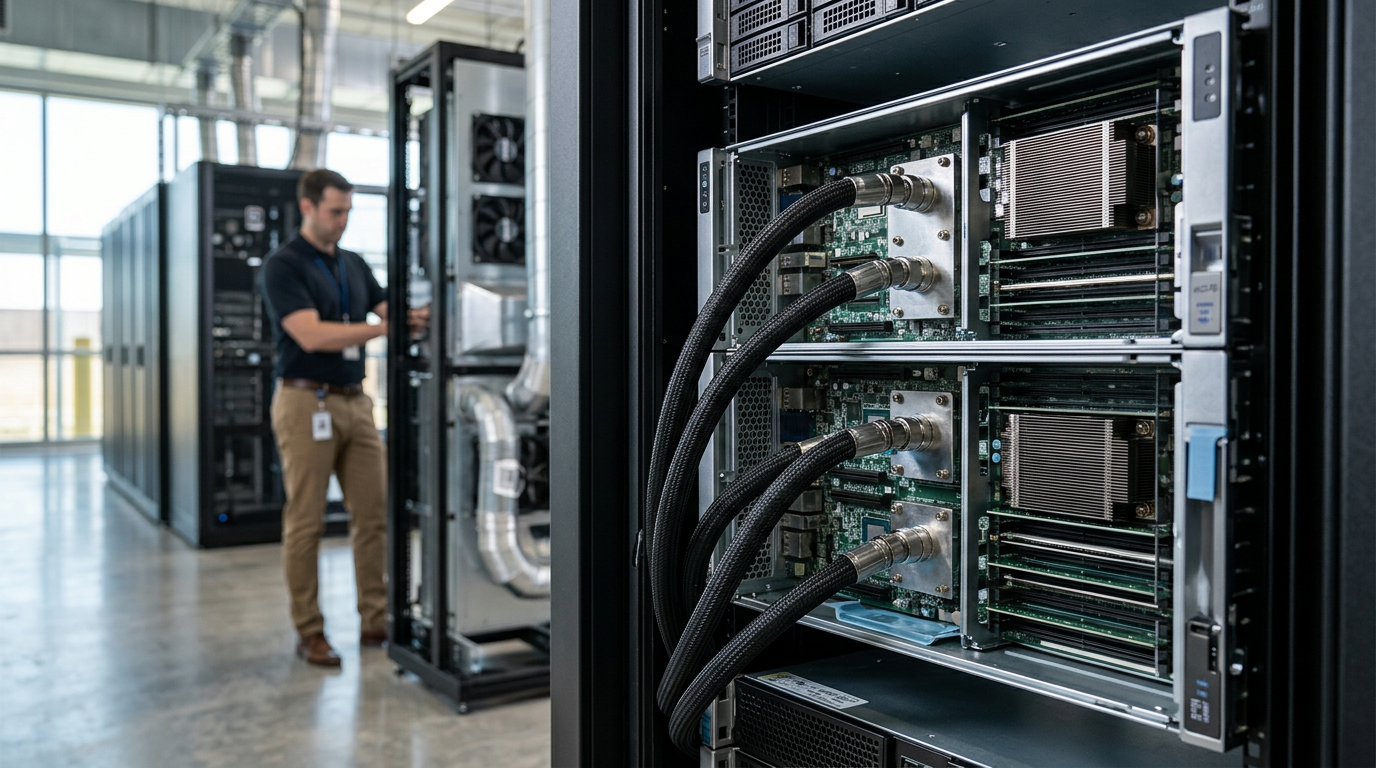
The uncomfortable truth for anyone underwriting the next wave of AI buildouts: air cooling is increasingly the limiting factor, not rack space. NVIDIA has been explicit that its Blackwell-era systems like GB200 NVL72 and GB300 NVL72 use direct-to-chip liquid cooling, and NVIDIA has been pushing sealed, closed-loop approaches that can be far more water-efficient than older evaporative methods. That’s not marketing fluff. It is an admission that the thermal load and the density targets have moved beyond what conventional hot-aisle / cold-aisle can comfortably absorb at scale. NVIDIA itself has highlighted reference architectures that cut energy use and floor space via liquid-cooled designs.([blogs.nvidia.com](https://blogs.nvidia.com/blog/blackwell-platform-water-efficiency-liquid-cooling-data-centers-ai-factories/?utm_source=openai))
“Elon’s #1 AI Stock” SET TO SOAR
Forget ChatGPT!
Because Elon Musk’s AI promises to be 100x more powerful.
After all, ChatGPT just works online…
While Elon’s AI works in the real world.
On the AMD side, MI300X is a useful anchor because the platform details are public and the power reality is straightforward: AMD positions MI300X as an OAM module used in dense 8-GPU baseboards, and the commonly cited module power class is roughly 750W per accelerator. Multiply that across an 8-GPU tray before you even talk CPUs, memory, fabrics, and conversion losses, and you can see why facility design is starting from coolant routing rather than from perforated tiles.([amd.com](https://www.amd.com/en/products/accelerators/instinct/mi300.html?utm_source=openai))
Here’s where it gets interesting for active traders: liquid cooling is no longer a “nice-to-have” feature that shows up late in a project. It is an upfront requirement that can pull forward orders for coolant distribution units (CDUs), rear-door heat exchangers (RDHx), manifolds, quick connects, and the whole ecosystem around heat rejection. In other words, it can shift dollars from general construction timelines into shorter-cycle infrastructure line items.
Slight tangent, but it matters: this is one of those transitions where the market can over-focus on the chip vendor headlines and under-focus on the physical bottlenecks. When deployment schedules slip, it’s not always because the GPUs are late. Sometimes it’s because the site can’t support the thermal envelope without a redesign.
Watch Now! Porter Stansberry & Luke Lango join forces to unveil:
The Three Titanic Forces Converging To Unleash A New 1776 Moment
“We have never seen wealth created at this size and speed” – MIT Researcher
Stocks to watch:
Vertiv (VRT) sits near the center of AI-era power and thermal infrastructure. The company has been rolling out purpose-built high-density products such as a chilled-water rear door heat exchanger aimed at AI/HPC loads, plus CDUs designed for direct-to-chip deployments. Those product launches are a tell: vendors don’t tool up globally unless customer pull is already there.([vertiv.com](https://www.vertiv.com/en-ca/about/news-and-insights/corporate-news/vertiv-announces-global-launch-of-chilled-water-rear-door-heat-exchanger-for-ai-and-hpc-applications/?utm_source=openai))
Modine (MOD) is in the conversation because data center thermal is increasingly about engineered systems and manufacturing capacity, not just components. Modine’s reporting has pointed to strong data center sales growth (notably +42% year-over-year in a recent quarter), which traders should treat as a demand signal that extends beyond one customer cycle. The key debate is durability: how much of the order flow is multi-year capacity build versus lumpy project timing.([s205.q4cdn.com](https://s205.q4cdn.com/270741342/files/doc_financials/2026/q2/Modine-Reports-Second-Quarter-Fiscal-2026-Results.pdf?utm_source=openai))
nVent (NVT) is less “pure cooling” and more “the picks-and-shovels around deployment.” Its data solutions lineup includes liquid cooling products like row-based CDUs and manifolds, and the company has been highlighting momentum tied to data centers in recent results. For traders, NVT is interesting precisely because it can participate in the build even when projects standardize around reference rack designs.([nvent.com](https://www.nvent.com/en-us/data-solutions/products/liquid-cooling?utm_source=openai))
Legendary trader makes the boldest prediction of his 40-year career
In 2020, Larry Benedict told CNBC the market was about to fall. Few believed him. Within weeks, markets dropped 34% but his readers had the chance to make 62%.
In 2022, he predicted the worst market in a generation. He went 11-for-11. One trade returned 117% in under a month.
Now he’s speaking out again… and he says what’s coming makes both of those look like a warm-up.
Click here to hear his new prediction and get his #1 ticker free.
If you’re trading this theme, the near-term tells are not theoretical. Watch order/backlog commentary, lead times, and margin behavior around high-density SKUs. And keep a close eye on any mention of rack-level power density targets in reference designs, because once those thresholds move up, the cooling bill tends to follow.