May 26, 2026
What the SpaceX Banks Aren’t Telling You to Do
Featured: DRAM Is Breaking Records
Dear Reader,
JPMorgan. Goldman. Morgan Stanley. In total, 21 banks are brokering the SpaceX IPO.
They will collect billions in fees on a deal that was done before you heard about it.
By the time you can buy a single share, the people who built the system will have already made 30 times their money.
That’s not a surprise. That’s the plan.
But here’s what they’re not telling you…
While every financial newsletter in America is hyping SpaceX, the world’s central banks have been buying gold, 850 tonnes last year alone.
Not shares. Not funds. Not pie in the sky. Actual physical gold. The one asset that exists entirely outside the system.
Ask yourself why the institutions that created the paper money system keep moving their own reserves into the one thing that doesn’t depend on it.
Then ask yourself why your retirement is still 100% inside the system they’re quietly stepping away from.
We put together a free 2026 Gold Guide on exactly what they know and what you can do about it.
It costs nothing. Takes 30 seconds to request.
The insiders already made their move.
Now it’s your turn.

Quick Cheat Sheet
- Ticker: DRAM | Launch: April 2, 2026
- AUM: $10.47B | Expense Ratio: 0.65%
- Gain Since Launch: ~90% | 52-Wk High: $56.38
- NAV: $53.16 | 1-Mo NAV Change: +38.28%
- Avg Daily Volume: ~21M shares | Net Flows (1-yr): $8.71B
- Top Holdings: SK Hynix, Micron (MU), Samsung (~73–75% combined)
- Key Support: $50.00 | Key Resistance: $56.38
- MA Signals: 12 buy / 0 sell (MA5 through MA200)
DRAM Is Breaking Records
Nobody was really talking about memory chips six months ago. Not like this.
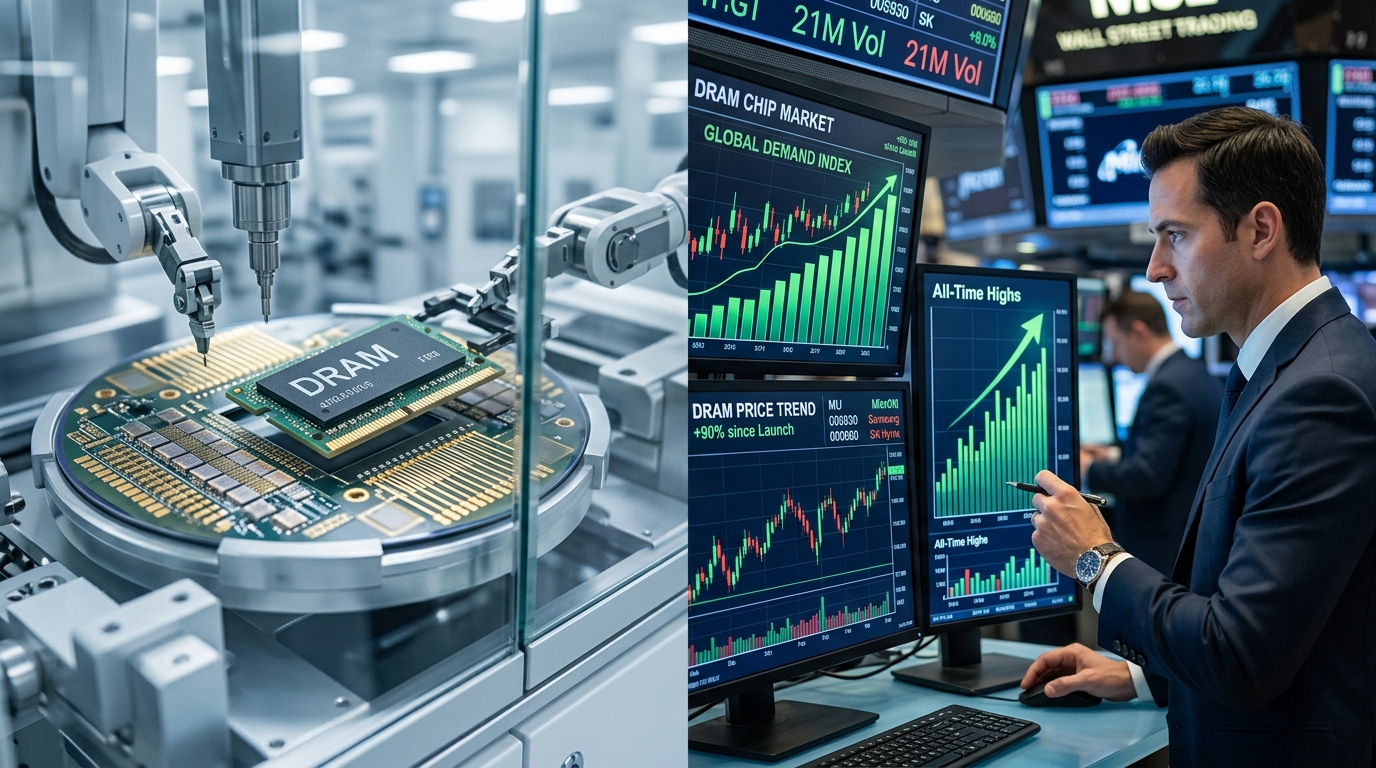
The Roundhill Memory ETF launched April 2, 2026, and crossed $10 billion in assets under management in under seven weeks. That’s not a milestone — that’s a record. The fastest ETF accumulation in history, full stop. And the fund itself is up roughly 90% since day one, touching a 52-week high of $56.38 in early May before pulling back to the $53 range. NAV is still up 38% over the past month alone. At ~21 million shares trading daily, this thing has genuine institutional participation, not just retail chasing a hot ticker.
What’s interesting is how straightforward the underlying thesis actually is. AI data centers need roughly six times more DRAM than traditional servers. That’s not a projection — it’s a current infrastructure reality. Nvidia’s accelerators are the ones getting the headlines, but they don’t function at scale without high-bandwidth memory feeding them. Memory is the bottleneck. It has been for a while. The market is just now catching up to that.
The fund reflects that concentration intentionally. SK Hynix, Micron, and Samsung make up roughly 73–75% of the portfolio. Every company in the fund must derive at least 50% of revenues from semiconductor memory — HBM, DRAM, NAND, embedded. No diversification for its own sake. Roundhill made a deliberate bet on the narrowest slice of the chip complex, and so far the market has rewarded that conviction hard.
Slight tangent: Sandisk was spun out of Western Digital back in February 2025 and has returned over 4,000% since. Most people missed it entirely. It’s worth knowing that dynamic exists in this space before assuming the DRAM story is already fully priced in.
Micron’s last earnings put a finer point on it — HBM revenue in the multiple billions annually, demand expected to outstrip supply into 2027. That’s a multi-year imbalance, not a quarterly blip.
On the technical side: all moving averages from MA5 through MA200 are currently bullish — 12 buy signals, zero sell. $53.30 is the near-term pivot. $56.38 is the ceiling to watch. A sustained move below $50 would be the first signal worth respecting.
Here’s where I’m at on this: the demand thesis is real. But 90% in seven weeks is the kind of move that tends to make the next entry complicated. Whether that matters depends entirely on your time horizon — and whether memory pricing holds as new supply comes online in late 2026.
That’s the number that actually decides what happens next.
For informational and educational purposes only. Not investment advice. Trading involves risk, including loss of principal.