June 10, 2026
The Hormuz Shock Is Hitting Aluminum Hard
Alcoa, Supply Chain Disruption, and What Comes Next for Critical Materials
Something broke in the global aluminum market in late February 2026. Not figuratively. Physically.
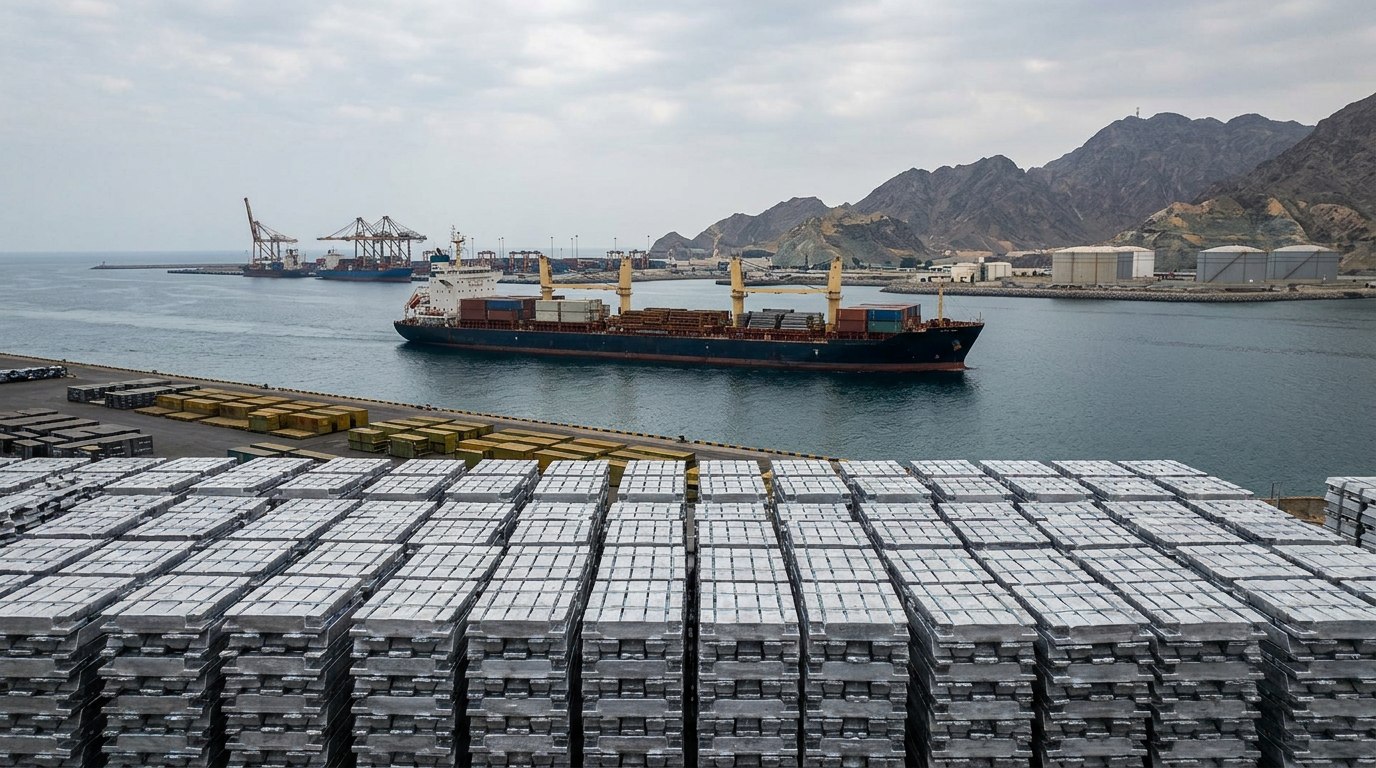
When U.S. and Israeli strikes on Iran triggered an effective closure of the Strait of Hormuz on February 28, the ripple hit industrial metals within hours. Three-month LME aluminum futures jumped as much as 10% by March 12. By late May, cash prices had reached $3,720 per tonne, a four-year high, and the market had moved into backwardation with a cash premium of approximately $59 per tonne over three-month contracts. That is a rare condition for aluminum. It tells you the physical scarcity is real, not manufactured by positioning.
This is the environment Alcoa Corporation ($AA) is operating in right now. And the numbers are starting to reflect it.
The Rare Earth Stock Boom: Even Bigger Gains Could Hit Soon
Tiny rare-earth miners are exploding: 200%, 300%, even 500% gains in just months. But while everyone piles into the same names, I’ve uncovered the next wave of this $3 trillion resource story…a breakthrough that could make today’s miners obsolete. I’m expecting the big announcement any day now.
Key Takeaways
- The Strait of Hormuz carried approximately 20.3 million barrels of oil per day in Q1 2025, representing roughly 25% of total global seaborne oil trade, according to EIA and IEA data.
- LME aluminum cash prices reached $3,720 per tonne in late May 2026, up more than 16% since the onset of Gulf hostilities, and representing a four-year high.
- More than 5 million tonnes of aluminum shipped through the Strait last year, bound for roughly 70 countries across Asia, Europe, and North America.
- Alcoa posted Q1 2026 net income of $425 million on $3.19 billion in revenue, with adjusted EBITDA of $595 million, up $68 million sequentially, driven by higher LME and Midwest premium aluminum prices.
- Average realized aluminum prices rose 31% year-over-year in Q1 2026 to $4,209 per tonne, while LME prices recently exceeded $3,600 per metric ton and continued climbing.
- Alcoa’s full-year 2025 revenue was $12.83 billion, with net income attributable to the company of $1.17 billion, compared to just $60 million in FY2024.
- 14 analysts carry a consensus Buy rating on $AA with an average 12-month price target of approximately $76 per share, per S&P Global data.
- The aerospace-grade aluminum market was valued at approximately $45.9 billion in 2025 and is forecast to reach $67.2 billion by 2032, at a 5.6% CAGR.
The Macro Backdrop: A Chokepoint That Cannot Be Bypassed
The Strait of Hormuz is 21 nautical miles wide at its narrowest point. The navigable lanes are four miles total. On an average day in 2025, approximately 20 million barrels of oil passed through it. That is one-fifth of everything the world consumes. In Q1 2025, flows through the strait made up more than one-quarter of total global seaborne oil trade, according to the U.S. Energy Information Administration. The IEA’s 2025 data puts crude oil alone at nearly 15 million barrels per day, roughly 34% of all global crude trade.
The destination picture matters here. Asian countries collectively receive 89.2% of the crude oil that transits the waterway. China alone accounted for 37.7% of total Hormuz crude flows as of Q1 2025. India sits at 14.7%, South Korea at 12%, Japan at 10.9%. These are the manufacturing nations. The countries that make the things that require aluminum, industrial inputs, and stable raw material supply chains. When Hormuz gets disrupted, the pressure lands directly on their cost structures.
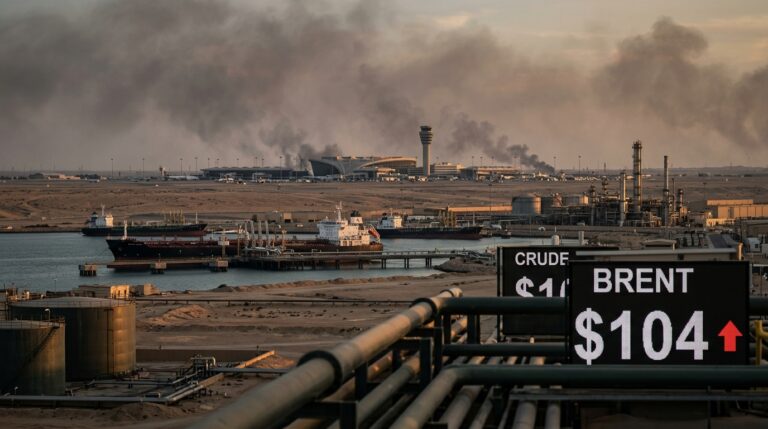
Brent crude jumped from $71 per barrel on February 27, 2026, to $94 per barrel by March 9, and continued climbing. About 90% of Strait traffic was diverted in the immediate aftermath of the conflict’s outbreak. German shipping group Hapag-Lloyd suspended all vessel transit until further notice. The market was not pricing in a temporary disruption. It was processing a structural one.
What makes aluminum different from crude oil in this crisis is the compounding mechanism. The Strait blocks metal exports going out and raw material imports coming in simultaneously. Gulf smelters that remained operational faced uncertainty about both alumina supply and their ability to ship finished product. Industry estimates suggest Gulf smelting facilities could require up to 12 months for full operational restoration, regardless of when hostilities end. Pot line restart timelines of three to six months mean physical supply recovery will lag well behind any geopolitical resolution.
Slight tangent, but it matters: LME warehouse inventories were already thin going into this shock. Registered stocks fell to 418,675 tonnes by late March 2026, the lowest level since July 2025, down 28.4% year-on-year. By May 8, stocks had declined further to 358,225 tonnes. The market had no inventory cushion when the disruption arrived. That absence of a buffer is what converted a logistics problem into a price event.
Trump named it. Scientists built it. Here’s what it means for you.
The name is “Golden Dawn.” That’s what President Trump’s team is calling America’s new Manhattan Project – but for AI. It will span more than 700 miles – making it by far the largest AI infrastructure project ever built. When Trump flips the on switch, Louis Navellier believes it will trigger a $100 trillion reset of the AI markets. For investors who get ahead of it, the timing could mean everything.
Louis’ revealing the one stock at the center of it all right here.
Sector Breakdown: Who Moves When Aluminum Moves
The aluminum supply shock is not an isolated commodity story. It flows directly into the cost base of several industrial sectors that traders need to be tracking.
Aerospace and defense is the most structurally significant end-market for high-grade aluminum. The aerospace-grade aluminum market was valued at approximately $8.78 billion in 2025 and is forecast to reach $17.59 billion by 2035, a 7.2% CAGR over the decade. The broader aerospace aluminum alloys market sits at an estimated $20.5 billion in 2024, projected to reach $30.8 billion by 2033. By end of 2025, Boeing and Airbus combined had a backlog of 15,461 commercial aircraft. At current build rates, that backlog would take each manufacturer more than 11 years to clear. Defense demand is compounding on top of this: the DoD’s National Defense Industrial Strategy Implementation Plan for fiscal year 2025 explicitly emphasized reshoring critical parts and materials to minimize risks from adversary nations. Aerospace manufacturers rely on several hundred Tier 1 suppliers and thousands across all tiers. Any supply chain tightening hits immediately.
The automotive and packaging sectors also absorb meaningful aluminum volumes, but aerospace and defense carry the pricing power. High-grade industrial aluminum commands a premium over standard LME benchmarks, and producers positioned upstream, with direct smelting and refining operations, are the natural beneficiaries when premiums widen. Regional premiums have already responded: European premiums have risen approximately 70%, while U.S. Midwest contracts have exceeded $2,550 per tonne. These are procurement surcharges on top of already elevated LME benchmarks.
Producers outside the Gulf with diversified geographic footprints are capturing the premium that supply-chain reliability now commands. That is the core structural advantage for a company like Alcoa.
Alcoa ($AA): What the Numbers Actually Say
Alcoa is a vertically integrated aluminum producer operating across bauxite mining, alumina refining, and aluminum smelting. It is the upstream company in the supply chain. When raw aluminum prices move, Alcoa’s revenue and margins move with them.
Full-year 2025 revenue came in at $12.83 billion, up from $11.90 billion in 2024. Net income attributable to Alcoa was $1.17 billion for the full year, compared to just $60 million in FY2024. That is not a rounding error. The company generated $1.6 billion in cash by year-end 2025, having also redeemed $141 million in 5.5% Senior Notes due 2027 during the fourth quarter.
Q1 2026 results reflected the beginning of the aluminum price acceleration. Net income attributable to Alcoa was $425 million, with diluted EPS of $1.60. Adjusted EBITDA reached $595 million, up $68 million sequentially, driven primarily by higher LME and Midwest premium aluminum prices. Average realized aluminum prices rose 31% year-over-year to $4,209 per tonne in Q1 2026. LME prices recently exceeded $3,600 per metric ton and have continued to move higher.
There is a mixed element here that traders should understand. Average realized third-party alumina prices fell sharply, from $575 per tonne in Q1 2025 to $324 per tonne in Q1 2026, a 43.7% decline. The Alumina segment posted negative adjusted EBITDA in Q1 2026. Revenue fell 7% sequentially to $3.19 billion on lower alumina shipments and the Middle East shipping constraints. Free cash flow was negative $298 million, primarily driven by seasonal working capital buildup and capital expenditures of $119 million. The company ended Q1 2026 with $1.4 billion in cash and $1.8 billion in adjusted net debt.
The divergence between aluminum strength and alumina weakness is the key tension in the Alcoa story right now. The bull thesis is that higher aluminum prices more than offset alumina margin pressure. The Q1 data supports that view. What matters going forward is whether aluminum prices hold at elevated levels long enough for the Aluminum segment to dominate the earnings mix. The San Ciprian smelter in Spain completed its restart in April 2026, contributing flat aluminum production of 607,000 metric tons in Q1 2026, with lower production costs and higher shipments expected in Q2. The company also set production records at five aluminum smelters in Canada, Norway, Australia, and the U.S. during 2025.
On the analyst side: 14 analysts polled by S&P Global carry a consensus Buy rating with an average 12-month price target of approximately $76 per share. UBS upgraded Alcoa to Buy with a price target of $80, up from $75. B. Riley maintains a Buy rating with a target of $92. Wells Fargo upgraded to Overweight with a $70 target. The stock has risen approximately 49% over the past 12 months as of the most recent data, with a 52-week range of $25.84 to $77.70. Return on equity through Q1 2026 was 21.9%. The company is paying a quarterly cash dividend of $0.10 per share.
One thing worth noting: Alcoa’s exposure to spot electricity prices is less than 1% of its total electricity consumption, due to long-term power contracts and financial hedges. In an environment where energy costs are rising sharply on the back of oil price acceleration, that structural insulation is a meaningful competitive differentiator against regional producers whose power costs are more directly correlated to energy markets.
Get YOUR Pre-IPO Exposure to ChatGPT’s Trillion Dollar IPO!
No Accreditation… No Qualifications…
Technical Framework
LME three-month aluminum futures have formed a pattern of consecutive higher-high, higher-low sequences since late February 2026. Every intraday retracement since mid-March has found support near the 20-day moving average. As of the most recent data, the current close of approximately $3,571 sits above both the 20-day (~$3,468) and the 50-day level (~$3,387). The MACD signal line remains positive, consistent with sustained above-average buying pressure rather than a speculative overshoot. The $3,380 to $3,420 zone is the key support level to monitor.
For $AA specifically, the stock holds buy signals from both short and long-term moving averages. A buy signal was issued from a pivot bottom point on April 29, 2026, with the stock rising approximately 24% from that level. Key support levels based on volume accumulation sit at $71.83 and $67.18. A close below the lower level would shift the short-term picture. Volume rose in conjunction with the recent price advance, which confirms rather than undermines the move.
The 52-week high is $77.70. The stock is trading near that level. Whether it breaks through or consolidates will depend heavily on whether Q2 2026 aluminum pricing holds above the levels that drove Q1 adjusted EBITDA to $595 million. Management guided for stronger Q2 performance on higher shipments from the San Ciprian restart. Traders should watch for Q2 earnings on July 15, 2026.
Scenario Modeling
Bull Case
Gulf hostilities persist beyond 60 days without diplomatic resolution. Gulf smelter restoration timelines extend toward the 12-month upper estimate. LME aluminum prices push toward the $4,000 per tonne bull-case target identified by Citi and JPMorgan. Alcoa’s Q2 2026 adjusted EBITDA builds materially on Q1’s $595 million base as higher aluminum pricing flows through and San Ciprian shipment volumes increase. Analyst targets toward $92 (B. Riley) come into focus. U.S. Midwest premiums remain above $2,550 per tonne, providing an additional margin layer above LME benchmarks. The aerospace and defense reshoring cycle creates a sustained demand floor independent of cyclical macro conditions.
Base Case
Partial diplomatic resolution eases Hormuz transit in the second half of 2026, but physical supply recovery lags conflict resolution by three to six months due to pot line restart timelines. LME aluminum prices consolidate in the $3,200 to $3,600 range. Alcoa maintains elevated revenue above the FY2025 level of $12.83 billion, with aluminum segment strength offsetting continued alumina segment pressure at around $324 per tonne. Q2 EPS benefits from San Ciprian volume recovery. Consensus 12-month price target around $75 to $76 per share represents the rational path of least resistance. Alumina prices remain suppressed, capping the full earnings upside.
Bear Case
A faster-than-expected diplomatic resolution reopens Hormuz within 30 days. LME aluminum prices retreat toward the $3,200 to $3,400 range as Gulf supply resumes and backwardation unwinds. Alcoa faces the dual pressure of lower aluminum prices combined with continued alumina segment weakness, with the Alumina segment remaining EBITDA-negative. Free cash flow stays negative on seasonal working capital into Q2. Tariff costs on imported aluminum compound margin pressure. The alumina price at $307 per tonne provides little offset. Key failure level to watch: a sustained close below $67 on $AA shares signals the bull case has broken down.
Musk’s Hidden AI Play Could Be the Next Big Thing
While tech giants dominate headlines…
Elon Musk is quietly building a formidable AI enterprise.
This under-the-radar stock offers a unique entry point into his latest venture.
Don’t miss out on this potential game-changer.
Active Trader Strategy Framework
The primary risk variable in the Alcoa trade is conflict duration. This is not a balance sheet story or an earnings quality debate. It is a geopolitical commodity duration trade. Traders need a clear framework for what they are holding and why.
- Key levels to monitor on $AA: Support at $71.83 and $67.18 based on accumulated volume. A breakdown through $67 warrants position reassessment. Resistance near the 52-week high of $77.70, with the fan-theory projection pointing toward $92.63 on continuation.
- Catalyst calendar: Q2 2026 earnings are scheduled for July 15, 2026. This is the event that will confirm or challenge whether the aluminum price environment is actually flowing through to reported earnings. Management guided for stronger Q2 performance. Execution against that guidance is the near-term test.
- Volatility expectations: LME aluminum prices have become a real-time indicator for Hormuz conflict resolution probability. Any ceasefire or diplomatic progress will generate an immediate response in aluminum futures and AA shares. Position sizing should account for headline-driven gap risk in both directions.
- Relative positioning: Alcoa’s less than 1% spot electricity exposure differentiates it from producers with direct energy price linkage. In a rising oil cost environment, this structural advantage matters for relative margin performance.
- Alumina watch: LME alumina held at approximately $307 per tonne through late May 2026. Any recovery in alumina pricing from current depressed levels would represent a material upside catalyst that is not currently priced into consensus estimates.
This is not a situation where any single trader can predict the outcome. The job is to understand the structure of the trade, the key variables, and where the risk is concentrated. Right now, the asymmetry favors understanding what a 60-day conflict extension means for the supply balance before making commitments that depend on a near-term resolution.
The aluminum market was already operating with thin inventory buffers before the Hormuz disruption arrived. LME registered stocks were down 28.4% year-on-year at end-December 2025, before the conflict began. The supply shock landed on a market that had no room to absorb it quietly.
Alcoa is the upstream company in this chain. Its FY2025 net income turnaround from $60 million to $1.17 billion was built on improving aluminum prices before the current crisis. What the Hormuz disruption has done is potentially extend and amplify that pricing environment into 2026 and beyond. The open question is not whether the company is positioned to benefit. It clearly is. The open question is how long the conditions that create that benefit persist.
The market will answer that question on its own timeline. The trader’s job is to be prepared for multiple outcomes before committing capital to one of them.
For informational and educational purposes only. Not investment advice. Trading involves risk, including loss of principal.