June 11, 2026
AI Needs Power. Here’s Who Supplies It.
GE Vernova and Cameco: Two Companies at the Center of a Structural Energy Shift
The grid is tightening. That’s not an opinion at this point. It’s a measurable, documented reality showing up in order books, capacity constraints, and corporate power agreements across the energy sector.
Global data center electricity demand reached 447 terawatt hours in 2025. Gartner now projects that figure climbs to 565 TWh in 2026 alone, a 26% jump in a single year. The IEA estimates total consumption from data centers will double by 2030. Goldman Sachs Research puts U.S. data center power demand at 31 GW today, rising to 66 GW by 2027 as capacity additions accelerate from 8.5 GW in 2025 to a projected 36.3 GW in 2027. Bloom Energy, in its January 2026 report, sees U.S. data center energy demand jumping from 80 GW to 150 GW between 2025 and 2028. That’s the equivalent of adding Spain’s entire energy economy in three years.
What’s interesting is the part that gets glossed over in most coverage. The problem isn’t just the volume of electricity needed. It’s the type. AI workloads require stable, continuous, 24/7 power. Solar peaks at midday. Wind is intermittent. Neither provides the baseload reliability a hyperscale data center demands. That structural mismatch is what’s forcing an entirely different category of infrastructure investment, and it’s the core reason GE Vernova ($GEV) and Cameco Corporation ($CCJ) are worth understanding in depth right now.
This Obscure Report is FREE and Has Revealed Which Stocks Were Ready To Deliver “Fast Cash”
Forget fancy screeners and tools that cost thousands of dollars…
This free-to-public, yet strangely unknown report points to stocks that one study shows has an 85.4% chance to surge upward…
Looking at our real money track record, someone with a simple $5,000 start in each trade could have pulled “FAST CASH” from the markets as quickly as…
$10,000 in 6 minutes… $11,500 in 2 hours… and $11,600 in 18 minutes.
The Macro Environment: What the Data Actually Shows
The capital commitment from big tech is staggering. The IEA reported that capital expenditure from five large technology companies surged past $400 billion in 2025 and is expected to rise by a further 75% in 2026. Technology companies are projected to invest $250 billion in AI infrastructure in 2025 alone, with Microsoft allocating $80 billion of that figure.
That spending is colliding with a grid that wasn’t built for this. In Virginia, data centers already consume nearly 25% of the state’s total electricity supply. The IEA has flagged that AI capacity is now constrained by power availability, not compute. Gartner’s analysts put it plainly: data center power security has become the central battleground for scaling in the global AI race.
The nuclear angle deserves its own paragraph. Big tech companies have signed contracts for more than 10 gigawatts of possible new nuclear capacity in the U.S. over the past year. Microsoft committed to a 20-year, 835-megawatt power purchase agreement to restart Three Mile Island. Amazon signed a deal with Talen Energy’s Susquehanna plant for 1.9 GW through 2042, supporting its plan to invest $20 billion in AWS facilities in Pennsylvania. Google ordered up to 500 MW of small modular reactors from Kairos Power and committed early-stage capital to Elementl Power for three U.S. reactor sites totaling 1.8 GW. Meta signed a 20-year PPA with Constellation Energy to buy 1.1 gigawatts of nuclear energy from the Clinton Clean Energy Center in Illinois.
The pipeline of conditional offtake agreements between data center operators and SMR nuclear projects has grown from 25 GW at the end of 2024 to 45 GW as of early 2026. That’s not a trend. That’s a structural realignment of who buys energy and how they secure it.
The macro backdrop: the 10-year Treasury is sitting around 4.3-4.5%, inflation is moderating but not defeated, and industrial capex cycles have historically performed well when rate environments stabilize. The energy infrastructure buildout is a multi-year, non-discretionary spending cycle. Utilities and hyperscalers don’t cancel these orders when equities wobble.
Could This Stock Be “Trump’s Next Big Buy”?
Jim Rickards believes the Trump administration is about to take a direct stake in a tiny $2 stock.
The Trump administration has taken a direct stake in MP Materials, Lithium America, Trilogy Metals, and USA Rare Earth.
Each time, shares sprinted higher. Click here to see why Jim believes this one is next.
GE Vernova (GEV): The Order Book Doesn’t Lie
GEV reported full-year 2025 revenue of $38.1 billion, up 9% year-over-year. Orders for the full year hit $59.3 billion, growing 34% organically, led by equipment at Power and Electrification. Total backlog grew $31.2 billion year-over-year, reaching $150 billion exiting 2025. Free cash flow for the full year came in at $3.7 billion.
Then Q1 2026 hit, and the numbers accelerated. Orders of $18.3 billion in a single quarter, up 71% organically. Backlog grew $13 billion sequentially. The Electrification segment alone booked $2.4 billion in equipment orders to support data centers in Q1 2026 alone, more than all of 2025 combined. Gas Power equipment backlog and slot reservation agreements grew from 83 to 100 GW quarter-over-quarter. The company now anticipates reaching at least 110 GW of combined gas turbine backlog and slot reservation agreements by year-end 2026.
Slight tangent, but it matters: GEV raised full-year 2026 revenue guidance to $44.5-$45.5 billion following Q1 results, up from the prior range of $44-$45 billion. Adjusted EBITDA margin guidance moved to 12%-14%, up from 11%-13%. Free cash flow guidance was raised to $5.0-$5.5 billion. By 2028, the company now targets $56 billion in revenue, 20% adjusted EBITDA margin, and at least $24 billion in cumulative free cash flow. The electrification backlog is expected to double from $30 billion to $60 billion in that same window.
Gas turbine production capacity is on track to reach 20 GW annualized output by mid-2026, with a target of 24 GW by 2028. New gas power equipment orders in 2026 are being priced 10-20 points higher than Q4 2025 orders on a dollar-per-kW basis. With roughly 90% of gas turbine capacity already contracted through 2030, pricing power is real and the backlog is weighted toward higher-margin equipment.
The Wind segment is a drag. Revenue was down 23% in Q1 2026, with segment EBITDA losses widening to approximately $382 million for the full year 2025. This is a known headwind the market has already discounted. The Power and Electrification segments are carrying the company, and the numbers suggest they’re doing it comfortably.
On valuation: 37 analysts polled by S&P Global carry a consensus Buy rating with an average 12-month price target of $1,216. Goldman Sachs raised its target to $1,328. Argus raised to $1,300. Baird sits at $1,400. The high-end target from the current analyst pool is $1,424. At roughly $935-$965 per share as of this writing, the consensus implies meaningful upside, though the stock has already appreciated substantially and is not cheap on near-term multiples.
Cameco (CCJ): The Fuel Behind the Renaissance
If GEV is the company building the grid, Cameco is the company supplying the fuel that makes nuclear power possible. That distinction matters because it positions CCJ differently in the capital stack of this theme.
Cameco delivered full-year 2025 revenue of $3.48 billion, up 11% from $3.14 billion in 2024. Net earnings attributable to equity holders jumped to $590 million from $172 million the prior year, a 243% increase. Adjusted net earnings climbed to $627 million from $292 million. Adjusted EBITDA reached $1.93 billion, up from $1.53 billion. Cash from operations hit $1.41 billion versus $905 million the year before. These are not incremental improvements. They reflect real operating leverage kicking in.
The uranium segment is Cameco’s core engine. In Q2 2025, uranium segment earnings before income taxes and adjusted EBITDA increased 46% and 43% respectively compared to Q2 2024, driven by higher sales volumes and average realized prices. The average long-term uranium price indicator reached $80 per pound U3O8 as of mid-2025. By Q1 2026, TradeTech’s monthly long-term uranium price indicator had moved higher to $93.00 per pound, reflecting firmer contracting activity and tighter supply conditions.
The contract book is the part most people overlook. As of March 31, 2026, Cameco had commitments requiring delivery of an average of approximately 28 million pounds of uranium per year from 2026 through 2030, with commitment levels higher than that average in 2026 through 2028. The company holds approximately 230 million pounds under long-term contracts in total. About 70% of recent contracts contain market-linked pricing mechanisms, meaning as spot and long-term prices move higher, the company’s realized pricing improves automatically.
The Westinghouse dimension is underappreciated. Cameco owns a 49% stake in Westinghouse Electric Company, the world’s leading nuclear reactor technology provider. Cameco and Brookfield have entered a strategic partnership with the U.S. government expected to accelerate the deployment of Westinghouse nuclear reactors domestically. Cameco also reported an expected increase of approximately $170 million (US) in its 49% equity share of Westinghouse’s 2025 second quarter and annual adjusted EBITDA, tied to Westinghouse’s participation in the construction of two nuclear reactors at the Dukovany power plant in the Czech Republic. This is a global franchise with multi-decade demand visibility.
The supply side is worth understanding. The European Commission has outlined an initiative to phase out Russian nuclear fuel imports across the EU, restricting new supply contracts for uranium and enriched uranium derived from Russia. Kazakh supply, which accounts for a significant portion of global uranium production, is facing potential 2026 production guidance reductions. Cameco operates high-grade uranium mines in geopolitically stable jurisdictions, including McArthur River and Cigar Lake in Saskatchewan, each targeting 18 million pounds of annual production. That provenance is increasingly valuable to utilities prioritizing supply chain security.
On valuation: 24 analysts carry a consensus Buy rating on CCJ with an average 12-month price target of $129.38 per Stock Analysis data. Scotiabank raised its target to $175. RBC Capital set $160. The median analyst target from recent coverage sits around $139-$150. The stock has a market cap of approximately $53 billion at current prices around $116-$120 per share, trading at a P/E around 125x, which is elevated on trailing earnings but reflects expectations for continued re-rating as uranium contract prices reset higher and Westinghouse contributions grow.
Technical Structure and Key Levels
GEV has been one of the strongest large-cap industrials in the market over the past 12 months. The stock has shown a pattern of consolidating after earnings-driven moves and then resuming trend. Key support zones to monitor sit in the $880-$900 range, where the 50-day moving average has been offering dynamic support in recent months. The Q1 2026 earnings release sent shares up over 13% on volume, which institutional traders will note as a significant accumulation signal. Resistance at all-time highs near $1,050-$1,100 is the next meaningful technical hurdle. VWAP from the post-Q1 2026 surge becomes an important reference for intraday positioning on pullbacks.
CCJ has a different structure. The stock has been in a broader basing pattern after the uranium spot price pullback from its 2024 highs. Support in the $105-$110 range has held on multiple tests. The $125-$130 zone represents a cluster of prior resistance that now needs to convert to support for the next leg higher to develop. Volume behavior on uranium-specific news days has been notably bullish, with call volume running above normal in early June 2026 according to options flow data. The stock carries meaningful beta to long-term uranium contract prices, and if utilities re-enter contracting at scale, the realized price improvement flows directly into earnings.
Both names are sensitive to macro rate moves. Rising long-end yields compress multiples on growth-oriented industrials and energy stocks. Traders should monitor 10-year Treasury yields as a macro overlay on both positions.
The Oil “Red Zone” Is Coming. It Could Wipe You Out.
The International Energy Agency is warning of a coming “red zone” in the oil markets, and it could be brutal for the U.S. economy. But if you see it coming, you could “skim” off big bucks.
Three Scenarios Worth Modeling
Bull Case
AI capital expenditure continues accelerating into 2027. Goldman Sachs’ projection of 66 GW of U.S. data center power demand by 2027 proves conservative. GEV reaches 110+ GW in gas turbine commitments by year-end 2026 and raises 2028 revenue guidance above $56 billion. Uranium long-term contract prices push through $100 per pound as utilities re-engage contracting at replacement-rate levels. CCJ realized pricing improves materially through market-linked contract mechanisms. Both stocks push toward the high end of analyst target ranges. The IEA’s projection of data center power consumption tripling for AI-focused facilities by 2030 adds another leg to the demand story.
Base Case
GEV executes on 2026 guidance of $44.5-$45.5 billion in revenue, margins expand modestly within the 12%-14% adjusted EBITDA range, and the gas turbine backlog continues growing toward 110 GW. The Wind segment remains a drag but does not worsen materially. CCJ maintains its 28 million pound annual delivery commitment book, realized uranium prices improve gradually as market-linked contracts roll over, and Westinghouse contributions grow steadily. Both stocks trade in line with consensus price targets over a 12-month horizon. Sector rotation into industrials and energy infrastructure provides a moderate tailwind.
Bear Case
AI infrastructure spending decelerates faster than expected, either due to interest rate volatility compressing tech capex, regulatory headwinds on data center permitting, or efficiency improvements reducing per-unit power demand. GEV’s Wind segment losses worsen beyond $400 million, and tariff costs in the $250-$350 million range pressure margins more than guided. For CCJ, a prolonged softness in uranium spot prices, combined with geopolitical normalization reducing the supply security premium, would push realized pricing below model assumptions. The elevated P/E on CCJ offers limited protection in a risk-off environment. GEV’s $880-$900 support zone becomes the line to watch for signs of structural deterioration.
Positioning Framework for Active Traders
These are not the same kind of trade. GEV is an industrial compounder with visible multi-year revenue and cash flow growth. The $150 billion backlog entering 2026, the trajectory toward $200 billion by 2028, and the pricing power embedded in gas turbine contracts make it a position where time works in your favor if the thesis holds. The volatility profile is lower than CCJ. Position sizing should reflect that.
CCJ carries more commodity sensitivity. The stock’s realized pricing is partially tied to spot and long-term uranium prices, which can move sharply on geopolitical headlines, production disruptions, or changes in utility contracting behavior. The Westinghouse stake provides some stabilization, but active traders should treat CCJ as a higher-beta expression of the nuclear thesis relative to GEV. Options strategies around earnings and macro catalysts may be worth considering for those managing volatility exposure.
Key levels to monitor for GEV: $880-$900 as primary support, $1,050-$1,100 as resistance. For CCJ: $105-$110 as support, $125-$130 as the breakout zone. Both positions benefit from macro confirmation in the form of continued AI infrastructure spending commitments from major tech companies, so monitor Microsoft, Amazon, Google, and Meta capital expenditure guidance alongside these positions.
Risk management is non-negotiable. Stops placed below key support levels limit drawdown if the macro backdrop shifts. Position sizing relative to overall portfolio exposure matters more than entry precision in a high-conviction, long-cycle trade like this. The data center power buildout is a multi-year cycle. The relevant question is not whether demand is real. It’s whether current valuations already price in the next 18 months of execution. On GEV, the 2028 guidance revision higher suggests the market is still catching up. On CCJ, the contract book re-rating is a slower-moving but durable catalyst.
Final Thought
The AI buildout is, at its core, an energy problem. The compute is available. The power often isn’t. That gap between where electricity supply is today and where data center demand is heading by 2028 and 2030 is not a short-term imbalance. It’s a structural deficit that utilities, governments, and hyperscalers are all scrambling to address simultaneously.
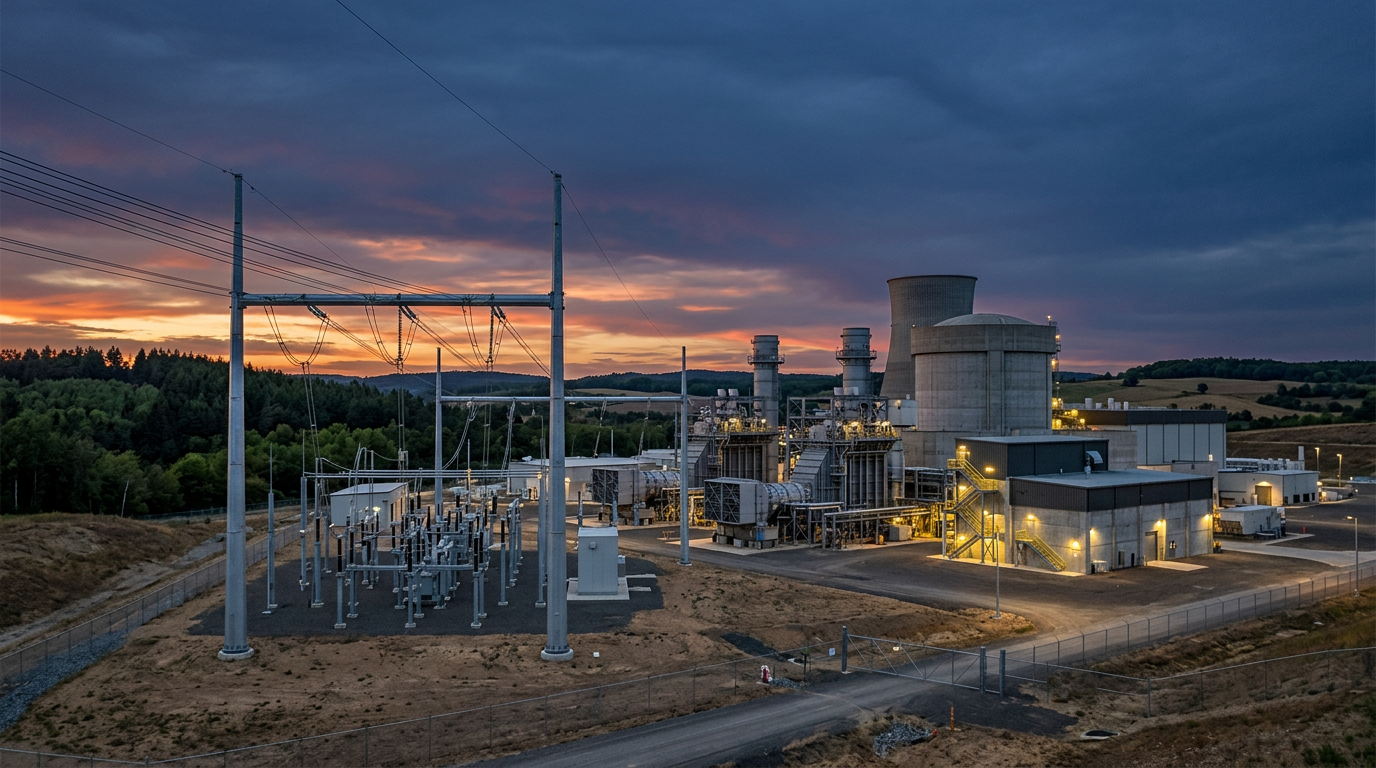
GE Vernova sits at the intersection of the gas turbine capacity needed to fill baseload gaps and the grid infrastructure required to distribute that power. Cameco sits upstream of the nuclear plants that tech companies are now betting on as their primary source of clean, continuous electricity. Both companies have the financial metrics, order visibility, and long-cycle contract structure that institutional capital looks for when building positions in a multi-year industrial cycle.
What’s left is execution risk, rate sensitivity, and the question of whether demand accelerates faster than supply can respond. The numbers suggest it already is.
The preparation happens before the move, not during it.
For informational and educational purposes only. Not investment advice. Trading involves risk, including loss of principal.