
June 12, 2026
Carnival Corporation: The Booking Surge That Wall Street Keeps Underpricing
First a note from InvestorPlace
Editor’s Note: Louis Navellier’s Stock Grader system helped him flag Nvidia before its 82,000% run – and has identified the top S&P 500 stock 12 years running. Today, he’s giving away his #1 AI stock pick for 2026, free. Click here to get the name and ticker or read more below.
Dear Reader,
I want to give you a free stock pick today.
No strings attached. No credit card required. Just the name, ticker, and my full analysis.
Here’s what I can tell you right now:
This company’s sales are up 28% year over year. It holds over 30,000 patents in wireless and video technology. And it just earned an A-rating in my proprietary Stock Grader system.
That’s the same system that helped me flag Nvidia back in 2005 – before its 82,000% run.
In fact, this system has identified the top-performing S&P 500 stock for 12 years running. Over the years, it has cost me $9 million to build and maintain. And right now, it’s flashing its highest possible rating on this AI play.
Click here to see which AI stock my $9 million system is flagging right now, free.
But this pick is just the beginning…
I’ve also identified three more AI stocks my system shows have the same early-stage characteristics as Nvidia did in 2005.
Regards,
Louis Navellier
Senior Investment Analyst, InvestorPlace
P.S. My Stock Grader system has cost $9 million to build and maintain. It helped me flag Nvidia at $1 split-adjusted. Today it’s flashing its highest rating on one AI stock and I’m giving you the name free. Click here before this briefing comes down.
Carnival Corporation: The Booking Surge That Wall Street Keeps Underpricing
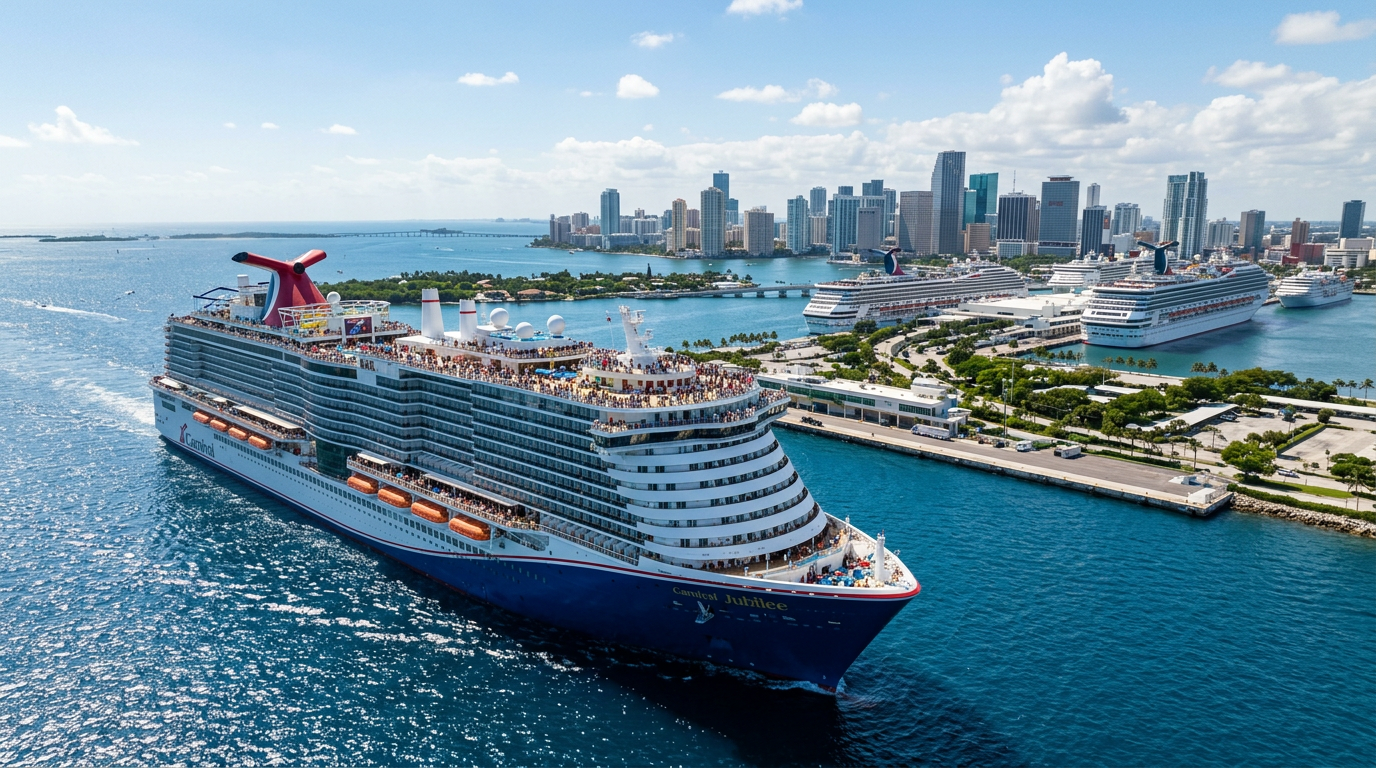
The consumer discretionary trade has been a minefield in 2026. Macro headwinds, sticky pricing pressures, and an uneven spending environment have made it genuinely hard to find businesses that are both growing revenue and expanding margins at the same time. Carnival Corporation ($CCL) is doing both – and the numbers are hard to argue with.
Here’s the short version before we get into the data: cruise demand is not softening. It’s accelerating.
Key Takeaways
- CCL posted record Q1 2026 revenue of $6.2 billion, with gross margin yields up nearly 10% year-over-year and record net yields in constant currency, outperforming analyst guidance.
- Adjusted EPS came in at $0.20 for Q1 2026, up 50% year-over-year, beating consensus estimates by approximately 11%.
- Customer deposits reached nearly $8 billion in Q1 2026, up 10% year-over-year – a new Q1 record that signals the depth of the forward booking curve.
- Bookings for 2026 sailings are up double digits year-over-year, with nearly 85% of inventory already committed at historically high prices in constant currency.
- Full-year 2026 adjusted net income guidance is set at approximately $2.21 per share with $7 billion in EBITDA; adjusted net income is expected to rise roughly 12% over record 2025 levels.
- CCL launched a $2.5 billion share buyback authorization and plans to distribute over $800 million in dividends during 2026, signaling confidence in its free cash flow profile.
- Bank of America data confirmed cruise spending rose across all income groups in the first four months of 2026 – unlike spending on flights and hotels, where lower-income spending declined.
Most $5 Stocks Are Noise. These 5 Are Different
There’s a reason most investors avoid stocks under $5. But not every company at this level fits that stereotype.
These five Nasdaq names are tied to real markets and long-term trends. They are still early, still developing, and not widely followed, which may be exactly why they stand out.
The Macro Context
The broader consumer environment in mid-2026 is pulling in two directions. About 77% of Americans plan to travel this summer, up from 74% a year ago, according to Bank of America’s annual summer travel survey. But nearly 40% of lower-income households say they have no summer travel plans at all. Discretionary spending is clearly bifurcating – and that split matters a great deal when you’re trying to position in the consumer space.
What’s interesting is where cruise lines sit within that picture. Unlike hotel stays or airline tickets, all-inclusive cruise packages offer a bundled cost structure that feels predictable to budget-conscious travelers. That perception is showing up in the data. Lower-income households spent more than 5% more on cruises in the first four months of 2026 compared to the same period a year ago, per BofA credit and debit card data – even as their flight and hotel spending contracted.
Slight tangent, but it matters: the U.S. cruise market is projected to generate over $27.6 billion in revenue in 2026, accounting for roughly 20.5 million travelers out of a record 37.3 million global ocean-going cruise passengers. That’s close to 60% of total worldwide cruise demand coming from a single country. The structural dominance of the American cruise consumer is not a cyclical story – it’s a compounding base that large operators like Carnival are built on top of.
Industry-wide, U.S. cruise booking growth came in at approximately 12% in 2026, with AAA projecting 21.7 million Americans will set sail this year – a 4.5% increase over a 2025 figure that was already beating expectations at 20.7 million passengers. Carnival is not riding a trend. It’s arguably leading it.
The Carnival Numbers – What They Actually Say
Full-year 2025 was already a landmark year for the company. Carnival delivered record revenues of $26.6 billion, up 6.4% from 2024. Full-year net income came in at $2.76 billion, up 44% year-over-year, with a profit margin of 10% compared to 7.7% in the prior year. Adjusted net income hit $3.1 billion, up over 60%. The company also achieved investment-grade-style leverage metrics by year-end 2025, reaching a debt leverage ratio of approximately 3.4x – a significant milestone for an operator that carried substantial pandemic-era debt.
Then Q1 2026 landed and continued the momentum. Revenue came in at $6.2 billion, up roughly 6.1% year-over-year and above analyst forecasts. Net yields increased 2.7% year-over-year in constant currency, over 100 basis points above guidance. Adjusted EBITDA reached $1.3 billion for the quarter. Net income was $275 million, with adjusted EPS of $0.20 beating consensus by approximately 11%.
The part people skip: customer deposits of nearly $8 billion heading into Q1 2026 represent real, locked-in future revenue – not a survey, not a projection. It’s cash sitting on the balance sheet tied to forward sailings. That figure was up 10% year-over-year. And with nearly 85% of 2026 inventory already committed at historically high prices in constant currency, the revenue visibility here is unusually strong for a company of this size operating in a discretionary category.
On the debt side, the deleveraging story has accelerated meaningfully. In Q1 2025, Carnival opportunistically refinanced $5.5 billion of debt, delivering $145 million in annualized interest savings while reducing the debt balance by $0.5 billion. The company then replaced a $3 billion revolving facility with a new $4.5 billion multi-currency revolver in June 2025, and completed multiple unsecured note offerings to retire higher-cost secured debt. This is not cosmetic financial engineering – it’s a structural shift in the company’s cost of capital and credit profile.
By the time Carnival reinstated its quarterly dividend of $0.15 per share in early 2026 and announced a $2.5 billion buyback alongside its Q1 2026 results, the company had effectively signaled that the balance sheet cleanup is largely behind it. Plans call for over $800 million in dividends for the full year 2026. That’s not a distressed operator – that’s a company with free cash flow confidence.
Missed Nvidia’s 44,000%? This is the next big opportunity
In February 2016, Nvidia was trading at $2.51, split-adjusted. The name barely came up in investment circles. But my data had flagged something. A pattern the market hadn’t priced in yet. I sent my readers a single, clear recommendation. And anyone who acted could’ve got in on the biggest investment story of this decade. The company I’ve identified today is in the same position. Same pattern. Same kind of gap. And the window is open right now. I’m revealing it, down to the ticker, in a new free presentation.
Analyst Positioning and Valuation
Wall Street coverage of CCL leans constructive. The consensus price target across 26 analysts sits near $33.30, with the most recent ratings from Loop Capital, Truist Securities, and TD Cowen averaging around $33 – implying roughly 20% upside from recent levels. B of A Securities set a high target of $45 back in January 2026. HSBC upgraded the stock in late March 2026, raising its price target to $30.10 from a prior hold rating. Several firms have lifted estimates citing resilient cruise demand, private island development supporting onboard yields, and improving returns on invested capital.
That said, not every firm is bullish. Some analysts have trimmed targets citing fuel cost headwinds and macroeconomic uncertainty. Full-year 2026 guidance absorbs a $500 million fuel cost headwind, which management has partially offset through operational improvements and pricing. The company guided to net yield growth of approximately 2.75% for the full year and EBITDA of $7 billion. Earnings per share guidance for 2026 is approximately $2.21.
Forward earnings growth is projected at roughly 13.5% annually, with return on equity forecast to reach 23.2% within three years. Those are not speculative numbers. They’re anchored in a business that beat guidance every single quarter in 2025 and raised full-year adjusted net income guidance three consecutive times before year-end.
Technical Framework
CCL has been a technically complex name this year. The stock sold off roughly 4–5% in pre-market following its Q1 2026 beat – an earnings-day reaction that’s become somewhat familiar for large-cap consumer discretionary names posting strong numbers into a risk-off macro environment. That kind of disconnect between fundamental outperformance and short-term price action is worth noting.
Active traders watching this name should keep a close eye on volume behavior around key support and resistance levels. Prior to the Q1 print, the stock had been consolidating in a range following its strong 2025 performance. Key decision zones are typically anchored near the VWAP on high-volume sessions, and momentum traders will be watching for either a reclaim of prior resistance levels or a breakdown through near-term support on elevated volume.
Broader sector context matters too. Royal Caribbean continues to post strong close-in demand with elevated onboard spending, particularly from higher-income travelers, while Norwegian Cruise Line saw bookings jump more than 20% year-over-year in Q3 2025, with that strength extending across all three of its brands. A rising tide for the sector creates a more favorable backdrop for positioning, though individual stock reactions remain tied to macro sentiment and volatility conditions.
Scenario Modeling
Bull Case – Fuel costs stabilize or decline, the consumer spending environment holds through summer peak season, and close-in demand continues outperforming internal forecasts as it has repeatedly done over the past four to six quarters. In this environment, CCL completes its buyback at lower price levels, further improving per-share metrics, and the 2026 EBITDA target of $7 billion is met or exceeded. Analyst price targets migrate higher toward the $38–$45 range cited by more constructive firms. The PROPEL long-term targets – ROIC above 16% and EPS growth over 50% versus 2025 by 2029 – become credible milestones rather than aspirational guidance.
Base Case – The most probable outcome is that CCL executes largely in line with current guidance: $2.21 adjusted EPS for 2026, $7 billion EBITDA, and net yield growth of approximately 2.75%. Forward booking momentum holds, the dividend is sustained, and the deleveraging story continues at a measured pace. The stock likely trades in a range reflecting moderate macro uncertainty, with near-term volatility driven by energy prices and broader discretionary sentiment rather than company-specific fundamentals.
Bear Case – A material deterioration in consumer confidence, a spike in fuel costs beyond the $500 million headwind already absorbed in guidance, or any broad-based pullback in discretionary spending that proves stickier than current data suggests. In this scenario, close-in demand weakens, the forward booking advantage narrows, and the company faces pressure to reduce its return-of-capital commitments. Leverage at $25.3 billion in total debt remains a structural risk in a stress scenario, and short-term liquidity coverage remains a point of watch given $3.7 billion in short-term assets against $12.4 billion in short-term liabilities.
Active Trader Framework
A few things worth watching heading into the next catalyst window. Carnival is scheduled to report Q2 2026 earnings on June 30, 2026. The revenue consensus sits near $6.68 billion. With the company’s consistent history of outperforming guidance – four consecutive beats in 2025 and an 11% EPS beat in Q1 2026 – the fundamental setup into that report is constructive on paper. That doesn’t mean the stock will rally. Execution on the earnings date itself will be shaped by the prevailing macro environment, energy prices, and broader risk appetite.
Risk management matters more here than the directional call. Volatility around earnings events in consumer discretionary has been elevated in 2026. Position sizing ahead of a known catalyst should reflect that. Traders focused on the longer-duration deleveraging and capital return thesis may find more favorable entry points in the weeks surrounding a post-earnings consolidation than in the immediate pre-earnings window.
What’s worth tracking beyond the headline EPS number: customer deposit growth, onboard revenue per passenger trends, and any forward commentary on 2027 booking curves. The latter in particular has been a differentiator – Carnival noted in late 2025 that 2026 booking volumes reached record levels at historical high prices, and any early 2027 commentary on the Q2 call would be a meaningful data point for longer-term positioning.
Investors are watching this fast-growing tech company
No, it’s not Nvidia… It’s Mode Mobile, 2023’s fastest-growing software company according to Deloitte.
Their EarnPhone has helped users earn and save over $1B, driving $115M+ in revenue and an eye-popping 32,481% revenue growth. And having secured partnerships with Walmart and Best Buy, Mode’s not stopping there…
Like Uber turned vehicles into income-generating assets, Mode is turning smartphones into an easy passive income source. The difference is, investors like you still have a chance to invest in Mode’s pre-IPO offering at $0.52/share.
They’ve just been granted the stock ticker $MODE by the Nasdaq and over 59,000 investors participated in their previous rounds.
$71M+ already invested – claim your stake at $0.52/share and earn up to a 20% bonus
Please read the offering circular at invest.modemobile.com. This is a paid advertisement for Mode Mobile’s Regulation A Offering.
The broader takeaway here is fairly straightforward. In a macro environment where most consumer businesses are fighting for revenue stability, Carnival is generating record revenues, compressing debt costs, expanding margins, and returning capital to shareholders – simultaneously. That kind of convergence doesn’t happen often. It doesn’t mean the stock is immune to volatility or that the path is linear. What it does mean is that the fundamental case is cleaner than the headline macro picture suggests, and disciplined traders will find it worth monitoring closely heading into the back half of 2026.
Preparation beats prediction. Know your levels. Manage your risk.
For informational and educational purposes only. Not investment advice. Trading involves risk, including loss of principal.