June 14, 2026
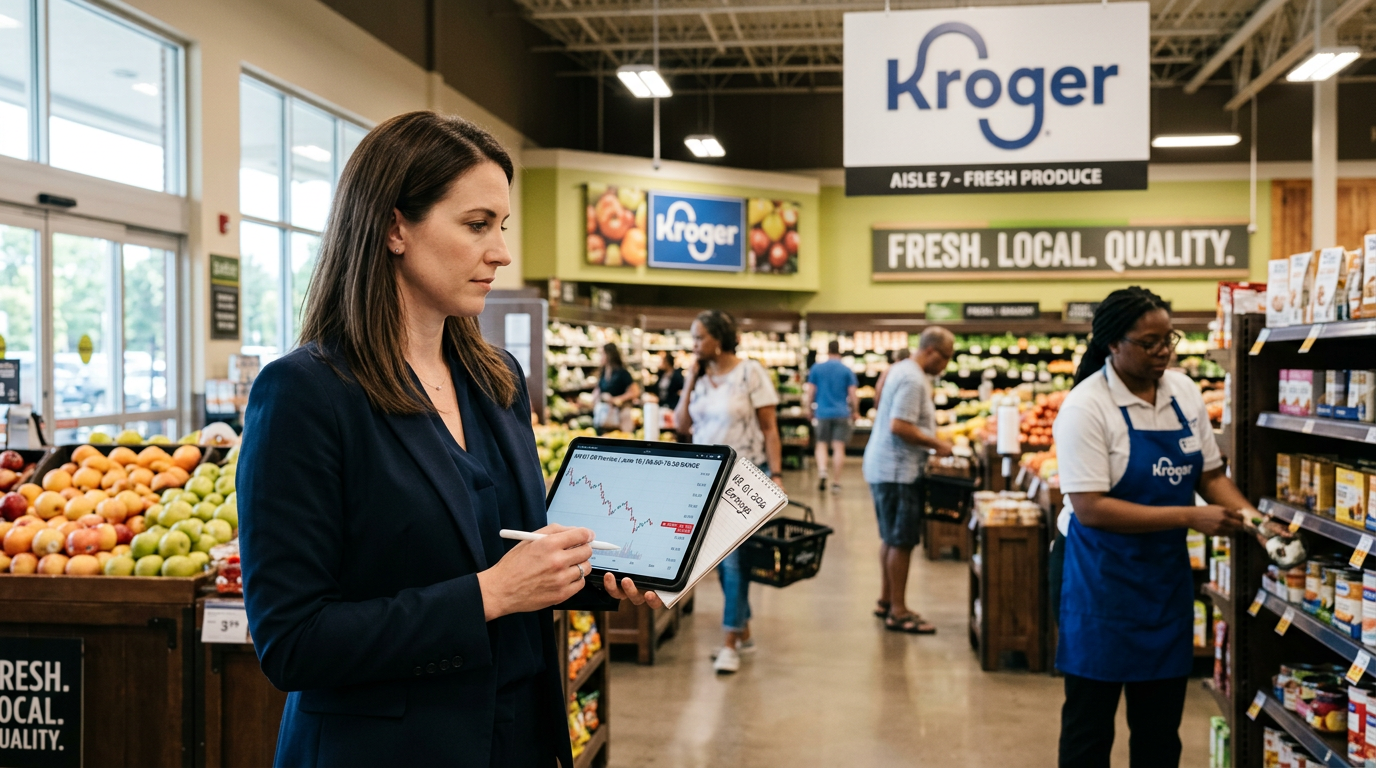
Kroger Reports Thursday Morning
Q1 2026 Earnings Preview | June 18, Before the Bell
KR is sitting right on the edge heading into Thursday. The 52-week range runs from $58.60 to $76.58 — and the stock has spent the last several weeks grinding back toward the lower half of that band after getting crushed from the low $70s down into the low $60s in late May. That’s not noise. That’s a stock under real pressure, and the June 18 print is the first genuine catalyst that could resolve which direction it breaks.
Earnings drop before the open. Conference call starts at 8:00 a.m. ET. Every active trader should have this one flagged the night before.
The Numbers Going In
Wall Street is pricing in EPS of $1.58 for Q1 2026 – that’s a roughly 6% year-over-year increase from the $1.49 adjusted EPS Kroger posted in the same quarter last year. Revenue consensus sits around $45.44 billion, compared to $45.11 billion in Q1 2025. Some estimates are slightly higher; Nasdaq/Finnhub has revenue expectations closer to $46.5 billion, which would imply more meaningful top-line acceleration. The divergence between data sources alone tells you how much uncertainty is baked into this setup.
For 2026 full-year guidance, management has already telegraphed adjusted net EPS of $5.10–$5.30, adjusted FIFO operating profit of $5.0B–$5.2B, and adjusted free cash flow of $2.7B–$2.9B. CapEx guidance runs $3.8B–$4.0B. Identical sales growth excluding fuel is expected at 1.0%–2.0% for the year, with Q1 expected near the low end of that range due to egg deflation headwinds. There’s also roughly $350 million in revenue headwind from the Florida fulfillment center closure, and another $300 million from the Vitacost divestiture. This isn’t a clean quarter on the comp line.
The recent earnings surprise history is actually decent. Last quarter – Q4 fiscal 2025 – Kroger posted $1.28 EPS against an estimate of $1.20, a 6.67% beat. The quarter before that, $1.05 vs. a $1.03–$1.04 consensus. Small beats, but consecutive. That pattern tends to drive pre-earnings institutional positioning. The question is whether the bar has been quietly raised enough that a small beat doesn’t move the needle – or whether guidance language on the pricing strategy becomes the dominant market reaction.
A New Fed Network Is Already Spreading to Banks Nationwide
A new Federal Reserve network called FedNow is already spreading to banks nationwide.
It promises instant payments.
But it could also route transactions through a centralized Fed-run hub.
The Foran Factor — Why This Print Is Different
This is the first full quarterly report under new CEO Greg Foran, who took the role in February 2026. He’s the first outside hire to lead Kroger in its 143-year history, and that matters. Foran previously served as CEO of Walmart U.S. from 2014 to 2019 – credited with the operational turnaround that revitalized that business through store standards, cost discipline, and a ruthless focus on fresh food execution.
Three weeks ago, Foran gave Bloomberg his first major interview since taking the role. The headline: Kroger is planning its biggest price cuts in years across thousands of product categories, funded by direct merchandise importing and technology-driven expense reduction. The reaction was immediate – KR dropped more than 4% in premarket trading on the day the news hit. Markets read price cuts on thin grocery margins the same way every time: margin compression first, volume recovery second. Whether or not that’s the right read on Foran’s actual execution runway is a different question.
What’s interesting is that Walmart – Foran’s former house – has already slashed prices on roughly 7,200 products, a tally that has grown by more than a fifth year-over-year. The competitive pressure is real, not theoretical. Costco, Trader Joe’s, ALDI, and Amazon are all mentioned explicitly in Foran’s competitive framing. Kroger isn’t fighting one battle. It’s fighting five simultaneously on thin operating margins that currently sit around 3.2%–3.3%.
The e-commerce story is a slight counterweight here. Adjusted e-commerce sales grew 20% in Q4, building into a roughly $16 billion business with seven consecutive quarters of double-digit growth. Management has flagged e-commerce profitability expected in 2026 – likely in the first half – with convenience delivery via Instacart, DoorDash, and Uber Eats contributing to over $1.5 billion in incremental sales. That’s a real margin lever if it materializes on schedule. Traders will be listening for any update on that timeline Thursday morning.
Investors are watching this fast growing tech company.
No, it’s not the publicly traded tech giant you might expect… Meet $MODE, the disruptor turning phones into income generators.
Mode’s 32,481% revenue growth ranked them #1 on Deloitte’s list of fastest-growing companies in software. They aim to pioneer “Privatized Universal Basic Income” powered by technology, not government, and their EarnPhone has already helped consumers earn & save $1B+. Their share price is set to change on 5/29 and the opportunity to invest at their current price is limited.
Share price moves today. Last chance to lock in current pricing.
Please read the offering circular at invest.modemobile.com. This is a paid advertisement for Mode Mobile’s Regulation A Offering.
Analyst Positioning and the Sentiment Backdrop
JPMorgan’s Thomas Palmer trimmed his price target to $70 from $72 ahead of this report, holding a Neutral rating. Erste Group downgraded KR to Hold from Buy last week. The broader Street consensus sits at Moderate Buy – but that aggregate masks a lot of hesitation at the individual analyst level. Telsey Advisory Group has a more constructive view, raising their target to $80 on the back of Foran’s credibility as an operator. The bull-to-bear range on price targets is wide: roughly $70 on the cautious end, up to $75–$80 for the optimistic cases.
The insider trading picture is worth noting. Over the past six months, Kroger insiders have made 30 open-market trades – all 30 of them sales, zero purchases. EVP Yael Cosset sold 173,344 shares for approximately $11.9 million. SVP Mary Ellen Adcock sold 103,936 shares for approximately $6.9 million. EVP Christine Wheatley sold 60,000 shares for approximately $4.2 million. That’s not necessarily a bearish signal in isolation – executives sell for lots of reasons – but the complete absence of open-market buying ahead of a major earnings print is a data point worth having in your framework.
Meanwhile, Point72 Asset Management removed 2,391,650 shares – a 52.9% reduction – from their KR position in Q1 2025. Large institutional exits like that don’t unwind in one quarter. The question is whether the Foran appointment and pricing strategy pivot have brought any of that institutional interest back, or whether the positioning is still structurally light.
Technical Structure Into the Print
The setup is defensive, not offensive. KR has broken the floor of its medium-term rising trend channel and is now trading within a broader rectangle formation defined by support near $64.48 and resistance near $75.36. The stock is approaching that lower support band right into earnings – which cuts both ways. A hold and beat could generate a technical squeeze. A miss or a guidance cut blows through support and opens the door to the mid-to-upper $50s.
Key levels traders should be mapping before Thursday’s open:
- Immediate support: $64.48 – the floor of the current range. A close below this level on earnings day is a structurally negative signal.
- Secondary support: ~$61.00 – the recent swing low from late May. This is the line that defines whether this becomes a range break or a full breakdown.
- First resistance: $66.33–$66.60 pivot zone – the area KR needs to reclaim on a beat to signal any real buying conviction.
- Key resistance above: $70.00 – where JPMorgan’s target sits, and where the stock broke down from in March. A post-earnings gap toward this level would represent roughly 8% upside from current price.
- 52-week high resistance: $75.36–$76.58 – only relevant in a strong beat + guidance raise scenario.
Volume context matters here too. Average daily volume runs around 4.8 million shares. An earnings reaction on well-above-average volume, in either direction, is worth treating as a more durable signal than a low-volume drift. Watch the first 30 minutes after the open closely – KR is a stock where the opening gap frequently sets the tone for the full session.
Options traders are currently pricing in an implied move of approximately 6% in either direction around the print. On a $64.71 stock, that’s roughly a $3.88 range – implying a post-earnings settlement somewhere between $60.83 on the downside and $68.59 on the upside at one standard deviation.
Three Scenarios for Thursday
Bull Case – EPS beat + Foran delivers a clear pricing roadmap with margin protection language. If Kroger posts $1.60+ EPS, same-store sales come in at or above the 2.0% end of guidance, and Foran articulates a credible timeline for price investment that doesn’t destroy the 2026 EPS range, this stock has a clear path back toward the $68–$70 zone. That would be a roughly 5–8% move from current levels. The technical trigger is a clean reclaim of the $66.33 pivot level on strong volume. Any confirmation that e-commerce profitability is on track for H1 2026 adds fuel to the move.
Base Case – In-line print, guidance maintained, muted reaction. Kroger posts EPS of $1.56–$1.60, revenue comes in close to $45.4 billion, and same-store sales land at the low end of the 1%–2% range. Foran speaks to the pricing strategy but avoids giving a timeline or specific margin impact. The stock trades up modestly on the beat – maybe 1–2% – but stalls below $66.50 resistance. This is the scenario where the range continues, and the real trade setup comes on the next catalyst. Most likely outcome given the cautious analyst setup.
Bear Case – Miss on same-store sales + forward guidance cut or price investment timeline acceleration. If identical sales come in below 1.0%, Foran announces an accelerated price-cut rollout with a specific dollar commitment that spooks the Street on margins, or if full-year EPS guidance gets trimmed below $5.10, KR breaks $64.48 support and the next meaningful level is the $61 swing low. A close below $61 opens the door to the upper $50s. The fuel headwind – supermarket fuel sales are expected to decline nearly 6% year-over-year – could also be a negative surprise driver if margins there deteriorate faster than modeled. SNAP dependency (approximately 6% of revenue) adds another low-income consumer sensitivity layer that could show up in discretionary mix data.
Trump Drops a Triple Bombshell
According to one ex-Wall Street insider, President Trump is preparing to unleash a stunning, triple-bombshell on Washington.
It’ll send shockwaves across America, the moment it goes live – triggering a $7.5 trillion chain reaction in the markets.
With one little-known corner of stocks erupting by up to 1,000% in 12-24 months.
This isn’t being covered on CNBC.
Active Trader Framework
A few things worth thinking through before Thursday’s open.
First, this is a gap-and-go or gap-and-fade setup, not a slow grind. KR has historically made its earnings day move in the first session and then consolidated. The Q4 2025 report – the 6.67% EPS beat – saw the stock move 9% on the day. That kind of reaction on a grocery staple is outsized, which tells you the positioning into prints has been fairly light. Light positioning means larger reactions, in both directions.
Second, the options-implied move of ~6% gives you a framework for strike selection if you’re trading around the event via options. Anything inside the $60.83–$68.59 range is essentially “priced in” by the market. To have a positive expected value on a directional options trade, you’d need to have a view that the actual move exceeds what’s already embedded in premium. Given the consecutive beats and a new CEO catalyst, that’s not an unreasonable thesis – but it’s a thesis, not a certainty.
Third – and this one gets skipped a lot – the conference call matters as much as the headline number. Foran’s first earnings call as CEO will set the narrative tone for the stock for the next two quarters. How he frames the price investment strategy, what language he uses around margins, and whether he sounds operationally confident or hedged will drive the post-open continuation trade. Read the transcript. Don’t just trade the gap.
Risk management is straightforward in this setup. If you’re long into the print, $64.48 is the hard stop level. Below that, the thesis is broken. If you’re looking for a post-earnings long on a beat, wait for the $66.33 level to confirm as support – chasing the gap open without that confirmation is a low-probability entry. And if the stock breaks $61.00 on heavy volume post-earnings, that’s not a buy-the-dip setup. That’s a range break that needs time to resolve.
The Kroger print on Thursday is more than a grocery earnings release. It’s the first real test of whether Greg Foran’s turnaround thesis holds under Wall Street scrutiny. The numbers matter. The language matters more. Preparation beats prediction every single time – know your levels, define your risk before the bell rings, and let the price action confirm the narrative rather than the other way around.
For informational and educational purposes only. Not investment advice. Trading involves risk, including loss of principal.