
June 18, 2026
Carvana Is Invading the $655 Billion New-Car Market. The Trade Is Not Obvious.
CVNA just made its seventh dealer acquisition — and the stock is down sharply from its 2026 high. Here’s what the math and the chart actually say.
Most people still think of Carvana as a used-car platform. That’s already the wrong frame. The more interesting question for traders in June 2026 is whether CVNA is in the early innings of something structurally bigger — and whether the current price reflects that, or ignores it entirely.
Trump Drops a Triple Bombshell
According to one ex-Wall Street insider, President Trump is preparing to unleash a stunning, triple-bombshell on Washington.
It’ll send shockwaves across America, the moment it goes live – triggering a $7.5 trillion chain reaction in the markets.
With one little-known corner of stocks erupting by up to 1,000% in 12-24 months.
This isn’t being covered on CNBC.
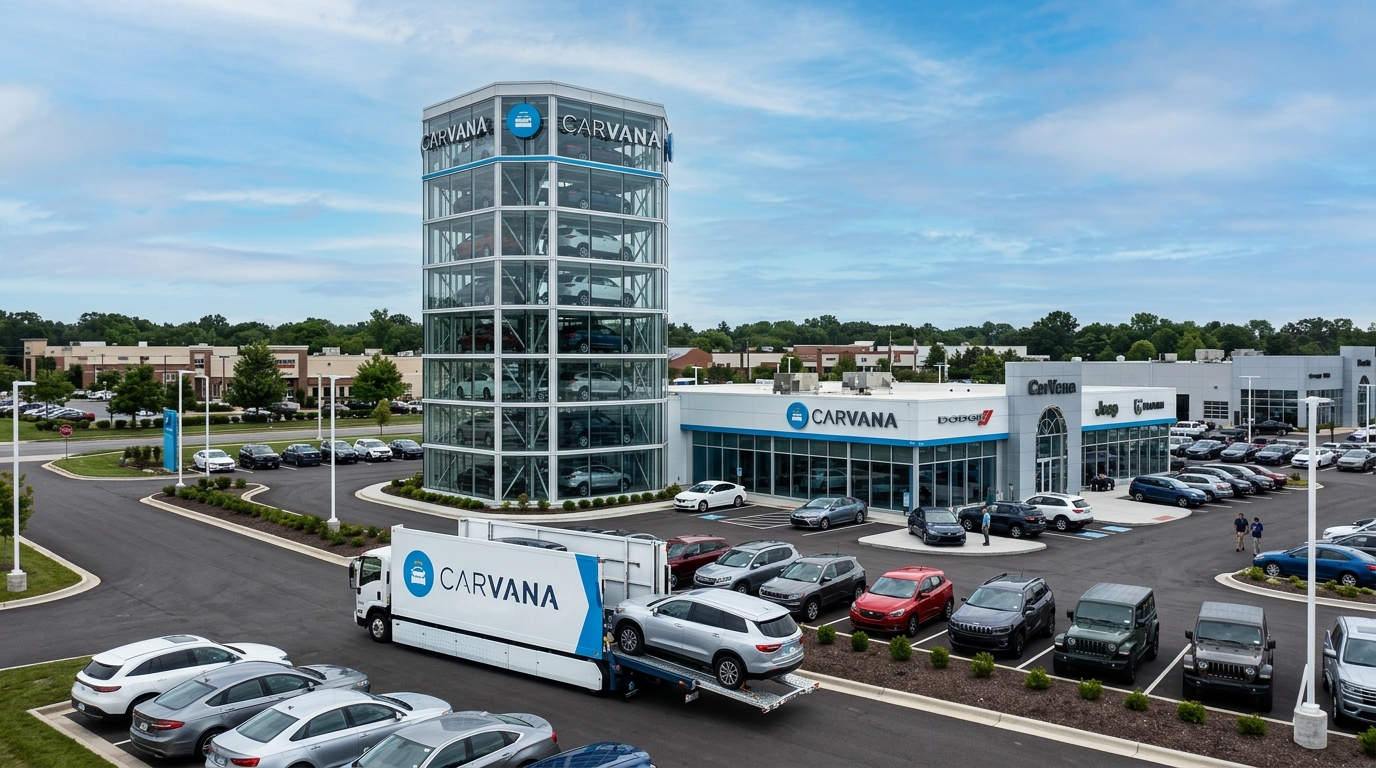
Here’s where things stand. Carvana has been quietly acquiring franchised dealerships since 2025 — seven Stellantis stores selling Chrysler, Dodge, Jeep, and Ram vehicles. The company has spent more than $160 million on these acquisitions, according to its regulatory filings and press reporting. And the early results are hard to ignore.
The Casa Grande Number Is the Story
One dealership. One month. More than 700 new vehicles sold. Before Carvana took over that Casa Grande, Arizona location, it was selling far fewer units monthly. Carvana walked in with its digital-first, no-haggle model and the store became the top-selling Chrysler, Jeep, Ram, and Dodge dealership in the United States.
That’s not a rounding error. It’s a proof of concept.
The mechanism isn’t complicated. Carvana applied the same model that disrupted used-car retail — online browsing, fixed pricing, remote purchase, home delivery — to new-vehicle sales. But specific customer transaction details (price paid, shipping cost, and city) have not been independently verified in credible reporting, so they shouldn’t be treated as established facts.
Industry commentary has characterized this push as meaningful and potentially disruptive for dealership retail. The $655 billion new-car market figure refers to the U.S. new cars market value in 2024, and the franchise model has dominated U.S. auto retail for decades. Carvana entering it at scale — with technology infrastructure incumbents didn’t build for direct-to-consumer, remote delivery at national scale — is genuinely different from prior challengers.
The Q1 2026 Numbers Already Support the Thesis
Before getting to the new-car expansion angle, the core business is worth anchoring on. In Q1 2026, Carvana sold 187,393 retail units, a 40% increase year over year. Revenue hit $6.432 billion, up 52% from Q1 2025. Net income came in at $405 million. Adjusted EBITDA was $672 million. EPS was $1.69.
Management guided for sequential increases in both retail units and adjusted EBITDA in Q2, projecting all-time company records on both metrics. That guidance was issued with the Q1 results on April 29, 2026. The next earnings date can vary by source and should be treated as unconfirmed until the company announces it.
For context on the scale of the business: Carvana’s 2025 10-K confirms that, during 2025, the company acquired five franchise dealerships for total purchase consideration of $160 million. But claims about 2025 full-year revenue, full-year earnings, and year-over-year percentage changes in those figures in this article were not verified from primary filings here and should not be stated as precise facts without citation.
So Why Is the Stock Down?
That’s the part traders need to sit with. CVNA’s 52-week high is about $97.38 (January 23, 2026), and recent quotes in early June 2026 were in the mid-$60s. That is a far larger decline than the “down 27% from a $486 high” framing in this draft, and the $486 price level is not consistent with the stock’s verified 2026/52-week trading range.
CarMax reported results in mid-April 2026 for its quarter ended February 28, 2026, and investors focused on margin compression in used vehicles (including lower retail used vehicle gross profit per unit). That margin discussion can weigh on sentiment for used-vehicle retailers broadly, including Carvana.
Specific valuation claims in this draft (for example: a recent CVNA price of $360–$370, consensus 2026 EPS of $8.56 revised from $7.17, and a 42–43x forward P/E) do not match the verified price levels in June 2026 and were not verified from a consensus-estimates source here. They should be removed rather than treated as settled math.
The Expansion Math and What It Opens Up
What the new-car move actually unlocks is underappreciated. Franchise dealerships can give Carvana access to: trade-ins that can feed the used inventory pipeline; service and parts operations; and participation in manufacturer programs and inventory channels that are typically structured around franchised dealers. The strategic logic is real even if the magnitude is still early.
That last point matters more than it sounds. One of Carvana’s highest-margin activities is reconditioning and reselling vehicles. Getting earlier access to trade-ins from new-car buyers — at scale — could become a structural inventory advantage relative to pure used-car competitors that lack franchise rights.
The backlash from the legacy dealer network is already real. Stellantis has implemented a policy limiting dealer groups to one acquisition per year, and industry reporting has tied that move to broader dealer frustration — with Carvana’s rapid accumulation of Stellantis stores as a key backdrop. However, the draft’s claim about a specific “February closed-door meeting” where discussions “ended abruptly” was not verified and should not be presented as fact.
Technical Picture
CVNA’s chart is complicated right now. The stock peaked in late January 2026 (around $97) and, by early June 2026, was trading materially lower. The precise moving-average levels, “death cross” timing, RSI readings, and short-term support/resistance levels in this draft were not verified against a specific chart/quote snapshot as of June 18, 2026 and should not be presented as precise facts without a cited data source.
Key Levels
- Support: Not verified in this draft (depends on the exact June 18, 2026 price and chart settings)
- Resistance: Not verified in this draft (depends on the exact June 18, 2026 price and chart settings)
- 52-week range context: Approximately $97.38 (high) and materially below that for the recent low within the 52-week window, per widely published price-history data
Three Scenarios
Bull Case: Q2 earnings confirm management’s guidance — sequential increases that set new records on units and adjusted EBITDA. New-car channel adds measurable revenue contribution. The stock regains key technical levels and re-rates as the market begins pricing the franchise expansion at scale. Specific price targets and “analyst consensus target” levels are not included here because they were not verified.
Base Case: Business continues executing well, but valuation and margin uncertainty cap upside. The CarMax margin read-through remains a headwind even if units beat.
Bear Case: Margin deterioration in Q2 — whether from used-vehicle economics, logistics cost pressure, or franchise ramp costs — triggers an earnings miss or a weaker outlook. The stock makes new lows and forces the “new-car story” to shift from a near-term trade to a longer-dated narrative.
The Framework for Active Traders
CVNA is a high-beta situation. Recent third-party datasets put CVNA’s 60-month beta around the mid-3s (about 3.45). Position sizing relative to your account volatility tolerance is the only framework that matters here before anything else.
The business is genuinely pushing into a market measured in the hundreds of billions of dollars. The Q1 results were real. The franchise expansion appears to be working in the locations where it’s been deployed. But the stock’s verified 2026 peak was in the high-$90s, not the high-$400s, and it has spent the intervening months giving a lot of that move back.
What matters next is the Q2 print date once confirmed by the company. That’s when the next set of data hits — and if management’s guidance for sequential records on units and EBITDA is confirmed, the stock has a credible path to recover. If margins disappoint or the CarMax read-through proves accurate, the technicals could still point lower before stabilizing.
The new-car story is real and long-term interesting. But long-term interesting and near-term tradeable are two different things. Know which one you’re positioning for before you size in.
For informational and educational purposes only. Not investment advice. Trading involves risk, including loss of principal.