June 20, 2026
Bigger Than OpenAI and SpaceX Combined
Featured: Small Caps Are Having Their Best Year in Two Decades
Editor’s Note: Marc Chaikin made one of Wall Street’s most popular indicators… found on every Bloomberg and Reuters terminal in the world. Now he’s pounding the table on Silicon Valley’s most popular startup, a breakthrough AI lab that recently surged 80X in a single quarter. Click here for the full details, or read below to learn more…
Dear Reader,
This AI lab planned for 10X growth in 2026.
Instead, its revenue soared 80-fold in one quarter.
In fact, it’s on track to outsell OpenAI and SpaceX put together.
And – to top it all off – it’s on the verge of achieving its first profitable quarter – a milestone it didn’t expect to celebrate until 2028.
This company didn’t exist a few years ago. Now it’s the front-runner in the AI race.
I’ve been investing for 60 years, and I’ve never seen a growth story like this.
Last week, this red-hot startup finally filed to go public. It’s expected to make its big debut this fall.
But on October 6, I believe it’s going to make an announcement that could make its already enormous $965 billion valuation climb sharply higher.
Leaked source code refer to this plan as Project Tengu, and I expect it to spark a 42-fold investment boom – not to mention a $500 trillion wealth transfer.
Nvidia CEO Jensen Huang calls this technology “incredible.”
And a senior Google engineer said it recreated a year’s worth of work in one hour.
When I showed one of my colleagues a short, 30-second demonstration of Tengu, it left her stunned.
She said, “This makes ChatGPT look like a simple parlor trick.”
I believe Tengu could turn this startup into the most valuable company in the world by the end of the decade.
Best part?
You don’t have to wait until its IPO to get a piece of the action.
I’ve discovered a $40 “backdoor” into this company that anyone with an internet connection can take advantage of.
Click here for the full details (must read before October 6).
Regards,
Marc Chaikin
Founder, Chaikin Analytics
P.S. U.S. businesses are now adopting this firm’s software at a faster rate than OpenAI. In fact, it’s become a trusted AI powerhouse for over 300,000 companies worldwide. But this is just the beginning. Click here to find out what I anticipate for October 6.
FEATURED
Small Caps Are Having Their Best Year in Two Decades
For most of the past decade, owning small caps felt like a consolation prize. Year after year, the Magnificent 7 vacuumed up capital, index returns were increasingly driven by a handful of trillion-dollar companies, and the argument for small caps was a historical footnote that never quite paid off in practice.
2026 is different. And the numbers are starting to get hard to ignore.
The Numbers
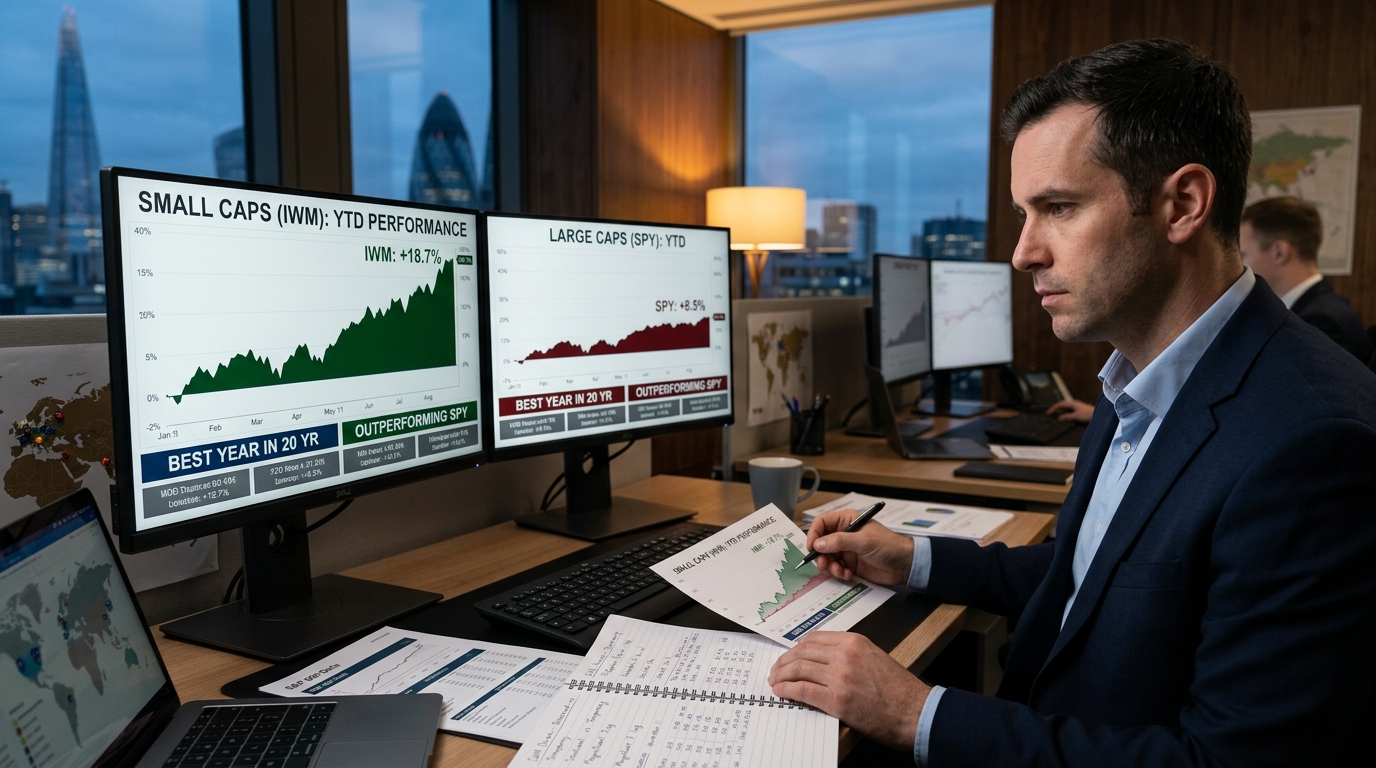
U.S. small-cap stocks are off to their strongest relative start to a year in more than two decades. As of mid-June, the iShares Russell 2000 ETF (IWM) is up roughly 19% year-to-date, outperforming the SPDR S&P 500 ETF Trust (SPY) – which is up approximately 9% over the same period – by around 10 percentage points. The Russell 2000 itself recently traded near 2,944, with the index posting a gain of 0.76% in a single session as investors continued rotating toward smaller companies.
The last time small caps led by this kind of margin at this point in the calendar year, the dot-com bubble was still unwinding. That comparison is not made lightly.
Jim Rickards Predicts: Trump’s Next Big Buy
This tiny $2 stock holds the exclusive rights to the largest gold reserve in the country.
And it has the potential to be the biggest fortune maker in Trump’s second term.
According to Jim Rickards…
Trump is about to take a direct stake in this $2 stock.
And if you’d like to learn how to stake your claim in this asset before President Trump and his administration make a move…
You need to act before June 30.
Click here to see Jim’s big prediction: “Trump’s Next Big Buy.”
What Is Actually Driving This
Three things converged. Not one. Not two. Three.
First, the One Big Beautiful Bill Act. Signed in mid-2025, the OBBBA’s most powerful provisions kicked in January 1, 2026. It made permanent the 21% corporate tax rate and restored immediate R&D expensing. It also moved the business interest deduction cap to an EBITDA-based calculation, which disproportionately benefits smaller, more leveraged companies. Bank of America estimates the consumer stimulus component alone could deliver $135 to $140 billion into the economy, translating to more than $1,000 per household during tax season. Small companies with domestic revenue concentration benefit from that more directly than any global mega-cap.
Second, the rate cycle. The Federal Reserve cut rates by a total of 75 basis points in the latter part of 2025, and the federal funds rate has held at 3.50% to 3.75% through the first four FOMC meetings of 2026. Small caps carry significantly more floating-rate debt than their large-cap counterparts – nearly 40% of Russell 2000 constituents carry floating-rate exposure – so the move lower in borrowing costs has flowed directly to balance sheets. The benefit compounds. That said, the June 17 FOMC meeting introduced a new wrinkle: new Fed Chair Kevin Warsh held rates steady, but the updated dot plot now signals that a rate hike may be on the table later this year. Nine of 18 officials projected at least one increase by year-end, and markets are currently pricing in a 25-basis-point hike as early as October. That changes the calculus. The floating-rate tailwind that helped launch this rally could reverse if inflation stays elevated and the Fed acts. Worth watching closely.
Third, the valuation gap. After years of mega-cap dominance, the gap between small-cap and large-cap valuations entered 2026 at a 30-year extreme. The Russell 2000 was trading at a forward price-to-earnings ratio of roughly 16x to 18x while the S&P 500 hovered near 23x to 26x – a discount of over 30%. IWM’s trailing P/E currently sits around 20x versus roughly 26x for SPY. That kind of discount doesn’t persist forever, and the compression has been one of the cleaner parts of this story.
They’re calling it the ‘Freedom-Dividend’
Tech titans like Elon Musk, Sam Altman, and Mark Zuckerberg are calling for Universal Basic Income as AI threatens to eliminate millions of jobs.
But there’s a critical question few are asking: Who will pay for it?
Instead of relying on taxpayer funding, Mode Mobile is using attention as currency, already paying out $1B to their users. Deloitte crowned them North America’s fastest-growing software company in 2023 after their revenue soared 32,481%.
And investors have a window to get in early before this becomes the template for post-AI income redistribution.
They’ve secured their Nasdaq ticker $MODE, and their $0.50/share pre-IPO offering may not be open much longer.
Earn up to 20% bonus shares by investing in Mode now.
Please read the offering circular at invest.modemobile.com. This is a paid advertisement for Mode Mobile’s Regulation A Offering.
The Part That Is Still Being Underestimated
Here is where it gets interesting. Most investors who have noticed the small-cap move are treating it like a tactical rotation. Buy IWM, wait for mean reversion, rotate back to tech. That framing probably misses the duration of what is unfolding.
Bloomberg’s bottom-up consensus as of early 2026 projects the Russell 2000 will deliver approximately 43% year-over-year earnings growth over the next twelve months. The S&P 500’s equivalent figure: roughly 11%. That is not a small gap. It reflects a structural catch-up after an earnings downturn that ran through 2023 and into 2024, now powered by the combined effect of lower borrowing costs, OBBBA-driven tax relief, and domestic revenue insulation. Small-cap companies in the Russell 2000 generate an estimated 70% to 80% of their revenue inside the United States, which has become a direct structural advantage as tariff policy reshapes global trade flows and currency headwinds pressure internationally exposed mega-caps.
There is also a structural tailwind from the reconstitution. The June 2026 Russell reconstitution – the first under a new semi-annual schedule – officially hits after the market close on June 26. Preliminary data from FTSE Russell shows that 43 existing Russell 2000 constituents are graduating to the Russell 1000, the most prominent of which is Bloom Energy, which grew well beyond the large-cap breakpoint. That graduation dynamic tends to precede sustained institutional buying as large-cap index funds are forced to add the name. Meanwhile, the total market cap of the Russell 2000 grew from $2.7 trillion at the 2025 reconstitution to $3.5 trillion in 2026 – a 30% jump that reflects genuine wealth creation at the smaller end of the market, not just index reshuffling.
The market is broadening. That is different from rotating.
What Could Go Wrong
Be honest with yourself here. Small caps experience drawdowns roughly 40% deeper than large caps during corrections. The Fed risk is now more live than it was six months ago. If inflation stays sticky – the Fed’s own June projections raised the 2026 headline inflation outlook to 3.6% and the core outlook to 3.3%, well above target – a rate hike would hit floating-rate borrowers disproportionately hard. Geopolitical shocks, a slowing consumer, and any meaningful GDP miss would hit the Russell 2000 harder and faster than the S&P 500.
The risk is not that the thesis is wrong. It is that conditions can shift quickly, and the margin for error in small caps is thinner than it looks from the outside.
There is also a crowding risk building. Large-cap growth funds that spent five years overweight in tech are now being forced to chase the rotation late. When they buy in size, they can drive valuations temporarily above fair value. That creates a whipsaw risk for anyone entering at the wrong moment.
Executive Order 14178 Could Make Early Investors a Fortune
Three days into his term, Trump signed a sweeping executive order to “reboot” the dollar. Now his plan is finally coming to fruition. And his old friend, Elon Musk, is leading the charge. Within weeks, America could have a new currency and life as we know it will never be the same.
The Actionable Part
Simply buying IWM captures the trend, but the variance within the Russell 2000 is wide. The rotation rewards selectivity. Characteristics worth screening for right now: domestic revenue concentration, exposure to infrastructure or defense sectors with OBBBA contract tailwinds, regional banking or Main Street consumer exposure, and balance sheets that were able to refinance floating-rate debt to fixed in 2024 or early 2025 before the rate pause set in.
Regional banks are worth a specific mention. Citizens Financial Group (CFG) reported Q1 2026 earnings per share of $1.13, a 47% year-over-year increase, alongside 24 basis points of net interest margin expansion. The bank is targeting more than 5% positive operating leverage for the full year, and analysts at JPMorgan and Citi have raised price targets in recent weeks. That is not a one-company story. It reflects a sector that has been in the penalty box for years and is now seeing credit quality stabilize, margins widen, and loan demand return.
Slight tangent, but it matters: the Russell reconstitution this year is the first under a new semi-annual schedule rather than the traditional annual rebalance. That doubles the operational workload for fund managers and creates more frequent forced-flow events. For active traders, that means more predictable windows where passive rebalancing creates price dislocations worth tracking.
The reconstitution closes on June 26. Passive flows are already moving. Most traders watching the S&P 500 for their market cues are looking at the wrong index right now.
The opportunity is not invisible. It is just not where most people are paying attention.
For informational and educational purposes only. Not investment advice. Trading involves risk, including loss of principal.