June 26, 2026
Bayer’s Best Day in 23 Years
Featured: This Pre IPO is Up 40X Already
First a note from Immersed
This Pre-IPO Stock is Up 4,000% Already
How do you follow 4,000% valuation growth? By preparing for an IPO.
That’s what Immersed did, reserving the NASDAQ ticker $IMRS. And the real opportunity for investors is now, before public markets do.
Why? Immersed changed the game in AR/VR, developing the Meta Quest store’s most popular productivity app. More than 1.5M people, including Fortune 500 teams, already use it up to 60 hours a week.
But that’s not all. Immersed’s soon-to-be-released Visor headset has 2M more pixels than Apple’s Vision Pro, for 70% less money, and with 70% less weight. No wonder they’re projecting $71M in first-year sales.
Here’s how they’re redefining the $250B+ future of work:
Breakthrough Platform: Immersed built the first full-stack remote productivity system, combining immersive AR/VR software, an AI assistant that works alongside you, and its own lightweight Visor headset to replace the traditional desktop.
Massive Momentum: Immersed is preparing to ship Visor, its first productivity-focused headset, with 75,000+ already on the waitlist. Meanwhile, its AI assistant, Curator, is rolling out new features to deepen user engagement and adoption.
Opportunity: You can join 6,000+ pre-IPO investors who have already secured pre-IPO shares in Immersed’s growth.
They have partnerships in place with Qualcomm and Samsung. Executives and founders from Intel, Reddit, and Sailpoint are shareholders. You can be, too. But there’s no time to waste.
FEATURED
Bayer’s Best Day in 23 Years
One ruling. Twenty-three years of waiting for a day like this.
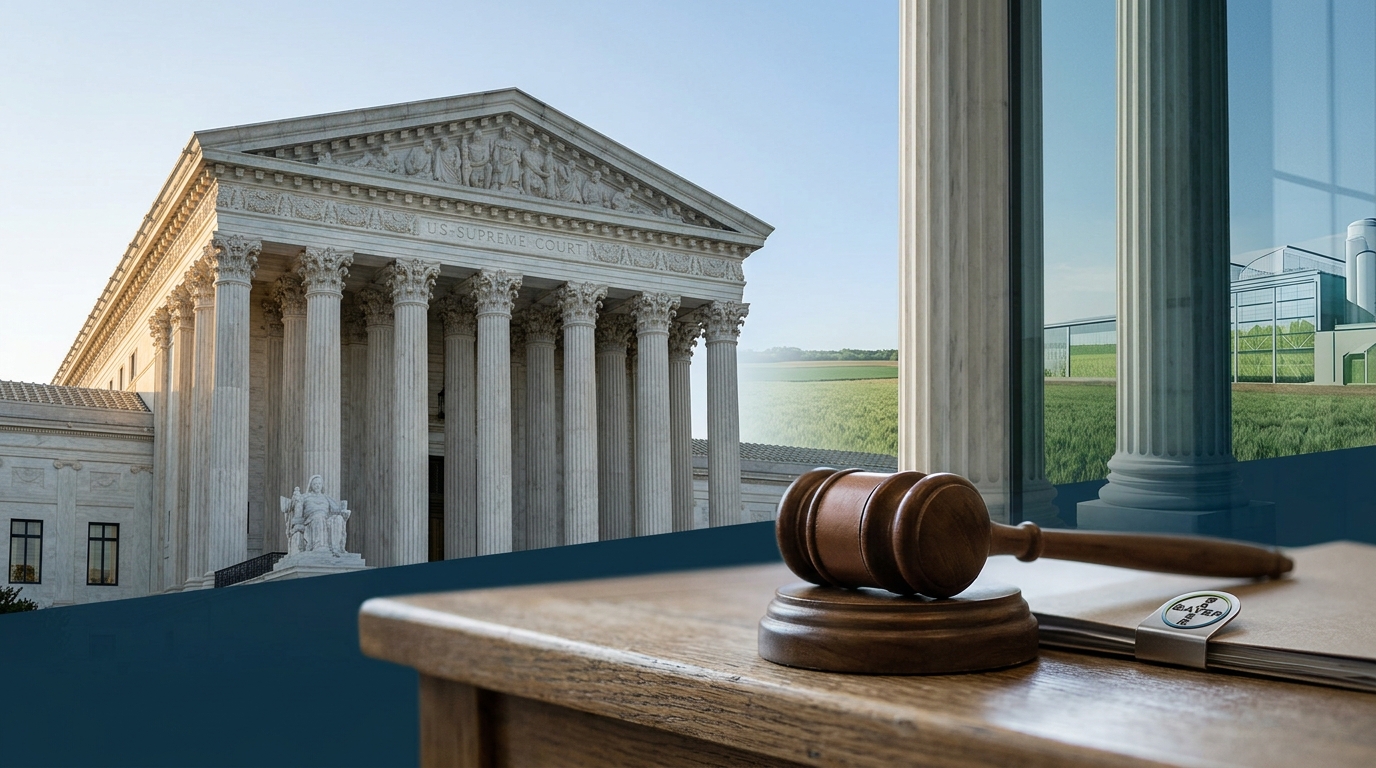
On June 25, 2026, the U.S. Supreme Court handed Bayer AG its most consequential legal victory in a generation. In a 7-2 decision in Monsanto v. Durnell, the court ruled that federal pesticide law preempts state-level failure-to-warn claims tied to Roundup. Consumers cannot sue Bayer for the absence of a cancer warning on its herbicide labels when the EPA has already cleared that label as adequate. Justice Ketanji Brown Jackson, joined by Neil Gorsuch, dissented.
The market reaction was immediate. Bayer shares surged 17.3% at the close in Frankfurt, touching 20% intraday before trading was briefly halted for volatility. The largest single-day gain since March 2003. The stock had already staged a roughly 40% rebound across 2025 before this move, but that rally was grinding and uncertain, built on hope. This was different. This was resolution.
Here’s what actually happened underneath the headline.
Bayer inherited this mess when it acquired Roundup manufacturer Monsanto for $63 billion in 2018. The litigation that followed — tens of thousands of lawsuits alleging that glyphosate caused non-Hodgkin lymphoma — has cost the company more than $10 billion and crushed the stock for years. CEO Bill Anderson has overseen the elimination of approximately 14,000 positions as part of a restructuring targeting roughly 2 billion euros in annual savings, all while trying to stabilize a business that the legal cloud made nearly impossible to value clearly.
The Energy Shock Is Here
Energy shocks don’t stay contained – they spread through the entire economy. As a market technician, I’ve studied these cycles for decades, and they always lead to monetary response – and currency pressure.
That cloud just got a lot thinner.
Justice Brett Kavanaugh, writing for the majority, held that the Federal Insecticide, Fungicide and Rodenticide Act demands uniform pesticide labels, and that state tort claims requiring a cancer warning go beyond what federal law permits. The ruling is expected to result in the dismissal of current warning-based claims and to bar future failure-to-warn lawsuits entirely. Bayer has also been pursuing a parallel $7.25 billion class-action settlement covering current and future glyphosate claims, and the company says it will continue to seek final court approval for that settlement — a financial floor that defines what remaining liability actually looks like.
Slight tangent, but it matters: the ruling’s reach extends well beyond Bayer. Legal analysts noted that the precedent could affect the medical-device, cosmetic, and food industries — any sector governed by federal regulatory approval frameworks where state tort law has historically created a patchwork of conflicting standards. This is a structural shift in how litigation risk gets assessed across U.S. industrials and consumer products companies. Most portfolios haven’t thought through that second-order effect yet.
The Valuation Before Today Was Already Interesting
Before the surge, Bayer’s trailing P/E sat around 8x — a steep discount to the European pharma sector. The company confirmed its full-year 2026 outlook in its Q1 earnings report on May 12: currency-adjusted sales of 45 to 47 billion euros, EBITDA before special items of 9.6 to 10.1 billion euros (currency-adjusted). Translating for current exchange rates, reported sales guidance sits at 44.5 to 46.5 billion euros and EBITDA at 9.4 to 9.9 billion euros. Core earnings per share are guided at 4.10 to 4.60 euros. Across 19 analysts tracked by Investing.com, the average 12-month price target is 49.47 euros, with a high of 60 euros and a low of 30 euros. The overall consensus rating is Buy.
The pipeline is the part most investors kept ignoring while the legal headlines dominated.
This IPO Could Make SpaceX Look Small (Read before October 6)
A red-hot AI startup just filed to go public — and it’s already valued at nearly $1 trillion. Wall Street legend Marc Chaikin believes a single announcement on June 16 could send that number far higher. He’s found a backdoor way in before the IPO.
- Asundexian: Bayer’s investigational Factor XIa inhibitor for secondary stroke prevention. Phase III OCEANIC-STROKE data, reported in November 2025, met its primary efficacy and safety endpoints — asundexian significantly reduced the risk of ischemic stroke vs. placebo with no increase in major bleeding risk. The FDA has granted it priority review. This is the intended successor to Xarelto, which is now facing patent expirations and generic pressure.
- Lynkuet: Bayer’s entry into non-hormonal menopause management — a high-unmet-need segment historically dominated by hormone therapies. Cited as one of five key pharma growth catalysts by management.
- Nubeqa and Kerendia: Both continued to post significant year-over-year growth in Q1 2026, with Nubeqa expanding across all regions. These are the current earnings drivers propping up pharmaceutical revenues as Xarelto winds down.
- Crop Science recovery: Volume recovery in the agriculture business has been flagged as a separate re-rating catalyst alongside litigation resolution. Corn Seed and Traits posted strong Q1 growth.
The bear case was always the litigation. Free cash flow is guided to be deeply negative in 2026 — between minus 1.5 billion and minus 2.5 billion euros for the full year — driven by roughly 5 billion euros in expected litigation-related payments. Net financial debt stood at 32.5 billion euros as of Q1 2026. And while the ruling blocks failure-to-warn claims, it does not end all Roundup-related litigation categories entirely. The $7.25 billion class-action settlement still needs final court approval, though it now moves through a dramatically cleaner legal environment.
What Happens From Here
The proposed settlement still needs final court approval — and a hearing was already scheduled. That process now moves forward with the core legal theory behind the bulk of Roundup lawsuits already off the table. The settlement framework, combined with the preemption ruling, effectively caps the worst-case scenario on Roundup liability in a way that wasn’t possible 48 hours ago.
The more interesting question is whether this triggers a full re-rating toward European pharma sector multiples. Even at a conservative 11 to 12x forward earnings — still well below the sector average — the math gets interesting fast. Bayer’s underlying pharmaceutical and agriculture businesses are large, globally diversified operations. They were just buried under a legal overhang that made valuation almost impossible to anchor.
That overhang is now materially smaller.
There is still real risk here. Net debt at 32.5 billion euros is heavy. Free cash flow stays negative through 2026 due to settlement outflows. Asundexian needs regulatory approval to deliver on its promise, and Xarelto’s erosion from generic competition is accelerating. The ruling blocks failure-to-warn claims specifically — not every possible litigation category tied to Roundup.
But this is a different company than it was 48 hours ago. The decade-long legal shadow that made serious institutional ownership essentially impossible just became something analysts can actually model, bound, and assess. Whether the full re-rating happens now or over the next 12 months — that is the question worth sitting with.
For informational and educational purposes only. Not investment advice. Trading involves risk, including loss of principal.