June 28, 2026
META Is Down 10% Since Q1 Earnings
Featured: META Is Down 10% Since Q1 Earnings
Editor’s Note: In 2016, our friend Louis Navellier recommended Nvidia at $2.51 – split-adjusted. It went up 44,000%. He also called Apple before a 36,000% rise and Microsoft before a 60,800% climb. Now he says a new AI device coming online in Tennessee is the setup for the biggest call of his career. He’s agreed to reveal the stock at the center of it – down to the ticker – for free.
Dear Reader,
In 2016, I sent my readers a simple recommendation.
Buy Nvidia… at $2.51, split-adjusted.
What happened next is now Wall Street legend.
Nvidia went up 44,000%.
The investors who acted made life-changing money.
Those who didn’t have been watching from the sidelines ever since.
I’m writing today because I believe history is setting up to rhyme.
Right now, behind a razor-wire fence in the mountains of Tennessee…
At the same secretive government lab that built the atom bomb in 1945…
American scientists are completing work on a new AI computer called “Golden Dawn.”
Golden Dawn will be 283 trillion times more powerful than today’s leading data centers.
It will span more than 700 miles – larger than the state of Texas.
And it will accelerate AI breakthroughs by 36,000% – turning a five-year timeline into five days.
When it launches, it will instantly leapfrog every AI model on earth: ChatGPT, Gemini, Grok.
And it will trigger what I’m calling a $100 trillion reset of the AI markets.
I’ve identified one company – still relatively unknown, just as Nvidia was in 2016 – that I believe is best positioned for what’s coming.
I’m revealing it, down to the ticker, in a new free presentation.
This is the biggest prediction of my 40-year career.
But you must act now.
Click here to watch it now, free of charge.
Regards,
Louis Navellier
Senior Quantitative Investment Analyst, InvestorPlace
P.S. My readers who got into Nvidia at $2.51 – split adjusted – didn’t need another winner. They were set. I believe “Golden Dawn” is a similar setup – a little-known company, a massive technological shift, and a narrow window to act before the crowd catches on. Go here for the full details, including the ticker.
FEATURED
META Is Down 10% Since Q1 Earnings
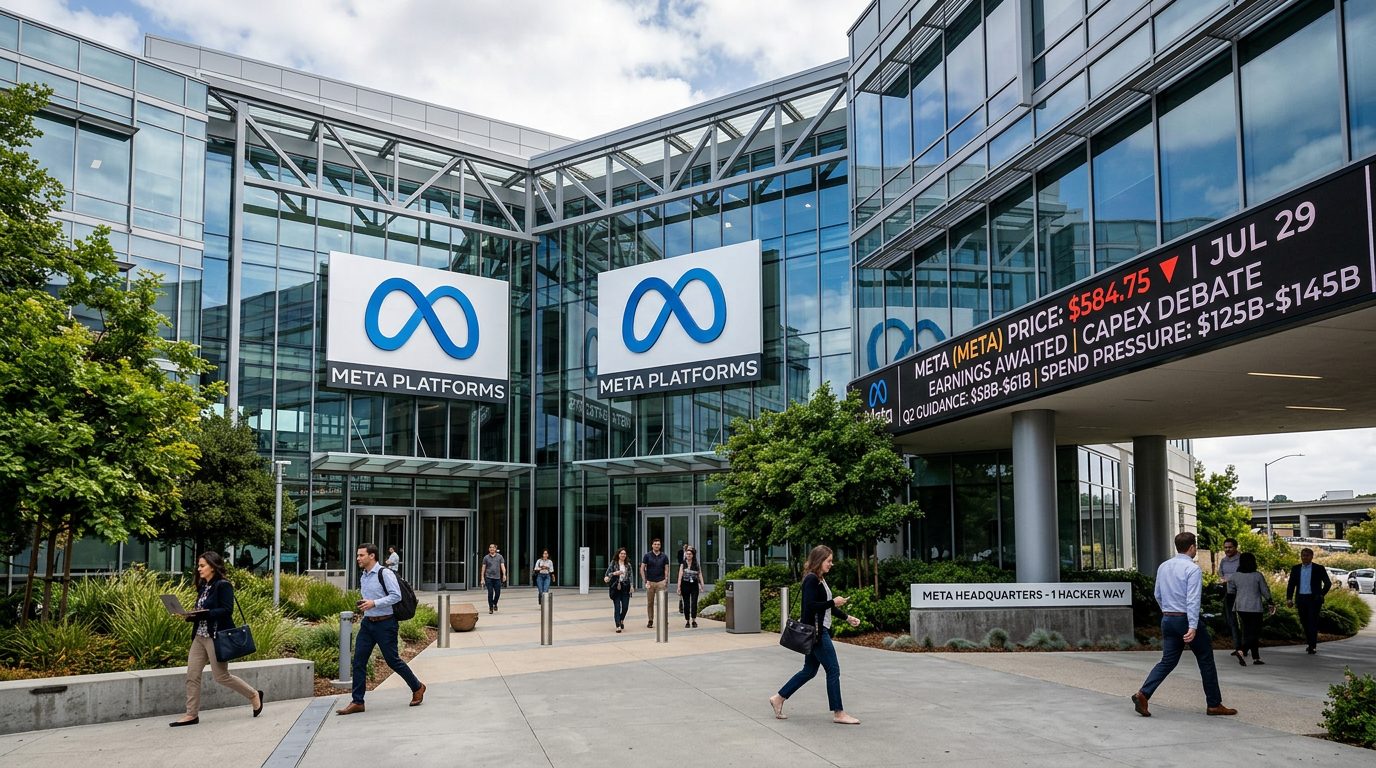
Meta Platforms has done something unusual. It beat Q1 estimates by a wide margin and the stock still sold off hard the next morning. It has drifted lower since. The stock is now sitting around $551, a roughly 10% drop from the April 30 close of $611.34 in the immediate aftermath of the earnings report.
That reaction tells you what the market is actually debating here. Not whether Meta can grow. It clearly can. The question is whether $125 billion to $145 billion in annual capex is justified, and whether the return on that investment shows up in the income statement before investors lose patience.
What Q1 Actually Said
Q1 2026 revenue came in at $56.31 billion, up 33% year over year — the fastest growth rate since 2021. Ad impressions across the family of apps rose 19% over the prior year. Price per ad rose 12%. Total operating income hit $22.9 billion at a 41% operating margin. Free cash flow came in at $12.39 billion, down from $13.7 billion in Q1 2025, as heavy infrastructure spending absorbed cash. The core business is not struggling.
One thing worth flagging on the headline EPS number. The reported figure of $10.44 per share included an $8.03 billion one-time tax benefit tied to updated U.S. Treasury guidance on R&D capitalization. Strip that out and adjusted EPS was closer to $7.31 — still a solid beat against the $6.82 consensus, but not the blowout the headline implied. The market picked up on that distinction quickly.
What rattled investors more was the updated capex outlook. Meta raised its 2026 capital expenditure guidance to $125-$145 billion, up from the prior $115-$135 billion range. Management cited higher component pricing and incremental data center costs. Then came the disclosure: a $107 billion step-up in contractual commitments in a single quarter. That number is hard to brush past.
Your 82% Discount For Life-Changing Dividends
Time is running out on our 4th of July special! For just $9 – an 82% discount – you could set yourself up for massive dividends as high as 140% – no options trade involved, just buying and holding ETFs. Don’t miss out on boosting your income with this limited-time deal.
The Q2 2026 guidance range is $58-$61 billion in revenue, assuming roughly a 2% FX tailwind. The Street consensus EPS estimate for Q2 currently sits at $7.32. The report is confirmed for July 29 after the close.
The Capex Debate Is the Real Trade
Here is where a simple bearish read starts to break down. The core ad business is large enough to absorb a major R&D and Reality Labs drag without structurally damaging equity value. And the AI ad infrastructure is already producing measurable returns: price per ad up 12%, impressions up 19%. These are not theoretical future payoffs. They are showing up in the current income statement.
What the market is actually pricing is founder-CEO execution risk at an unprecedented capital deployment scale. Zuckerberg has committed to a level of spending that now rivals the annual revenue of many S&P 500 companies. If Q2 shows further acceleration in ad revenue growth and holds the operating margin near Q1’s 41%, that concern weakens considerably. If ad growth decelerates or the margin slips, the bear case gets louder.
Slight tangent, but it matters: Meta also announced roughly 8,000 job cuts alongside the capex raise, framing the workforce reduction as a way to offset rising infrastructure costs. That combination — massive capex increase plus headcount reduction — signals management is trying to hold the margin line even as it scales spending aggressively. Watch whether that holds in Q2.
Engagement Numbers and What They Mean
Daily active people across Meta’s family of apps stood at 3.56 billion in Q1, up 4% year over year from 3.43 billion in Q1 2025. There was a sequential dip from Q4, partly attributed to internet disruptions in Iran and WhatsApp access restrictions in Russia. Specific, verifiable causes — not a platform health story.
Q2 revenue guidance of $58-$61 billion, if achieved at the high end, would represent approximately 29-31% year-over-year growth. The midpoint of $59.5 billion already came in above where Wall Street was modeling before the print.
Technical Structure Heading Into July
META has spent the past month trading in a range of roughly $540-$643. The stock is currently below its 50-day moving average, with MACD having turned negative in early June. The Momentum Indicator also crossed below zero in mid-June. These are not signals that suggest a trend reversal is imminent — they suggest the stock is in a digestion phase ahead of a known catalyst.
The 52-week range is $520.26 to $796.25. At roughly $551, the stock is trading near the lower end of that range, about 6% above its 52-week low. The 52-week average sits around $669. That gap between current price and average represents a significant dislocation relative to where the fundamentals actually stand.
Support in the $540-$542 zone is the floor traders are watching. A break below that would likely accelerate selling toward the $520 low. On the upside, $610-$615 is the first meaningful resistance zone — the level the stock needs to reclaim to suggest the post-earnings slide has reversed.
The Playbook Every Options Trader Should Have!
Do you dream of retirement but it seems like an impossibility? Wish you knew the best moves to get you there sooner?
It’s closer than you think and you won’t have to work overtime to get it!
Hi! I’m Dave Aquino, expert options trader and my e-book, “How To Master the Retirement Trade” has helped thousands reach their goals!
Follow the link to get your copy and see what you’ve been missing!
Options Market Structure
With earnings confirmed for July 29, implied volatility on near-term options has been elevated relative to the stock’s trailing range. Historically, META has moved less post-earnings than what the options market prices in — that mismatch has historically favored premium-selling approaches for experienced traders who size positions accordingly. The 52-week IV high sits near 49%. Current implied volatility is tracking materially below that. There is room for IV compression through the late-July event if Q2 results normalize market anxiety around the capex story.
Three Scenarios for July 29
Bull Case: Q2 revenue comes in at or above $60 billion. Operating margin holds near 41%. Management holds full-year capex guidance at $125-$145 billion without another raise. Q3 guidance comes in above Street consensus. In this scenario, the stock has a credible path back toward $610-$650 quickly. The argument that the AI infrastructure is already monetizing becomes much harder to dismiss.
Base Case: Q2 revenue lands near the midpoint of guidance around $59-$60 billion. Margins hold roughly flat. No further capex raise. Q3 guide is in line. Stock recovers modestly toward $580-$600 but the capex overhang keeps a ceiling on the multiple. Analysts — 72 of whom currently cover META with an average price target around $835 — maintain their outlooks with modest adjustments.
Bear Case: A third consecutive capex raise above $145 billion. Revenue near the low end of guidance. Margin compression. Q3 guide disappoints. In this scenario, the $520 52-week low gets tested. The argument that Zuckerberg is prioritizing AI moonshots over near-term shareholder returns becomes the dominant framing heading into the back half of 2026.
Trade Framework
For traders expecting Q2 revenue at or above the midpoint of guidance with stable margins: A defined-risk bull call spread in the $590-$640 range for the August expiration targets a post-earnings recovery toward the prior resistance zone. The stock has already traded as high as $643 in the past month. A clean beat could recover that level.
For traders expecting another capex raise or margin deterioration: A bear put spread below $540, targeting the $520-$505 zone, defines the downside scenario without unlimited exposure. The 52-week low is $520.26 and another negative capex surprise could test or breach it.
For neutral positioning: An iron condor structure around the expected move range exploits the historical tendency for META to underdeliver on options-implied moves. Size appropriately. Defined wings are not optional here — the binary nature of earnings events demands it.
What to Watch on July 29
Three things determine the post-earnings direction. First, whether Q2 ad revenue growth holds strong — that is where the AI infrastructure investment proves it is already paying off. Second, whether management raises or holds full-year capex guidance again. A third consecutive raise above $145 billion would almost certainly trigger a selloff regardless of the headline beat. Third, whether the Q3 revenue guide comes in above current Street consensus models.
The stock is cheaper than it was six months ago. The business is growing faster than nearly anything in the mega-cap universe. Full-year 2026 revenue is forecast by analysts at roughly $253 billion, with consensus EPS around $32. At $551 per share, that is a P/E ratio near 20x on a business compounding revenue at 33% annually.
The question is not whether Meta is building something real. It is whether $145 billion a year is a fortress being constructed or a bet being placed. Late July gives you the next piece of that answer.
For informational and educational purposes only. Not investment advice. Trading involves risk, including loss of principal.