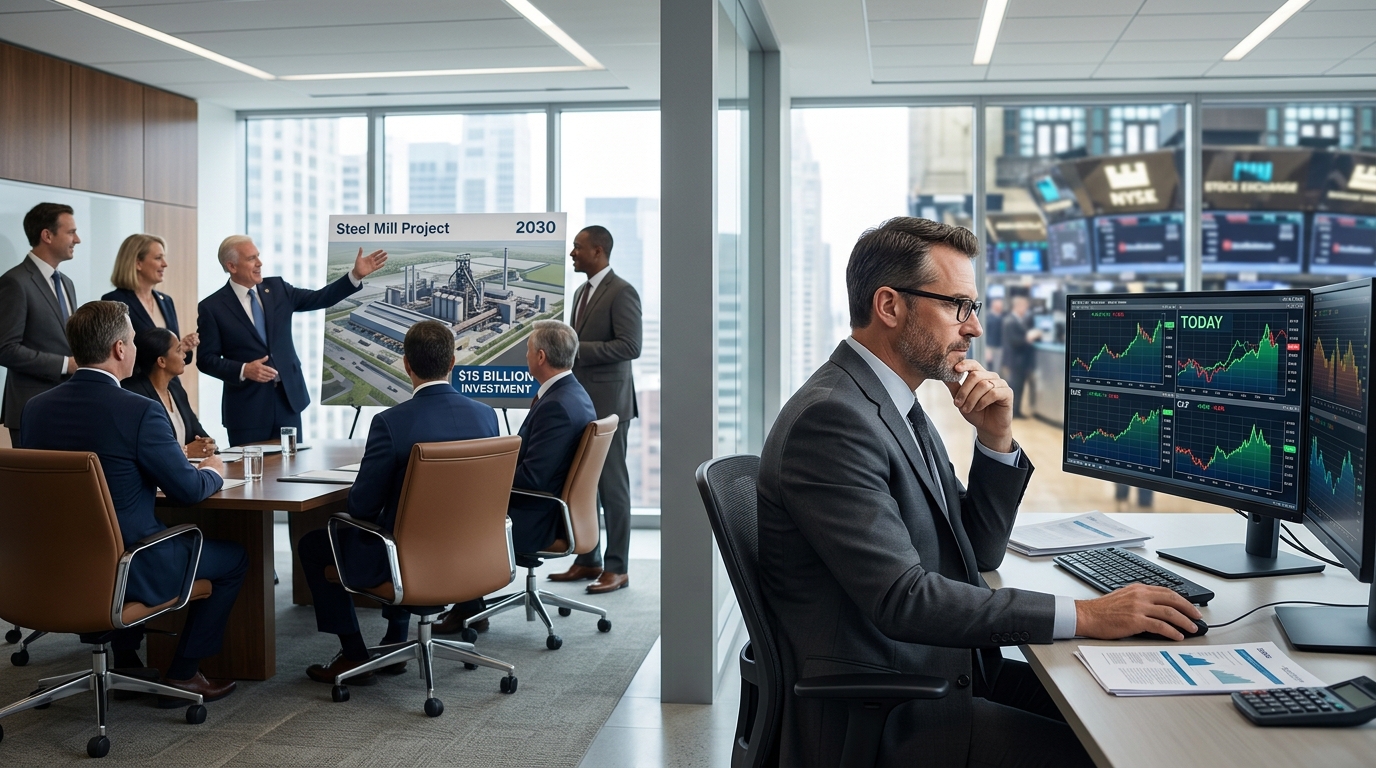
Monday’s Oval Office announcement had every element of a market-moving event: President Trump at the center, Commerce Secretary Howard Lutnick flanking him, Iowa’s congressional delegation present, and a headline number that commands attention. $15 billion. One of the largest steel plants in American history. Mesabi Metallics, the Minnesota-based company owned by India’s Essar Group, intends to build a steel complex in eastern Iowa capable of producing 7.5 million tons per year in its first phase and ramping to about 10 million tons annually at full scale.
The number that actually matters sits quietly beneath the headline: 2030. That is the earliest date Mesabi Metallics has pointed to for first production. Years of permitting, construction, and commissioning stand between yesterday’s ceremony and a single ton of Iowa steel.
- $15 billion total investment; described by the White House as one of the largest steel plants in American history
- Phase-one capacity: 7.5 million tons per year; full-scale target: about 10 million tons annually
- Production start date: 2030, per White House and company statements
- Projected permanent jobs: 1,750; construction jobs: up to 6,000
- Nucor (NUE) and Steel Dynamics (STLD) both down about 2% on Monday
- Cleveland-Cliffs (CLF) fell about 9% Monday, with tariff sensitivity around its Canadian Stelco unit cited in market commentary
- Hot-rolled coil is trading around $1,200 per short ton, with Steel Market Update’s September readings in the low $1,200s
History Argues for Scrutiny
The project’s own track record demands a longer discount rate on that 2030 target. Mesabi’s Minnesota iron ore mine, a roughly $2.5 billion investment, is only now reaching first production in late 2026 after nearly two decades of starts and stops. The Iowa mill is meaningfully more complex in scope. Essar Steel Minnesota, the project’s predecessor entity, filed for bankruptcy in 2016 after years of missed deadlines. Announced timelines from this ownership group have a documented habit of extending.
The Foxconn parallel is instructive. In Trump’s first term, a celebrated $10 billion Wisconsin factory groundbreaking produced a renegotiated deal in April 2021 at $672 million, with promised jobs cut from 13,000 to 1,454. Reshoring ceremonies and delivered capacity are distinct assets.
Where the Actual Trade Lives
None of this diminishes what is happening inside the established producers right now. Nucor guided Q3 earnings between $5.55 and $5.65 per diluted share, up from $5.04 in Q2, and Steel Dynamics guided Q3 EPS to $5.34 to $5.38, up sharply from $3.69 in the prior quarter. Steel Dynamics posted record steel shipments of 3.7 million tons in Q2 2026, with net sales of $6.1 billion. Both companies are operating in a pricing regime that has pushed domestic hot-rolled coil into the low $1,200s per short ton.
Beyond tariffs, both Nucor and Steel Dynamics carry structural exposure to data-center construction, one of the more durable sources of U.S. industrial steel demand currently. That demand driver exists regardless of any Iowa groundbreaking date.
Cleveland-Cliffs presents a distinct risk profile. CLF sank about 9% Monday while Nucor declined about 2%, a gap driven in part by cross-border tariff sensitivity through its Canadian Stelco unit. That specific liability does not burden the domestic mini-mills in the same way.
Scenario Framework
Bull Case: Tariff policy holds or tightens through 2027, hot-rolled coil sustains above $1,100 per short ton, and data-center construction accelerates steel demand. NUE and STLD extend year-to-date gains; CLF closes its performance gap as Stelco risk is repriced. Mesabi’s Iowa announcement reinforces long-term capacity confidence without creating near-term supply overhang.
Base Case: Tariff levels remain broadly stable, Q3 earnings from Steel Dynamics (reporting October 19) and Nucor (timed around late October) confirm guidance, and sector valuations consolidate around current levels. The Iowa announcement is a sentiment positive with no operational consequence before 2030.
Bear Case: A U.S.-Canada trade resolution reduces tariff protection for domestic producers. CLF’s Stelco exposure amplifies any selloff. Mesabi’s Iowa timeline slips further, removing a long-term confidence signal from the sector thesis entirely. Hot-rolled coil retreats toward $900 per short ton as import pressure returns.
Active Trader Framework
The mini-mills, specifically NUE and STLD, are the investable steel thesis today. Both report earnings within the next month; those results will confirm or challenge the Q3 guidance. Watch steel shipment volumes and metal margin guidance for Q4 directional signals. For CLF, the Stelco tariff sensitivity is the variable to monitor, not the Iowa announcement. Key technical level for the sector: the XME ETF’s response to any trade-policy headline out of Washington between now and November 3.
The Iowa mill is a legitimate long-horizon reason to remain constructive on domestic steel capacity. It is not a catalyst for positions held this week. Tariff policy, Q3 earnings, and hot-rolled coil pricing are. Position sizing and stop disciplines should be calibrated to those variables, not to a groundbreaking four years away.