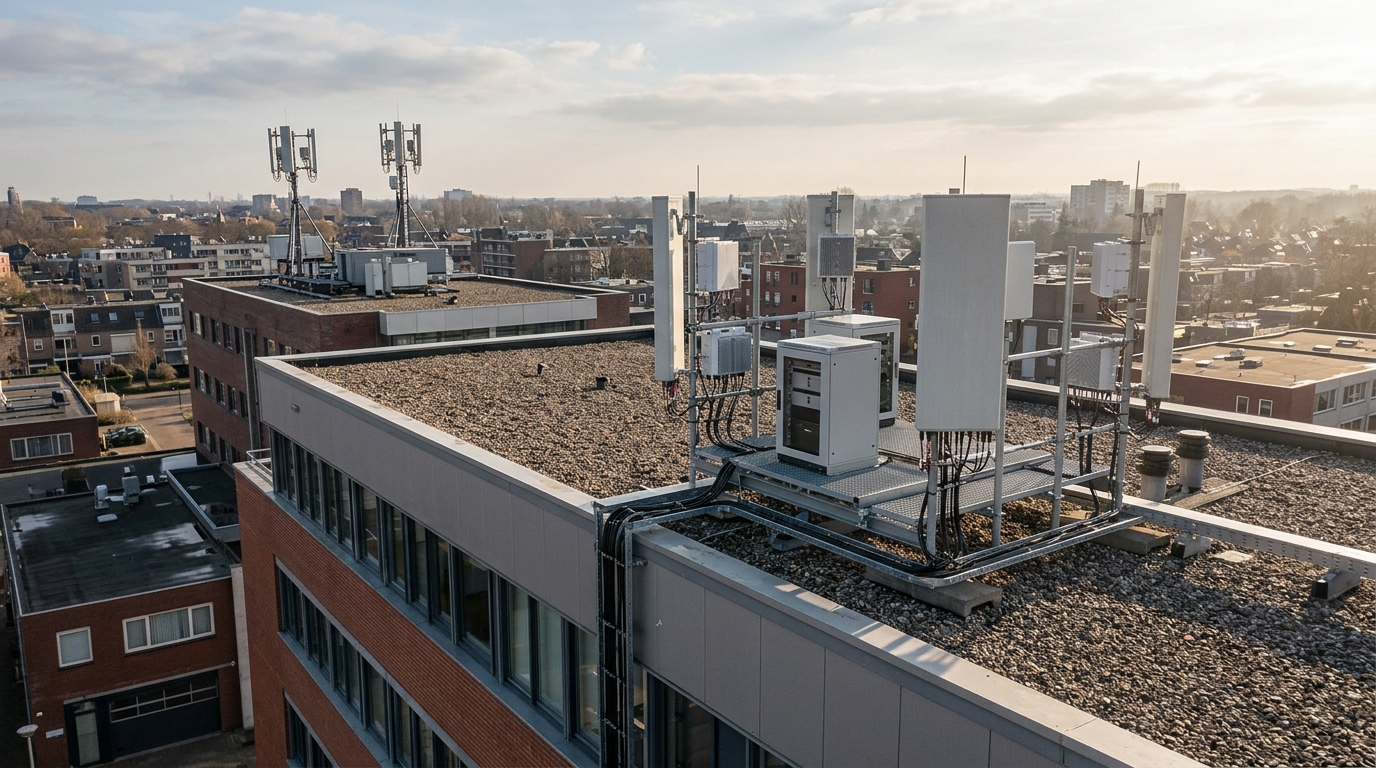
For two decades, a cell tower was a steel pole collecting rent. That business model still works. What is changing, rapidly, is what gets bolted to the tower beside the antenna.
The Market Behind the Move
Multi-access edge computing (MEC) is no longer a whitepaper concept. Recent market-research estimates vary widely, but most point to a fast-growth curve through the end of the decade. The economics driving that curve are straightforward: routing data from a factory floor or autonomous vehicle back to a centralized cloud and waiting for a response takes tens of milliseconds. Processing it closer to the device can cut that materially, but performance depends on radio conditions, backhaul, distance and application design.
Who Is Committing Capital
The carrier positioning is already diverging. Industry analysis published by RCR Wireless in April 2026 estimated that if T-Mobile were to retrofit roughly 13,000 rooftop cell sites with AI-RAN servers, the cumulative cost could reach about $3.7 billion over time, including deployment and supporting infrastructure. AT&T’s widely cited “$8 billion” figure refers to the next phase of FirstNet investments (over 10 years), rather than a standalone commercial edge-computing budget.
The disagreement between carriers is itself tradeable information. Verizon’s CTO Santiago “Yago” Tenorio has publicly expressed skepticism that GPUs currently deliver a cost-justified performance boost for RAN workloads, saying at Mobile World Congress that AI-RAN “doesn’t make sense” economically today. That cost discipline gap is where the execution risk sits for investors betting on edge as a near-term revenue line.
Tower REITs Are the Sleeper Play
The more structurally interesting position may not be the carriers at all. American Tower did open its first edge data center in Raleigh, North Carolina, but the ribbon-cutting was in May 2025, not May 2026. AMT trades near $164, with Q3 results due late October. The company has discussed targeting roughly 200 to 300 basis points of tower cash EBITDA margin expansion by 2030.
SBA Communications (SBAC) is running a parallel experiment. On its Q2 2026 earnings call, management said roughly half of its U.S. portfolio would be well suited for the types of edge uses it’s discussing, including disaggregated architectures for AI-oriented applications.
Scenario Modeling
- Bull Case: AI inference demand forces carriers to sign multi-year edge compute leases at tower sites. Tower REITs add a third revenue stream alongside antenna and power leases. AMT re-rates above $200 as data center revenue mix rises through 2027.
- Base Case: Edge pilots remain pilots through mid-2027. AMT and SBAC capture incremental revenue, but the contribution stays below 5% of total property revenue. Carriers fund GPU deployments from existing capex without accelerating tower lease amendments.
- Bear Case: Hyperscalers build their own distributed edge nodes, bypassing tower real estate entirely. High upfront investment requirements and unclear short-term ROI slow adoption, particularly among smaller telecoms. Tower companies are left holding pilot costs with no material lease-up.
Active Trader Framework
AMT’s Q3 earnings in late October is the nearest hard catalyst. Watch data center segment revenue against the $1.175 billion to $1.195 billion full-year 2026 property-revenue guidance range and listen for any language around edge compute contract signings. SBAC’s 80% tower cash flow margins leave room to absorb pilot costs without hitting the income statement materially, making the position lower-risk but also slower-moving. T-Mobile’s AI-RAN capex commitment, if it accelerates, would be the event most likely to force AT&T and Verizon to respond with their own tower compute deals, compressing the strategic window for fence-sitters. Monitor the $3.7 billion deployment pace as the leading indicator.