Blane Markham here, with an alert!
If you still haven’t saved your copy of “How To Turn $100 Options Into $1,000 Gains”…
… do it right now before the download link expires.
We’ll be moving this book behind a paywall in the near future so grab it now while you still can.
You’ll thank me.
FREE: How To Turn $100 Options Into $1,000 Gains
To your success,
Blane Markham
Markham Trading Team
Reminder:
Grab your copy of How To Turn $100 Options Into $1,000 Gains before we move it behind a paywall.
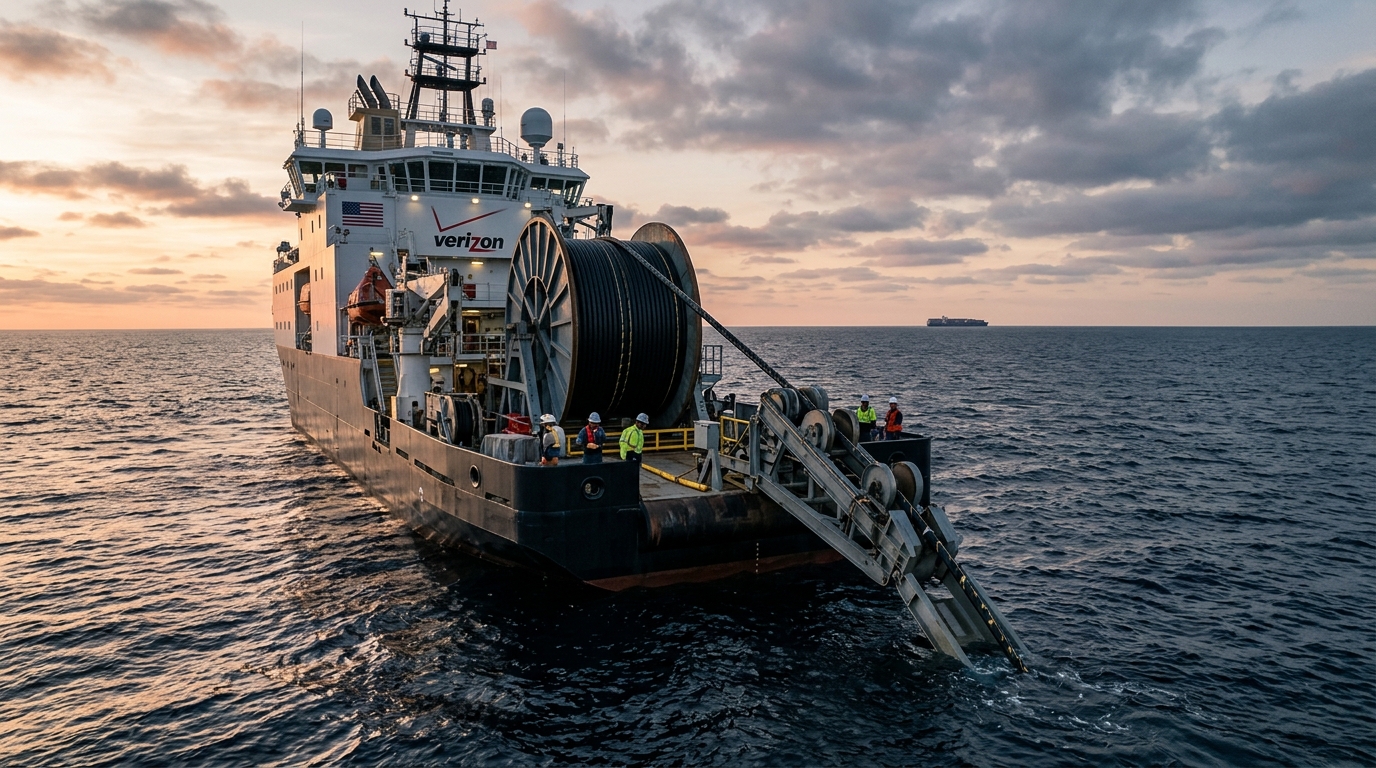
Verizon Fiber Is Becoming a Key AI Backbone
The world’s intercontinental internet does not run through satellites. Over 99% of all intercontinental internet traffic travels through submarine fiber-optic cables spanning well over 1 million kilometers beneath the world’s oceans. That glass, laid over decades by telecom consortia, is now the most contested infrastructure asset in the AI era, and Verizon sits at the center of that reconfiguration.
- Verizon CEO Dan Schulman confirmed a dark fiber agreement with Google worth more than $1 billion, intended to connect Google data centers and support the transport demands of AI workloads.
- Schulman said these agreements are expected to be worth multiple billions of dollars in revenue over the next several years.
- Hyperscale cloud companies are estimated to command about 71% of total lit capacity worldwide, generating about 84% of trans-Atlantic and 78% of trans-Pacific capacity demand.
- TeleGeography has estimated subsea cable investment will exceed about $13 billion between 2025 and 2027, roughly double the level of investment in 2022 to 2024.
- VZ trades at only 9.49x forward non-GAAP earnings, nearly 28% below the sector median of 13.16x.
- Verizon is set to announce Q3 2026 results on October 26. Consensus estimates cited in many market calendars currently point to revenue of about $34.77 billion and EPS of about $1.27.
The Structural Shift in Subsea Power
The old consortium model is breaking down. AWS, Microsoft, Google, and Meta are increasingly choosing to own subsea cables outright, and the shift says as much about resilience as it does about capacity. AWS announced Fastnet in November 2025, its first wholly-owned transatlantic cable linking Maryland to County Cork, Ireland, with a design capacity exceeding 320 Tbps.
That is the competitive backdrop Verizon is navigating. Google, Meta, Microsoft, and Amazon are widely viewed as the dominant buyers of subsea bandwidth, but the exact share of route capacity they “control” varies by dataset and definition. Traditional carriers have been compressed into the role of landing partners and terrestrial connectors, not capacity owners. Verizon’s move is to flip that dynamic by monetizing its existing long-haul and metro network before hyperscalers bypass it entirely.
VZ: The Numbers That Matter
Adjusted EPS rose 6.6% year over year to $1.30 in Q2, and adjusted EBITDA climbed 7.2% to a record $13.7 billion. Verizon committed to buy over 80 million miles of high-density optical fiber from Corning through 2032. Capital expenditures for 2026 are expected within the range of $16.0 billion to $16.5 billion.
The AI Connect initiative adds a revenue vector the market is not yet pricing properly. Dark fiber means Verizon supplies the physical glass strands while Google lights them with its own equipment, a low-capital way for Verizon to monetize infrastructure it already owns. Management has said it expects AI Connect to become meaningful starting in 2027.
Verizon is not the only carrier repositioning its physical infrastructure for AI-era demand. T-Mobile is committing $3.7 billion to retrofit cell sites with AI-RAN, a competing bet on where carrier capital earns its next return.
Scenario Modeling
Bull Case: Verizon closes two to three additional hyperscaler dark fiber deals before year-end 2026, as Schulman signaled. Combined with fiber broadband margin expansion and Frontier synergies, the AI Connect line re-rates VZ toward the sector median multiple near 13x. Price target zone: $59 to $62.
Base Case: Q3 EPS lands at consensus $1.27, broadband net adds hold above 300,000, and management reaffirms full-year EPS guidance of $4.99 to $5.04. AI Connect remains a 2027 story. VZ holds in the $44 to $48 range through year-end.
Bear Case: Additional hyperscaler contracts fail to materialize, wireless competition from satellite providers intensifies, and Frontier integration costs overshoot. Execution risk is highest if Frontier synergies disappoint or AI Connect takes longer to contribute meaningful revenue. Stock tests the $40 to $42 support band.
Active Trader Framework
Q3 earnings on October 26 are the near-term catalyst. Watch AI Connect commentary above all else: any named contract beyond Google moves the thesis from one data point to a repeatable revenue model. VWAP on VZ has held above the $43 level since the Q2 print. A beat with forward guidance lift reopens the $48 to $50 resistance cluster built in September. Position sizing should account for the $16.0 to $16.5 billion capex commitment as a floor on free cash flow optionality.
Verizon built its fiber for a different era. The AI buildout arrived and called it exactly what it needed. Preparation means knowing which contracts confirm that story and which earnings line shows it is working.