The acquisition thesis was clean. Amazon needed precision navigation and autonomous surface systems to protect the most capital-intensive bet in its history. Astrobotic had both. And then Voyager Technologies got there first.
The Asset Amazon No Longer Can Buy
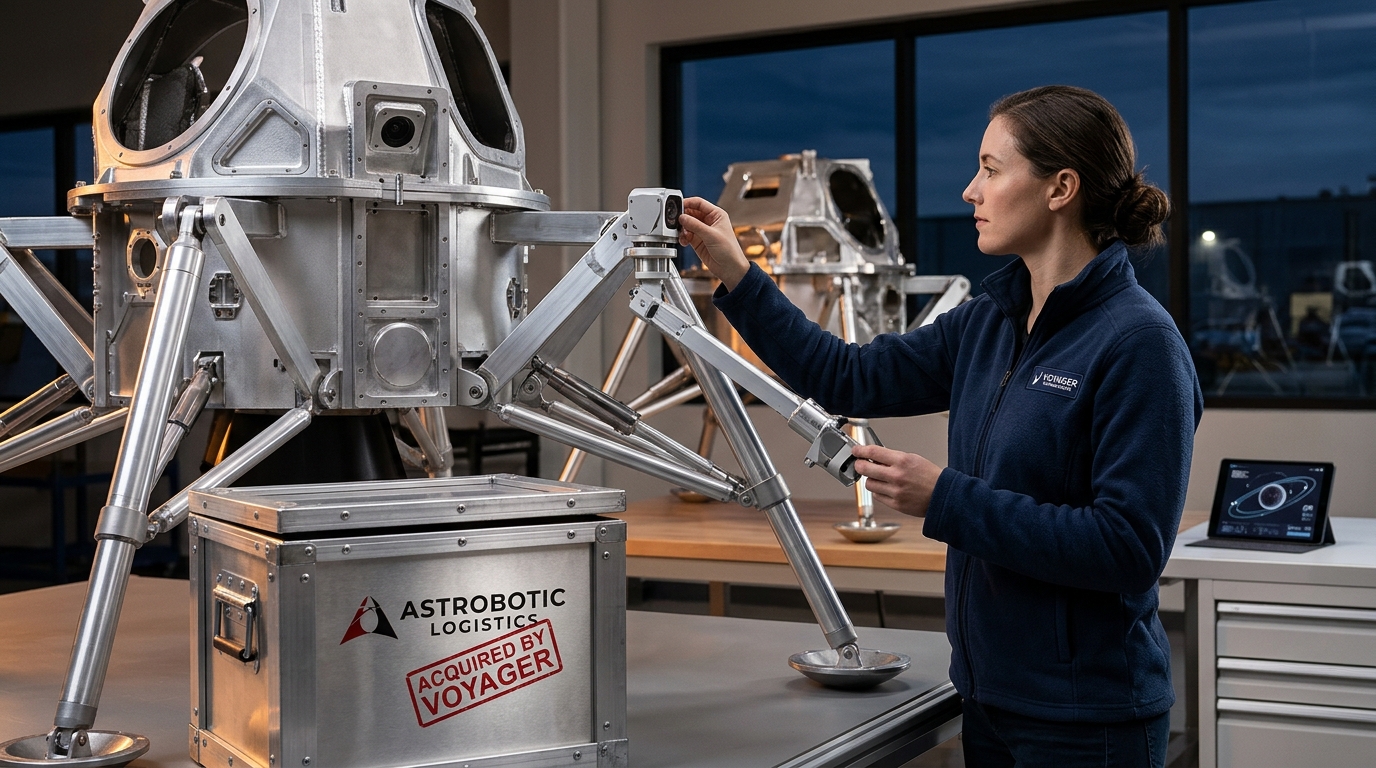
Astrobotic is America’s commercial lunar logistics and robotics company, a Carnegie Mellon spinout that has secured hundreds of millions of dollars in NASA awards and other government work and built lunar landers and rovers. It is best known for its Peregrine program, which flew in January 2024 but did not complete a lunar landing attempt due to an in-flight propulsion issue. Voyager Technologies acquired Astrobotic in July 2026 in a transaction valued at up to approximately $300 million, including contingent consideration, paid in a mix of cash and stock. Astrobotic now operates inside Voyager as Voyager Lunar Systems in Pittsburgh.
Why Amazon Leo Needed This
Amazon’s capital expenditure projection for 2026 was about $200 billion, covering AI, chips, robotics, and low-Earth-orbit satellites. Amazon has committed roughly $10 billion to its satellite broadband constellation, Amazon Leo (formerly Project Kuiper). By July 2026, Amazon Leo had launched roughly 390 to 400 production satellites, based on Amazon’s own mission updates and widely reported constellation counts. Amazon’s Gen1 constellation targets 3,236 satellites. A separate claim that a Gen2 expansion of 4,500 satellites was FCC-approved in January 2026, bringing total authorization to 7,727, could not be verified and has been removed.
At that scale, the orbital logistics layer matters enormously. Amazon’s Leo Ultra enterprise terminal advertises download speeds of up to 1 gigabit per second and upload speeds up to 400 megabits per second, with enterprise-focused networking integrations. But ground-to-orbit traffic is only one axis of the problem. As the constellation grows, autonomous on-orbit servicing and navigation-grade autonomy become critical infrastructure. Those are exactly the capability families Astrobotic’s lander, rover, and lunar power programs were built to mature.
What Voyager Locked Up
The approximately $298 million NASA task order announced June 30, 2026 and highlighted shortly after the deal close underscores the strategic timing of Voyager’s move. Griffin-1 completed a major environmental test campaign at NASA’s Jet Propulsion Laboratory in late September 2026 and is expected to launch in late 2026. The mission will deliver 10 payloads from six countries to the lunar South Pole region. Voyager has said Astrobotic is expected to contribute approximately $40 million to $50 million of revenue during the remainder of 2026.
For Amazon, the real cost is not the $300 million price tag it could have paid. It is the compounding advantage Voyager Lunar Systems now holds in precision landing data, surface power distribution, and autonomous navigation heritage. Those datasets take years to build.
Scenario Framework for AMZN Traders
- Bull Case: Amazon partners commercially with Voyager Lunar Systems for relay and navigation data, preserving Leo’s orbital advantage without owning the surface layer. AMZN above $230 on AWS acceleration.
- Base Case: Amazon builds orbital logistics in-house, accepting a 12 to 18-month capability lag. Leo growth proceeds but deep-space relay remains a gap through 2028.
- Bear Case: A rival hyperscaler moves on a complementary space robotics asset, widening Amazon’s surface-layer deficit. AMZN underperforms on Leo capex scrutiny.
What Traders Watch Now
The VOYG position is already priced for the Astrobotic upside. Voyager raised its full-year 2026 revenue guidance to $275 million to $305 million, representing 66% to 84% year-over-year growth, driven in part by the Astrobotic acquisition. The more interesting positioning question is whether Amazon moves on a second-tier lunar robotics or autonomous navigation name before that window closes too. Monitor AMZN earnings commentary on Leo’s surface and relay strategy. Silence on that front is itself a data point.