Tuesday delivered a double shock. Headline CPI rose 0.4% month over month in October, exceeding economist forecasts for 0.3%, while core CPI climbed 0.3% against an expected 0.2%. Core inflation has now held at 0.3% for a third consecutive month, indicating that price pressures have yet to meaningfully abate. Hours before the data dropped, Fed Governor Christopher Waller had drawn a precise line in the sand.
Waller said that if October CPI data came in around 0.3% or higher, “a stronger policy move may be needed,” and that “a 50 basis point hike in the policy rate should be considered at the December meeting.” The data met his threshold. Dallas Fed President Lorie Logan then made clear she favors at least two more interest rate increases and even seemed open to the extra-large hike Waller discussed. “It may be possible to move more rapidly this winter than the FOMC has moved so far this fall,” Logan said.
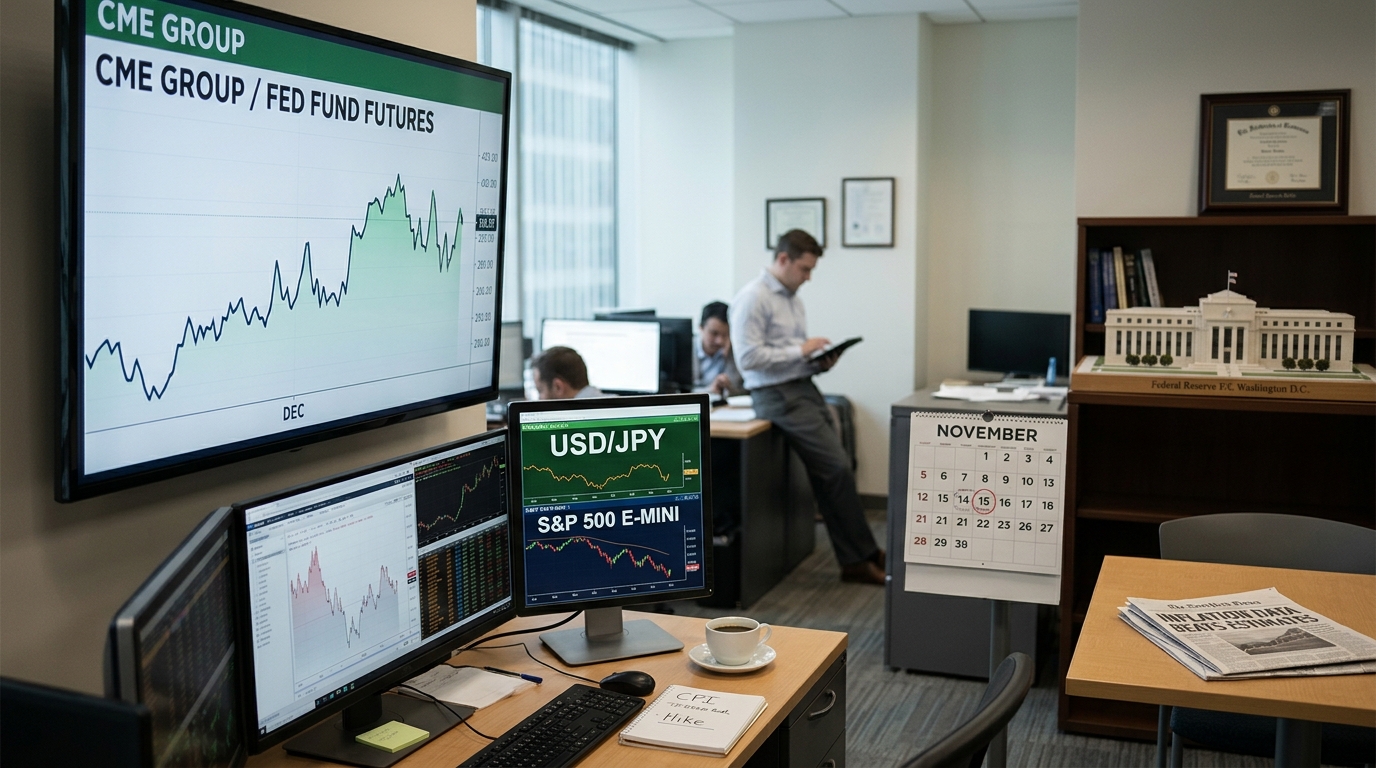
Based on CME FedWatch, the market-implied probability of a 50-basis-point move at the December meeting moved sharply higher after the CPI release. A December hold is still being priced as a low-probability outcome.
No Cash Bonds to Absorb It
Here is the structural problem for today’s session. SIFMA confirmed a full market close for Wednesday, November 11, 2026 for U.S. dollar-denominated fixed income securities in observance of Veterans Day. With no live cash Treasury market, equities lose a key reference point for interest rates, so stock moves may respond more to alternative signals such as futures and economic headlines. Any residual Treasury market response to Tuesday’s inflation figures could spill into Thursday, when cash bond trading restarts.
Bond ETFs and Treasury futures can still be traded today. That is where the rate pricing lives until Thursday. The 10-year yield ended Tuesday near 5.0% (about 4.98% by Treasury/Fed reference series), while the 2-year rose to about 4.73% and the 30-year finished near 5.35%. Those moves stand frozen in cash terms until Thursday.
Where the Repricing Trades Today
The dollar absorbed a share of Tuesday’s shock immediately. USD/JPY traded in the high 158s into November 10. A 50-basis-point December move would widen the rate differential further against the Bank of Japan’s policy rate, keeping upward pressure on the pair.
Rate-sensitive equities are the other live channel. Rate-sensitive industries took the hardest hits Tuesday, with the SPDR S&P Homebuilders ETF falling sharply as the jump in Treasury yields threatened higher mortgage rates. Individual homebuilders also sold off, while financials held up better on the day.
Franklin Templeton’s Jeff Schulze noted that “higher front-end yields and a stronger dollar” will weigh on equity valuations, with investors pricing both a possible 50bp December hike and additional increases beyond.
Scenario Modeling
Bull Case: Core PCE, due November 25, prints at 0.2% or below, pulling the 50bp discussion off the table. The 10-year retreats from around 5%, homebuilders and rate-sensitive names recover sharply, and USD/JPY retraces toward 156. The S&P 500 reclaims Tuesday’s loss and extends the November rebound.
Base Case: The Fed delivers 25bp at the December FOMC meeting. The 10-year consolidates near 5%, dollar/yen holds the 157 to 160 range, and equities remain range-bound into the decision. Markets will likely wait on the October PPI due November 13 and the October PCE reading on November 25 before firming conviction on the size of the December move.
Bear Case: November CPI or PCE prints another 0.3% core, cementing a 50bp hike and opening debate on January. The 10-year breaks decisively above 5.3%, USD/JPY pushes toward 162, and the Nasdaq revisits its recent lows. Technology, REITs, utilities, homebuilders, and small caps face the most pressure in a rising-yield environment.
Active Trader Framework
Today’s session is defined by thin liquidity in rate markets. That cuts both ways: momentum moves in equities and FX can overshoot without cash Treasuries to anchor them, but reversals can be equally sharp when Thursday’s bond session opens. Position sizing matters more than directional conviction on a day like this.
Key levels to monitor: USD/JPY at 160 (a psychologically significant level) on the upside, and 156.50 as the first meaningful support. For the S&P 500, 7,500 is the immediate floor from Tuesday’s close at 7,520.93. The XHB homebuilder ETF around $103 remains a live tell for how aggressively markets are pricing further tightening. Treasury futures, specifically the December 10-year contract, replace the cash market as the rate anchor today.
Volatility expectations should be elevated given the liquidity gap. The VIX closed Tuesday near 19.5. Traders positioned in rate-sensitive sectors face the clearest near-term risk. Those with exposure to financials or the dollar have the cleaner asymmetry heading into Thursday’s bond market reopening.
The question December’s FOMC will answer is not whether to hike, but by how much. Preparation now means knowing your levels before that answer arrives.