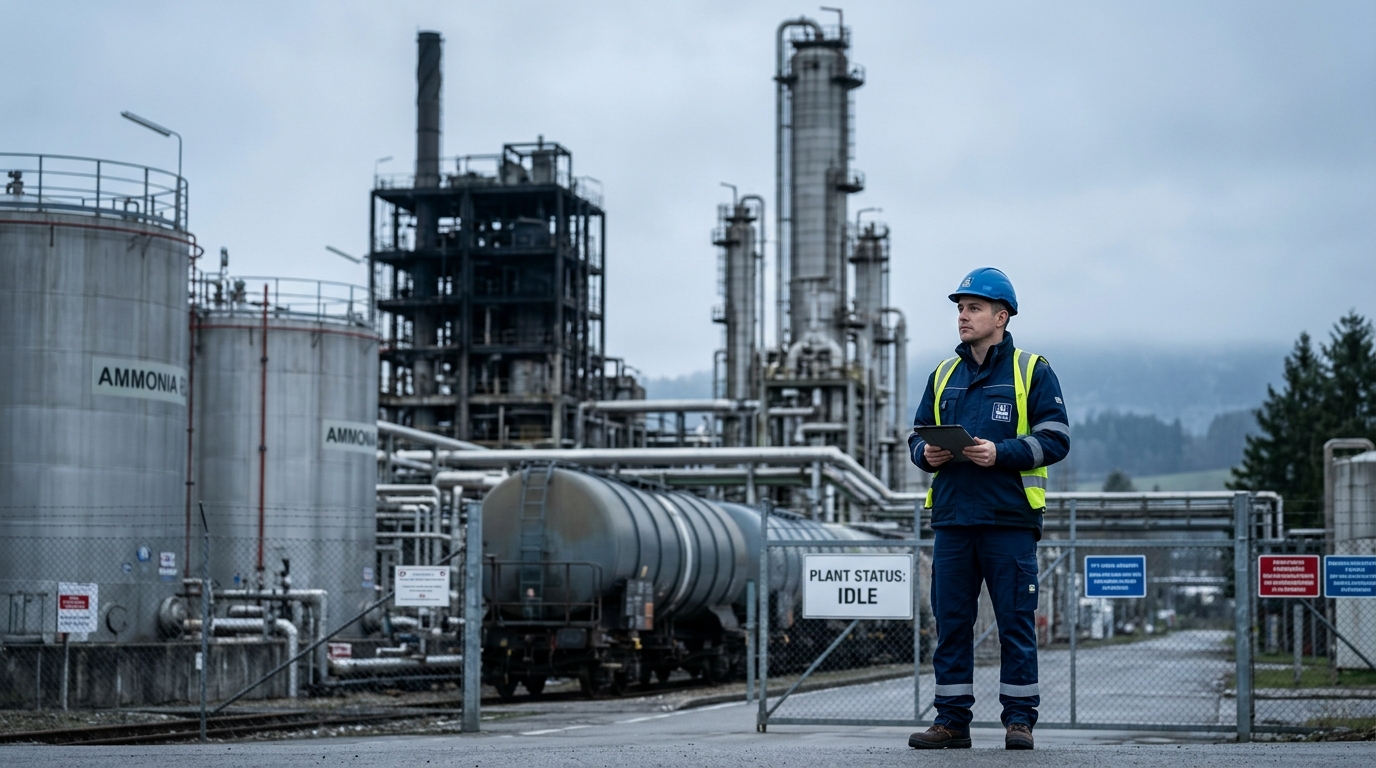
When a commodity story becomes a production-shutdown story with a measurable volume attached, the investment question changes. That happened overnight. The Financial Times reported on November 24, 2026 that roughly a third of European ammonia output has been suspended as producers cannot run at a profit against current energy costs. This is not a warning, a forecast, or a producer review. It is capacity that is already off.
The numbers behind the shutdown
TTF, the European gas benchmark, has been trading around €85–€90 per megawatt-hour this month, after touching €100 at the end of October for the first time since the 2022 energy crisis. The only verified monthly averages I can confirm today are for October 2025 through September 2026, when September averaged about €75.3/MWh and November 2025 averaged about €30.8/MWh. At these kinds of levels, the economics of making ammonia from European gas are simply negative.
Natural gas accounts for about 70% of the cost of producing nitrogen fertiliser in the EU, and the gap to North American producers is not marginal. Nutrien’s natural gas figure in the draft could not be verified from primary company reporting in time for publication, while Yara’s reporting shows a European weighted average gas cost of USD 11.9 per MMBtu in 2025. With this winter’s TTF well above late-2025 levels, the spread has widened further.
CF Industries cited an estimated 37% of European ammonia capacity offline or operating at reduced rates in October 2026. Third-quarter 2026 ammonia production in Europe fell to 1,511 thousand tonnes from 1,870 thousand tonnes in the same period of 2025, while the year-to-date total dropped to 4,724 from 5,333 thousand tonnes.
Yara’s predicament
Yara is the most exposed large-cap name in this story. Yara chief executive Svein Tore Holsether said in the Financial Times report published November 24, 2026 that Europe’s largest fertiliser maker has curtailed ammonia production across its European facilities by 27%. Natural gas is both the main feedstock for ammonia and a major energy input, so price spikes quickly raise production costs. Based on forward markets as of October 13, 2026 and on a volume-neutral basis, Yara estimated its gas cost for fourth quarter 2026 would be about USD 450 million higher than a year earlier.
Yara’s response is structural: it expects its energy exposure to improve once it completes its acquisition of the Gulf Coast Ammonia plant in Texas City, Texas, a deal announced at USD 1.3 billion that would shift the company toward greater exposure to U.S. gas pricing. That transaction had not yet closed as of Yara’s third-quarter 2026 report. Until it does, every day of elevated TTF costs Yara real money.
Who absorbs the displaced volume
The key distinction is between temporary economic curtailments, which restart quickly if the gas-ammonia spread normalises, and structural closures, which remove capacity durably and shift import dependence toward regions with cheaper feedstock. The longer TTF holds above the economic restart threshold, the more of this year’s curtailments migrate from the first category to the second.
The issue for investors is not the absolute cost of gas but where producers sit on the global cost curve. CF Industries is a large North American nitrogen producer with access to comparatively cheap US supply. If European producers pay more, CF will enjoy a significant input-cost advantage. Nutrien, similarly positioned on North American gas, benefits from the same structural spread.
European domestic production now costs roughly $1,096 per ton, while imported ammonia runs about $760 per ton, with supply cited as coming primarily from North Africa, Trinidad and Tobago, and the US. That price gap is what is driving the curtailments, and it is also what makes CF Industries and Nutrien increasingly indispensable to European buyers who cannot wait for TTF to fall.
The long-term verdict
Europe’s industrial base has been losing ammonia capacity in a slow bleed since 2022. Today’s Financial Times report quantifies the latest step: roughly a third of output suspended, Yara cutting 27% of its European production, and TTF showing no immediate reason to retreat quickly. The IEA has warned in prior gas market reporting that tight LNG markets and winter demand can intensify competition for cargoes and lift spot prices during peak periods. If that plays out, Europe’s ammonia economics stay impaired longer, and the “temporary” label keeps getting harder to defend.
Investors with a multi-year horizon should ask which producers own cheap, abundant gas and the logistics to ship product into a structurally import-dependent Europe. The answer has not changed, but the conviction behind it just got a large and measurable data point.