
April 17, 2026
The Strait Just Opened. Now the Real Trade Begins.
Iran’s Hormuz announcement sent oil plunging and stocks to all-time highs — but the resolution is far from complete, and the market may be pricing in a script that hasn’t been confirmed.
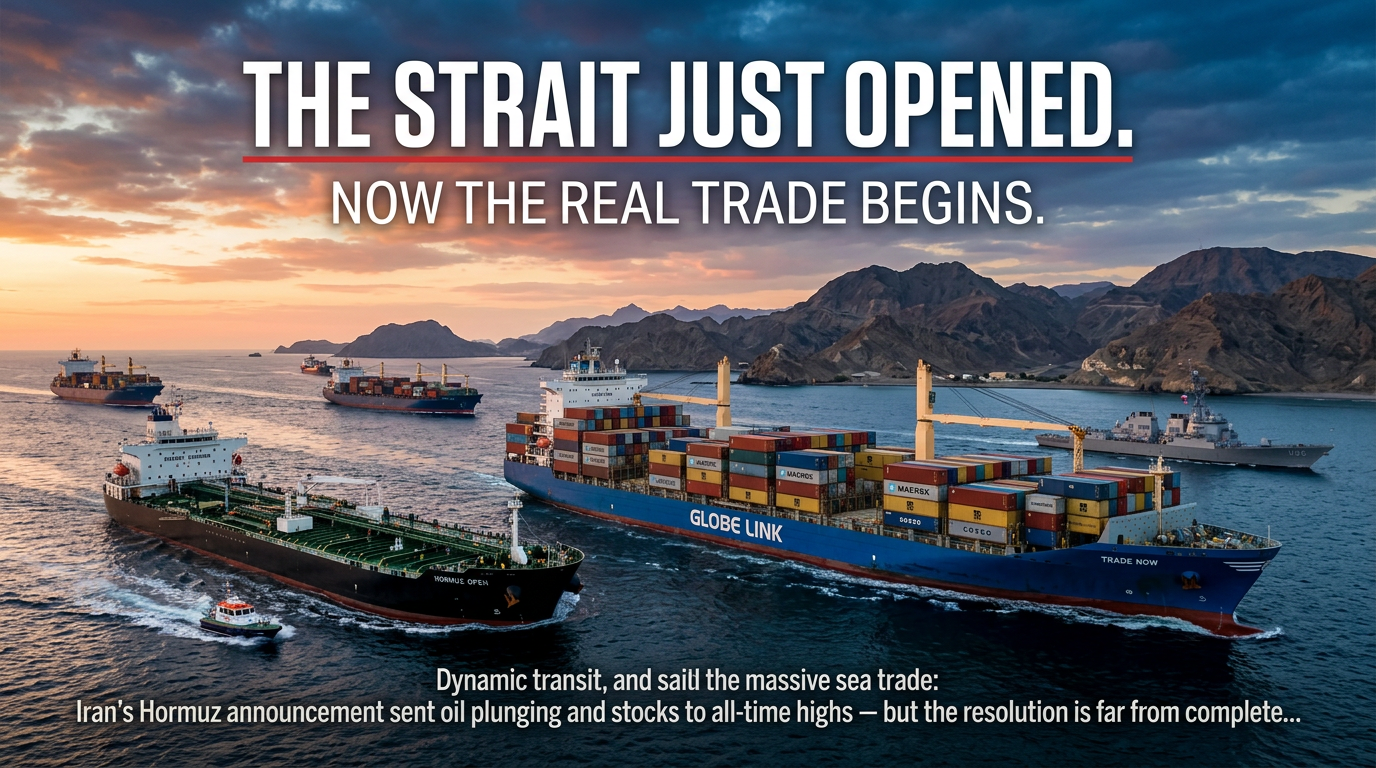
This morning, the Iranian Foreign Minister declared the Strait of Hormuz “completely open” for commercial vessels. Oil dropped 10% inside of an hour. The S&P 500 crossed 7,100 for the first time in history. The Dow jumped over 1,000 points. If you were watching the tape at the open, it felt like a resolution. Maybe it was.
But here’s where I’d pump the brakes — just slightly. The U.S. naval blockade of Iranian ports remains in full force. President Trump said so explicitly this morning in a Truth Social post: “THE NAVAL BLOCKADE WILL REMAIN IN FULL FORCE AND EFFECT AS IT PERTAINS TO IRAN, ONLY, UNTIL SUCH TIME AS OUR TRANSACTION WITH IRAN IS 100% COMPLETE.” So we have Iran saying the waterway is open. We have the U.S. saying it’s still blockading Iranian ports. And we have stocks at all-time highs. That’s the market you’re trading right now.
How We Got Here
The conflict began February 28, 2026. By early March, shipping transits through the Strait had plummeted by nearly 97%. That’s not a typo — 97%. The Strait of Hormuz, which in normal times facilitates roughly one-fifth of the global supply of oil and natural gas, was effectively shut down. Brent crude, which had been sitting near $70 per barrel at the end of 2025, tested $120 before settling back near $96 in the immediate aftermath of a fragile two-week ceasefire. The IEA called it the “most severe oil supply shock in history.”
The S&P 500 fell roughly 9% from its January highs at the trough. The Nasdaq entered a correction. CNN’s Fear and Greed Index hit “extreme fear” in March. Fund managers — according to a Bank of America survey at the time — raised cash levels to 4.3% from 3.4%, the sharpest single-month increase since the COVID selloff in March 2020. The VIX climbed toward 28.
Then the ceasefire hit on April 7. Pakistan brokered an initial agreement — Trump suspended bombing operations, Iran agreed to partially reopen the Strait. The relief rally was immediate and dramatic. Over the following 11 trading sessions, the S&P 500 posted advances in all but one, accumulating gains exceeding 10%. According to data from Bespoke Investment Group, this marked the fastest move from a correction of this magnitude to a new record high since 1928. That number deserves a pause.
Wednesday’s close above 7,000 was the first record close since January. Thursday added to it — the Nasdaq posted its 12th consecutive positive session, its longest winning run since 2009. Then this morning — Iran declares the Strait completely open, oil collapses, and the S&P pushes through 7,100 intraday for the first time ever.
The question isn’t whether the rally happened. It clearly did. The question is what it’s priced in — and whether that script holds.
What the Market Is Actually Pricing
There’s a framework traders have been leaning on throughout this conflict — informally called the “TACO trade,” shorthand for “Trump Always Chickens Out.” The logic: Trump has repeatedly demonstrated a willingness to de-escalate when economic pain becomes acute. Liberation Day in April 2025 is the clearest example. The S&P cratered more than 12%, and within days Trump announced a 90-day tariff pause. Stocks saw one of their biggest single-day rallies in history on the reversal. Investors remember that. They’ve essentially bet, from the start of this conflict, that a similar pattern would play out here.
So far, that bet has paid off. The IMF cut its 2026 global growth forecast to 3.1% from 3.3%, citing energy price spikes and supply disruptions. Headline inflation is now projected at 4.4% for the year — and that’s under the reference scenario that assumes a short-lived conflict. The market has decided to price the optimistic case. That’s not irrational. It may be exactly right. But it means almost no downside risk is currently priced in for a scenario where the conflict extends or the ceasefire collapses.
Slight tangent here, but it matters: the AI-energy dynamic complicates this more than most coverage acknowledges. Unlike previous oil shocks, this one coincides with a massive surge in energy demand from AI infrastructure buildout. Data centers run on natural gas. The disruption in LNG flows through Hormuz has tightened domestic natural gas markets significantly — U.S. LNG exports hit near-record capacity at roughly 18 billion cubic feet per day in March. This creates a demand floor for energy prices that simply didn’t exist in previous commodity shocks. Even if the Strait fully reopens and stays open, the IEA projects it could take approximately two years for energy output to return to pre-war levels. The inflation tail doesn’t disappear overnight.
Sector Breakdown: Who Won, Who’s Exposed
Energy has been the standout sector of 2026, gaining roughly 40% year-to-date as of mid-April. ExxonMobil (XOM) and ConocoPhillips (COP) have been the headline performers — domestic production capacity turned into a premium asset the moment Hormuz shut down. This is a structural shift worth noting: energy is no longer just a cyclical play for portfolio managers who care about geopolitics. It’s become a hedge against the kind of supply shock that now has real precedent.
Technology has also held in remarkably well — and this is the counterintuitive part of the whole setup. AI-related names have essentially run on their own dynamic. Oracle surged more than 12% on April 13 alone following its Customer Edge Summit, and Palantir Technologies added over 3% on the same session. The iShares Semiconductor ETF (SOXX) hit a new all-time intraday high on April 14, led by gains in Credo Technology and Marvell Technology. The tech-heavy Nasdaq has soared more than 15% since late March. Technology stocks now account for nearly half of the S&P 500’s market cap — and that concentration has been both the market’s armor and its vulnerability.
The sectors most exposed to a prolonged conflict scenario are consumer staples, airlines, and industrials. Conagra (CAG) — already down more than 17% in 2026 — represents the consumer staples pressure point. A secondary fertilizer shock is quietly building: with a significant portion of global nitrogen and sulfur fertilizer exports blocked by the Iranian closure, urea prices have jumped 30%. That feeds through to food prices with a lag. Airlines face a more immediate problem. The IEA executive director stated Thursday that Europe has “maybe six weeks of jet fuel left” — and flight cancellations are likely imminent if the Strait doesn’t fully normalize quickly. Heating oil futures, which proxy jet fuel, plummeted 13% this morning on the Hormuz announcement, which gives some relief — but the structural damage from months of constrained supply takes time to unwind.
Banks came in strong this earnings season. Goldman Sachs posted record equities trading revenue in Q1. JPMorgan Chase, Goldman, and Bank of America collectively beat Wall Street expectations. BlackRock climbed 4% on its first-quarter results. The financial sector has benefited from elevated volatility — trading desks thrive on it. What kills financials is a credit event or recession, neither of which is in the base case yet.
Technical Framework
The S&P 500 closed Thursday at 7,041.28. This morning it crossed 7,100 intraday — a level it has never traded at before. After a 10%+ rally in eleven sessions, momentum is clearly intact. But a few things worth watching on the tape:
- VIX compression: The VIX closed lower in 10 of the last 12 sessions heading into today. It’s been declining from the ~28 level hit in March. When it reaches its median (~17.6), you’ve largely priced in the resolution. Watch whether it stabilizes or keeps dropping — if it pushes sub-15, you’re pricing in something close to perfection.
- Oil as a real-time macro signal: Brent crude went from near $120 at the conflict peak to around $90 this morning after Iran’s announcement. The EIA’s April forecast models a Q2 peak of $115/b before gradually declining to $88/b in Q4 — the today move is consistent with that path if the ceasefire holds. WTI near $85 post-announcement is the key level to watch. A move back above $95 would signal re-escalation risk.
- 10-year Treasury yield: Fell to 4.23% this morning on the Hormuz news — its lowest level since mid-March. Traders are now wagering the Fed can resume cutting rates before year-end. Fed funds futures show the overnight rate ending 2026 in the 3.50%–3.75% range, unchanged since December. J.P. Morgan’s base case doesn’t expect a cut until September. If inflation stays sticky from the energy lag-through, that timeline gets pushed.
- Russell 2000: Small caps hit a new all-time high this morning, trading above 2,750 — surpassing the prior high of 2,735 set January 22. Small caps had lagged the large-cap recovery meaningfully. Their participation in today’s rally is a constructive breadth signal for bulls.
- VWAP and support levels: On the S&P, the prior all-time high of approximately 7,002 now becomes near-term support. The January 22 high at 6,886 is the next meaningful level below if sentiment reverses. A gap fill scenario targeting 6,700–6,750 remains the bear case anchor for Q2.
Three Scenarios
Base Case — Controlled De-escalation (~50% probability): The ceasefire extends beyond the April 22 expiration. The U.S. blockade is gradually lifted in exchange for verifiable Iranian concessions on nuclear development. The Strait of Hormuz normalizes commercial traffic by mid-to-late Q2. Brent crude settles in the $85–$95 range through Q3. The Fed holds through summer and delivers one cut in September. The S&P 500 consolidates in the 6,900–7,200 range through Q2 earnings, with no significant new catalyst pushing it materially higher in the near term. Energy outperforms on a relative basis as oil prices remain structurally elevated versus pre-conflict levels. This is what the market is pricing today.
Bull Case — Full Resolution (~25% probability): A comprehensive U.S.-Iran peace deal is struck before month-end. The blockade lifts fully. Oil normalizes toward $80/b faster than expected. The Fed signals a July cut, and rate-sensitive sectors — real estate, utilities, small caps — see a second leg of the rally. The S&P pushes toward 7,400–7,500 on a combination of peace euphoria and earnings momentum. AI names that have already recovered extend further as the macro overhang clears. The China-U.S. trade dynamic, with the May 14–15 Trump-Xi summit on the calendar, adds a secondary tailwind if a trade framework is announced.
Bear Case — Re-escalation (~25% probability): The ceasefire collapses again. Iran resumes Hormuz restrictions. Brent crude retests $110–$115. The Fed is explicitly forced into a hold-and-watch posture as core inflation moves back above 3.5%. Credit conditions tighten at the margin. The S&P gives back the post-ceasefire rally, retesting the March lows near 6,400–6,500. The Trump-China dynamic complicates things further — Trump has threatened a 50% tariff on China if Beijing is found supplying arms to Iran. With the May summit still weeks away, this remains a live variable. A simultaneous trade war re-escalation with China on top of a Middle East re-escalation would be the scenario most investors are not positioned for.
The China Variable — Don’t Let It Drift Off Your Radar
This piece has focused primarily on the Hormuz trade because that’s what’s moving markets today. But there’s a secondary risk that the tape hasn’t fully priced: the China-Iran nexus. Trump threatened a 50% tariff on China after reports suggested Beijing was preparing to deliver air defense systems to Iran. China’s Foreign Ministry said it was “making active efforts to promote peace talks,” and reports suggested China actually pressed Iran toward the initial ceasefire. But the relationship between Beijing and Tehran — China is one of Iran’s closest allies and a major buyer of its oil — means any re-escalation of the conflict puts the China trade relationship directly back in play.
The U.S. Supreme Court struck down IEEPA-based tariffs in February 2026, forcing the Trump administration to pivot toward Section 301 investigations as the new mechanism. Those investigations launched in March and cover China, the EU, Vietnam, Taiwan, Mexico, Japan, and others. Hearings are scheduled for April and May. The May 14–15 Trump-Xi summit in Beijing is the next major inflection point. If that summit produces a trade framework — or if it blows up — the impact on markets will be significant. The tariff issue hasn’t gone away. It’s just been temporarily overwhelmed by the energy shock narrative.
Average U.S. tariffs on Chinese imports currently stand at roughly 47.5%, covering 100% of goods. Chinese tariffs on U.S. exports average 31.9%. These are not small numbers. And with U.S. soybean exports to China already at their lowest level since 2018 — roughly $3 billion in 2025 — the agricultural sector is quietly taking structural damage while everyone watches the oil market.
Active Trader Strategy Framework
The market is moving on geopolitical headlines with a speed and magnitude that rewards preparation over reaction. Here’s how to think about it structurally:
- Energy positioning: The sector’s 40% YTD gain reflects real fundamental improvement — domestic producers benefit from structurally elevated oil prices even after today’s 10% drop. XOM, COP, and domestic natural gas producers warrant attention on any pullback. The thesis isn’t “oil goes back to $120” — it’s that oil stays elevated relative to 2025 levels for longer than the market expects, even in the base case.
- Energy longs vs. airline/consumer staples hedges: If the ceasefire holds, airlines recover sharply — heating oil futures just plunged 13%. But the structural damage to jet fuel supply takes months to reverse. Consider the asymmetry: airlines benefit immediately from peace; they suffer immediately from re-escalation. Energy names have a slower, more muted response in either direction.
- Tech — handle with care at ATH: The Nasdaq is up 15%+ in three weeks and posting its longest win streak since 2009. Momentum is real. But multiple compression risk at these levels — the S&P trading near 20.5x forward earnings — means any negative surprise hits harder than it would at cheaper valuations. AI names like Oracle (now up over 17% in two sessions), Palantir, and Nvidia are extended. The framework here is tighter stop management, not abandonment of the trend.
- Small caps as a peace signal: The Russell 2000 hitting all-time highs today is meaningful. Small caps are more domestically focused, more rate-sensitive, and more vulnerable to economic slowdown. Their participation validates the macro narrative. Watch them as a leading indicator — if small caps start to diverge while large caps push higher, that’s a warning sign worth taking seriously.
- Weekend risk remains elevated: The ceasefire’s most recent extension expires April 22. That’s five days away. The U.S. blockade remains in effect. Peace talks collapsed in Islamabad last weekend. Any geopolitical development over the weekend — positive or negative — will gap the market Monday. Position sizing going into the weekend matters more than usual right now.
Here’s what I keep coming back to: the market has made a specific bet — that Trump will follow the script, that the ceasefire holds, that the Strait stays open, that oil normalizes, that the Fed eventually cuts. Every piece of that chain needs to hold for the S&P 7,100+ level to be justified. Most of the time, when you string that many assumptions together, at least one of them doesn’t cooperate.
That doesn’t mean the trade is wrong. It means the risk profile of being fully long at all-time highs, against this backdrop, is different from being fully long at all-time highs in a quiet macro environment. The VIX at 28 a few weeks ago was pricing in uncertainty. If it grinds toward 15 while the blockade technically remains active and the China summit is still pending — that’s a different kind of risk. Not necessarily a reason to sell. But a reason to define your levels before the tape does it for you.
Preparation beats prediction. That’s the only framework that survives this kind of environment consistently.
This editorial is for informational purposes only and does not constitute investment advice. Trading involves risk of loss. Past market behavior during geopolitical events is not indicative of future results. All scenario analysis represents opinion, not prediction. Consult a licensed financial advisor before making investment decisions.
— Active Trader Daily