
April 22, 2026
Tesla’s Terafab Moment Just Hit
Here’s What Active Traders Need to Know
First a note from our friends at Immersed
Most private tech deals sell a dream.
This one has receipts.
It built the #1 work app on Meta Quest, where 1.5M+ professionals are logging 40 to 60 hours a week inside a virtual workspace.
That kind of sustained use is rare.
Here’s what that looks like in numbers:
1.5M+ users already working on the platform
$7M+ in revenue generated
$24M raised from 6,000+ investors
75,000+ professionals on the hardware waitlist
This isn’t based on assumptions. The usage is already there.
Now the company is building on that foundation.
$71M in projected hardware demand
Reserved NASDAQ ticker: IMRS
Featured in TIME, Wired, and Forbes
You can still invest at $0.72/share, before a potential IPO.
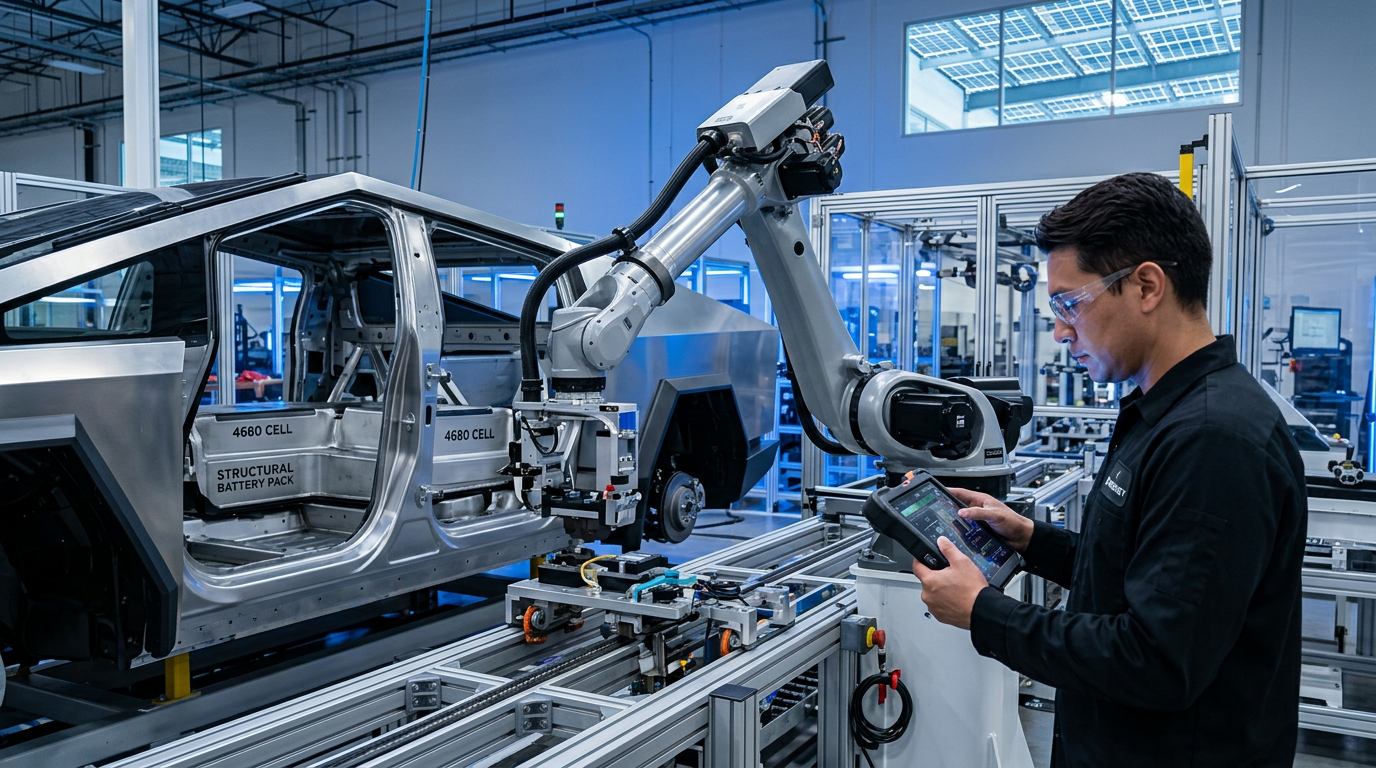
Tesla reports Q1 results after the U.S. close today, Wednesday, April 22, 2026 (with the webcast scheduled for 5:30pm ET). That date matters because it’s a rare collision: a mega-cap equity catalyst on the same day macro volatility has already been pulled around by energy and rates.
And Tesla isn’t being priced like a simple auto company right now. The market is treating tonight as a referendum on two things that don’t show up cleanly in one quarter of GAAP numbers: (1) how quickly Tesla can put an autonomous ride-hailing product into actual service at scale, and (2) whether “Terafab” is real enough to change the long-run cost curve of Tesla’s compute stack.
Slight tangent, but it matters: when traders say “this is a story stock,” they often mean “there’s no way to quantify it.” That’s lazy. You can quantify it – you just have to do it with cash, capex, margins, and realistic bottlenecks instead of one-quarter EPS.
Meta Description
Tesla reports Q1 2026 after the close on April 22. Traders are focused on robotaxi timelines and the Terafab chip initiative. Below is a data-driven read-through: macro context, sector impacts, stock-specific numbers, key levels, scenario modeling, and a risk-managed action framework.
Bullet Summary
- Tesla Q1 2026 deliveries vs. production: 358,023 deliveries vs 408,386 production (a ~50,363 unit gap in the quarter), raising questions about inventory and pricing power heading into Q2.
- Street baseline into the print: IR-compiled consensus centered around GAAP EPS of ~$0.16 (average) and gross margin around ~17.5% (average), with wide dispersion that matters for options and post-earnings positioning.
- Macro constraint check: March 2026 CPI: headline +3.3% YoY and +0.9% MoM; core inflation around ~2.6% YoY. That keeps rate sensitivity elevated for long-duration growth.
- Rates are not “low” again: SOFR has been hovering around ~3.6% in April (roughly mid-3.5% to mid-3.6% daily range), keeping financing costs and equity discount rates meaningfully above the 2020–2021 regime.
- Foundry / AI supply chain pressure is still real: TSMC reported Q1 revenue around $35.9B and guided Q2 revenue to $39.0B–$40.2B; March 2026 monthly revenue was ~NT$415.19B (+45.2% YoY). Any Terafab credibility debate runs into that backdrop.
- Robotaxi impacts other large caps: Uber reported Q4 2025 revenue of $14.4B (+20% YoY). If autonomous rides get pulled forward, the market will also debate what that means for platform distribution economics.
- Energy is back in the inflation equation: Brent was cited around the mid-$90s and WTI around ~$90 in recent coverage tied to Middle East risk. That can be an EV tailwind over time, but it can also feed inflation and rates, which often hits high-multiple equities first.
Market Context Analysis
Start with the macro math, because it still runs the first 30 minutes after any earnings release.
Inflation pulse: March CPI came in hot on a monthly basis: +0.9% MoM and +3.3% YoY. Core inflation has been cooler than headline (around ~2.6% YoY in March), but traders don’t get to ignore headline when gasoline and freight costs are swinging.
Funding conditions: Short-term cash yields still compete. SOFR hovering around ~3.6% in April is a clean way to internalize that. Equity risk premium arguments are nice; a trader’s reality is: the hurdle rate is still high enough to pressure long-duration multiples when macro heats up.
Energy and geopolitics: The recent inflation pulse and rate volatility have been tied to Middle East risk and oil spikes. Brent near ~$95 and WTI near ~$90 were cited in coverage. For Tesla, that can cut both ways. Higher oil improves the relative economics of EVs, but the second-order effect is inflation expectations moving higher, which can lean on high-duration equities.
Index-level environment: Broad U.S. equities have been sensitive to the day-to-day cadence of geopolitical headlines. In that kind of market, single-stock earnings reactions tend to be less “about the quarter” and more about whether management reduces uncertainty on the next 2–4 quarters. Tesla is the definition of that dynamic: autonomy milestones and Terafab specificity will likely matter as much as EPS.
Here’s where I’m at: tonight’s TSLA reaction will be a blend of micro (deliveries, margins, cash flow) and macro (rates, oil, liquidity). If you treat it like a normal auto earnings print, you’ll misread it.
Sector Breakdown
Tesla sits at the intersection of at least four “sectors” that trade differently: autos, energy storage, AI compute, and mobility platforms. The market rotates capital across those buckets fast, and Tesla’s commentary can move more than Tesla.
1) Autos and EV supply chain
The core check is simple: unit volume vs. profitability. Tesla already told us Q1 2026 delivered 358,023 vehicles while producing 408,386. That’s not a rounding error. That’s ~50k units of production ahead of deliveries in one quarter, which tends to make the market ask: “Is pricing doing more work than we think?”
On the supplier side, this is where names with concentrated EV exposure can get whipsawed: battery materials, power electronics, and the Tier-1 component ecosystem. Even if Tesla’s longer-run autonomy angle is what traders talk about on TV, the near-term P&L is still built from gross margin and operating expense control.
2) Semiconductors and foundry leverage
The Terafab conversation lands directly on the most important chokepoint in modern AI: advanced-node silicon, packaging, and the power + cooling + yield learning that comes with it.
Consider what’s already happening at the foundry layer. TSMC reported Q1 revenue around $35.9B and guided Q2 to $39B–$40.2B. Separately, its March 2026 monthly revenue print was ~NT$415.19B, up 45.2% YoY. That’s demand pressure at scale. Terafab has to be evaluated against this baseline: the world’s best manufacturing ecosystem is already running hot.
That means the read-through list is not just “chip stocks.” It’s: foundries (TSM), equipment (the capex cycle), and the incumbents selling training compute. Any credible internal silicon roadmap from Tesla changes how the market thinks about long-run supplier bargaining power – but only if Tesla speaks in timelines, scope, and milestones that sound like manufacturing, not ambition.
3) Mobility platforms and autonomous economics
Autonomous ride-hailing is not only a Tesla question. It also forces a valuation conversation for companies with distribution and demand aggregation. Uber is the cleanest public proxy for that: it posted Q4 2025 revenue of $14.4B, up 20% YoY. If Tesla can field autonomy at scale, the market will debate whether Uber becomes a partner, a customer, or a pressured incumbent in certain metros.
4) Energy and storage
Higher oil can improve EV math but raises inflation risk. On the grid side, the question is whether Tesla can keep expanding storage deployments and maintain margins while expanding capex for autonomy and silicon. If Tesla uses tonight to emphasize capital intensity, traders will want to see how that interacts with free cash flow.
Financial Breakdown
This is where the market tends to get overly cute: “TSLA is about autonomy so margins don’t matter.” Margins matter because capex is rising, and the company has to fund multiple heavy initiatives at once.
Tesla (TSLA): what we already know going in
The hard Q1 datapoint Tesla has already printed is volume: 358,023 deliveries vs. 408,386 production. The difference – about 50k units – is large enough that investors will focus on: (a) inventory movement, (b) automotive gross margin ex-credits, and (c) whether price cuts or incentives were required to move metal.
Consensus guardrails: The IR-posted consensus snapshot centered around GAAP EPS averaging about $0.16 with a broad range across analysts, and gross margin around 17.5% on average (with a wide distribution). When dispersion is wide, post-earnings volatility tends to be driven by the “surprise vs. the most positioned expectation,” not the median.
Capex and the “Terafab test”: If Tesla is serious about building a vertically integrated silicon facility, the market needs to translate that into capex, timeline, and payoff. Capex isn’t an abstract debate – it’s a cash flow debate. Tonight, listen for: (1) total capex range for 2026, (2) how much is autonomy compute vs. manufacturing footprint, and (3) whether management frames Terafab as R&D plus partnerships or as a heavy build that competes for capital with vehicles and energy.
NVIDIA (NVDA): the downstream beneficiary – and the long-run question
NVDA is the scoreboard for AI compute demand. In its fourth quarter (ended Jan 25, 2026), NVIDIA reported quarterly revenue of $68.1B, and for fiscal 2026 it reported revenue of $215.9B, up 65% year over year. Those numbers explain why “build your own compute” projects get attention: the spending is enormous.
The near-term reality is still simple: if Tesla is ramping autonomy training and inference, the default suppliers remain NVDA and the broader AI stack. The long-run risk to NVDA is not “Tesla builds chips.” The long-run risk would be Tesla building enough of its own silicon and systems integration to reduce dependency at scale. That is a multi-year process with manufacturing, packaging, and yield learning curves, not a press release. Tonight’s value is in whether Tesla provides milestones that allow the market to time that curve.
Taiwan Semiconductor (TSM): the reality check
TSMC reported Q1 revenue around $35.9B, and it guided Q2 to $39.0B–$40.2B. Its March revenue alone was ~NT$415.19B (+45.2% YoY). That is the backdrop. The base case for most customers is still: advanced-node silicon goes through TSMC (or Samsung), with packaging constraints increasingly important. Terafab has to be evaluated against that industrial fact pattern.
Uber (UBER): distribution and unit economics in mobility
Uber’s Q4 2025 revenue was $14.4B (+20% YoY). That gives you a practical benchmark: the demand aggregation layer is already huge and profitable enough to matter. If Tesla’s autonomous product is accelerated, UBER becomes one of the market’s first places to express a view on the economics of rides, pricing pressure, and platform take rates – even if Tesla’s product is vertically integrated.
Mobileye (MBLY): an alternative autonomy proxy (and a reminder about timelines)
Mobileye guided 2026 revenue to roughly $1.9B–$1.98B, implying flat to ~5% growth. That is not a “boom” profile; it’s a reminder that autonomy commercialization tends to be lumpy, regulatory-sensitive, and slower than engineering demos imply. If Tesla provides aggressive robotaxi timelines tonight, traders will likely weigh those claims against what other autonomy-adjacent companies are guiding.
Trading Framework
I’m going to keep this framework decision-oriented, not predictive. Earnings nights punish certainty.
1) VWAP discipline the next day
For TSLA, the most useful “tell” after the print is often whether price can hold above the next-day VWAP after the opening volatility. A rally that fails below VWAP repeatedly is typically a sign institutions are distributing into strength rather than chasing.
2) Moving averages: treat them as behavior zones
Because TSLA is high beta and trades with both growth and single-name catalysts, the 20-day and 50-day moving averages tend to behave like institutional decision zones. Post-earnings, watch for: a clean reclaim and hold (which often draws systematic buying) vs. a one-day spike-and-fade (which often attracts mean reversion).
3) Support/resistance: use the earnings gap itself
Earnings gaps create natural reference levels: the after-hours high/low, the next-day opening range, and the first hour high/low. Those levels often matter more than any pre-existing lines because they represent fresh positioning and fresh pain thresholds.
4) Volume: you want to see “participation,” not just price
A large percentage move on mediocre volume is often fragile in TSLA. A move supported by heavy volume across the first two hours the next day is a better signal that multiple participant types are involved (long-only, systematic, event funds).
One more small point traders skip: on these high-volatility earnings, your real edge often comes from the second day, not the first. Day 1 is emotion plus forced positioning. Day 2 is interpretation.
Scenario Modeling
Rather than pretend we know the print, define the conditions that would justify price acceptance in either direction. The point is preparation, not prophecy.
Bull Case (upside continuation)
Conditions that would support sustained upside after the initial reaction:
- Margins land clearly above the consensus band (gross margin above the ~17.5% average expectation) and management explains mix and pricing without hand-waving.
- Cash flow holds up despite capex talk – even if capex rises, the market wants confidence that Tesla can fund autonomy + silicon + manufacturing without forcing a “choose one” trade-off.
- Robotaxi details include dates, geographic scope, and operational constraints (service areas, safety driver policy, regulatory status). If updates are specific enough to model, the market tends to pay for them.
- Terafab milestones sound industrial: site status, partners, process node ambition, packaging approach, and a plausible multi-stage ramp. The more concrete, the more investors can map it to a capex timeline.
Base Case (range trade, high volatility)
Most probable outcome in a market like this:
- Headline results broadly in-line with the consensus snapshot (GAAP EPS near the ~0.16 neighborhood, gross margin near ~17.5%), which pushes the stock reaction toward guidance tone and Q&A interpretation.
- Autonomy update is directionally positive but not time-bound – enough to keep the long-term debate alive, not enough to anchor near-term revenue modeling.
- Terafab is framed as an ambition with early steps rather than a fully costed plan. The market may treat it as optionality, but optionality doesn’t always get paid in a high-rate environment.
- Price action becomes a tug-of-war: day-one gap, partial fade, then two-way trade around the first hour range as traders sort signal from noise.
Bear Case (downside follow-through)
Conditions that can turn a miss into something more serious:
- Margins disappoint relative to the consensus band and the explanation points back to pricing pressure or underutilization tied to the production-delivery gap. (Remember: production 408,386 vs deliveries 358,023 already sets up that question.)
- Capex talk rises without a funding story – if Tesla communicates large spending ambitions but can’t keep confidence around free cash flow, multiple compression risk increases in a ~3.6% cash-rate world.
- Robotaxi timeline language gets pushed out again or is paired with more operational constraints than bulls have assumed.
- Terafab credibility issues: vague commentary, no milestones, or anything implying this is more branding than manufacturing.
Active Trader Strategy Framework
What matters is not “bullish or bearish.” What matters is whether you can define risk and avoid getting forced into decisions by volatility.
1) Size to volatility, not conviction
TSLA earnings regularly produce large post-close moves. If you choose to carry exposure, consider sizing so that a large gap doesn’t create a portfolio-level event. That’s basic, but it’s where most damage happens.
2) Use “reaction levels,” not opinions
Two practical reference systems for the next session:
- After-hours range: the high/low formed between the release and the open. A break and hold beyond that range often signals follow-through participation.
- First-hour range + VWAP: if price reclaims VWAP and holds while expanding volume, it’s often a better signal than the first 5-minute spike.
3) Pair-trade thinking: who benefits if Terafab gets traction?
A thoughtful way to express a view without making it all-or-nothing on TSLA is to think in pairs:
- TSLA vs. AI compute incumbents: If Tesla’s internal silicon ambition looks credible, the market may debate long-run supplier power. NVDA is the obvious reference given fiscal 2026 revenue of $215.9B.
- TSLA vs. foundry reality: If Terafab milestones sound thin, the market may rotate back to “capacity is scarce and expensive,” which tends to support the existing foundry winners like TSM (Q1 revenue ~$35.9B; Q2 guide $39B–$40.2B).
- TSLA vs. distribution platforms: If robotaxi timelines get pulled forward with credible operational details, UBER becomes a second-order beneficiary or risk depending on perceived partnership/competition (Q4 2025 revenue $14.4B, +20% YoY).
4) Watch the macro cross-currents during the conference call
This week’s macro sensitivity is not theoretical. CPI is running +3.3% YoY with a sharp March jump (+0.9% MoM), and energy has been a driver. If oil headlines hit during the call window, the equity reaction can become less about Tesla and more about rate-sensitive duration risk.
One last thought: if you’re trying to trade TSLA purely off the first headline, you’re competing with machines parsing the PDF in milliseconds. The human edge is in the second derivative – what changed, what’s quantified, what’s funded, what’s timed.
Tonight’s Earnings
Tesla’s Q1 print tonight is less about whether the quarter was “good” and more about whether the company reduces uncertainty around two capital-intensive ambitions: autonomy at scale and Terafab as a real manufacturing initiative.
The market already has a reason to be demanding. Q1 deliveries were 358,023 against production of 408,386, and the consensus snapshot implies investors are bracing for GAAP EPS around $0.16 and gross margin around 17.5%. That’s the bar.
In the background, inflation is still sticky enough to keep rates relevant (March CPI +3.3% YoY) and cash yields still matter (SOFR around ~3.6%). That combination tends to punish vague promises and reward specificity.
So that’s the standard for tonight: numbers, timelines, and trade-offs. If you get those, you can map the next few quarters with discipline. If you don’t, you’re trading emotion. And emotion is expensive.