
May 2, 2026
AVAV Has Fallen Hard — Now Comes the Harder Question
The stock is well below its 200-day, short interest is elevated, and Q4 earnings are 7 weeks out. Here’s the full tactical breakdown.
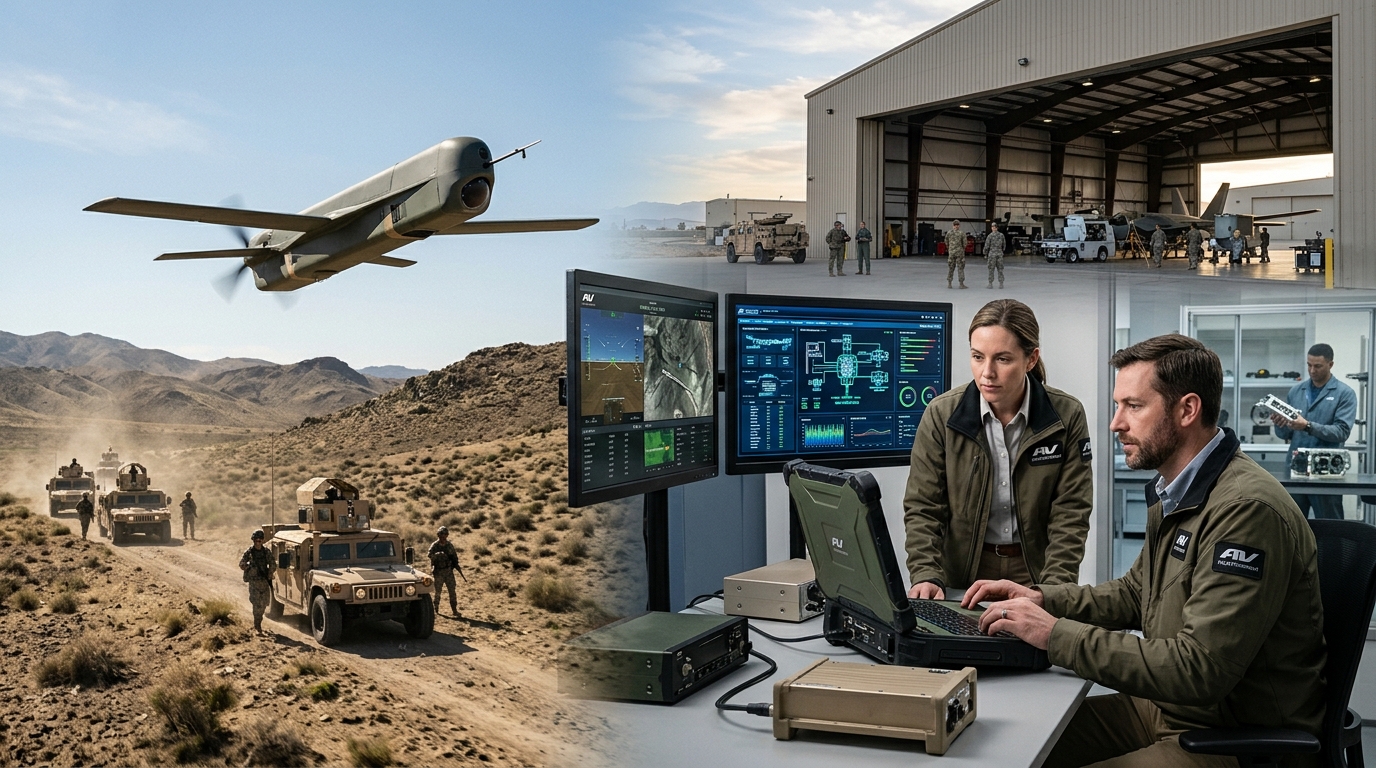
AeroVironment (NASDAQ: AVAV) hit an all-time high of $417.86 in October 2025. It’s now trading near $185. That’s a 55% drawdown from peak in roughly seven months — and the question active traders are wrestling with right now isn’t whether something broke. It’s whether what broke is temporary or structural.
Worth understanding the sequence of events. The BlueHalo acquisition closed May 1, 2025 — a transformative deal that nearly doubled AV’s revenue run rate but injected a wall of non-cash amortization into the P&L. Then Q2 FY2026 came in at record revenue of $472.5 million, up 151% year-over-year, and the stock was above $300 as recently as late January 2026. Then Q3 hit. Revenue of $408 million missed the $476–$485 million consensus by a wide margin. A $151.3 million goodwill impairment tied to the Space Force’s termination of the SCAR phased-array antenna contract landed on the balance sheet. Management cut full-year revenue guidance from $1.95–$2.0 billion down to $1.85–$1.95 billion. And the stock got punished — hard.
That’s the bad part. Here’s why the setup is still worth tracking closely.
The Numbers Traders Need to Know
- Q3 FY2026 revenue: $408M — up 143% YoY, but short of the $476–$485M consensus estimate
- Organic growth: 38% year-over-year in Q3, with Autonomous Systems segment carrying the load
- Funded backlog: $1.1 billion as of January 31, 2026 — a record, up from $726.6M at April 30, 2025
- YTD total awards: $4.6 billion through the first nine months of the fiscal year; book-to-bill of 1.6x
- Unfunded backlog: Approximately $3 billion, providing multi-year revenue visibility beyond funded orders
- GAAP net loss: $156.6M in Q3, or $3.15/diluted share — driven almost entirely by the $151.3M goodwill impairment
- Non-GAAP adjusted EBITDA (Q3): $44.5M — up from $21.8M in the prior-year period; adj. EBITDA margin at 11%
- FY2026 guidance: Revenue $1.85–$1.95B; non-GAAP EPS $2.75–$3.10; adjusted EBITDA $265–$285M
- Cash position: $649M at Q3 end; total assets $5.45 billion; stockholders’ equity $4.27 billion
- Short interest: 11.6% of float, up 35.9% over the past 12 months — meaningful, but not extreme
The headline GAAP numbers look terrible. They’re meant to. The impairment is a one-time, non-cash accounting event — it doesn’t change the cash position, the backlog, or the order trajectory. But it handed bears the narrative they needed, and the stock got sold aggressively. The tape since has been messy. Extended periods of low-volume drift, punctuated by sharp intraday moves in both directions.
Iran War TRUTH: What Was Revealed Behind Closed Doors
There’s a strategy behind the Iran war.
I know because I heard it directly in a closed-door meeting with a source whose connections run deep into global power networks.
He walked me through the real purpose and the massive deal tied to it.
What’s Actually Driving the Business
Slight tangent, but it matters — the market keeps framing AVAV as a drone story, and that framing is about five product lines behind where the company actually is. AV now operates across autonomous systems, loitering munitions, counter-UAS, directed energy, space-based platforms, cyber, and electronic warfare. The BlueHalo acquisition accelerated that diversification. The LOCUST laser weapon system demonstrated live aboard the USS George H.W. Bush, neutralizing multiple drone targets from a maneuvering carrier deck. The Switchblade 600 Block 2 and Switchblade 300 Block 20 recently generated a $186 million production contract. AV just launched Halo_Shield, a modular counter-UAS detection system. The new 140,000 square-foot Salt Lake City manufacturing facility is being scaled to support over $2 billion in annual production capacity.
The Autonomous Systems segment — which includes Switchblade, JUMP 20, Puma, and Titan counter-UAS platforms — posted 50%+ organic growth in Q3. The Space, Cyber and Directed Energy segment declined 19% amid the SCAR disruption and funding timing delays. Management is now transitioning the BADGER phased-array system from a government program-of-record to a commercial product — they believe it has a head start on any potential competition. Whether they’re right is one of the key variables traders need to track into Q4.
Management guided for record Q4 revenue. The setup depends heavily on delivery timing that was pushed from Q3 into Q4, plus resolution of government funding delays that stalled several anticipated orders. If that revenue materializes, Q4 print should look dramatically better than Q3.
The Technical Structure
This is where active traders need to pay careful attention, because the technical picture is genuinely broken in the intermediate term — and that matters for sizing and entry decisions regardless of how constructive the fundamental thesis looks.
AVAV is trading near $185, well below both its 50-day moving average (~$215) and its 200-day moving average (~$273). The 52-week range spans $154.39 to $417.86 — the stock is currently sitting in the lower third of that range. Bollinger Bands place support near $172, with near-term resistance around $204–$210. Average True Range of approximately $13 per session indicates moderate daily volatility — meaning the stock can cover meaningful ground quickly in either direction.
Short interest of 11.6% of float with 4.6 days to cover is not a squeeze setup, but it does mean there’s a short-covering bid available if the stock begins to reclaim key levels with volume. The days-to-cover ratio has risen 39% from the previous reporting period — short sellers have been accumulating, and they’ll need an exit at some point.
VWAP from the post-Q3-selloff (mid-March through now) sets up around $200–$205 as the key level to reclaim for the tape to shift. Failure to hold $172 on any news-driven flush opens a retest of the 52-week low region near $154.
He Made $95 Million in the 2008 Crash. Now He’s Focused on Gold.
Barron’s ranked his fund in the top 1% worldwide. He went 20 years without a losing year.
Now he’s applying his strategy to the wildest gold market in decades – and sharing a three-step method that could pay you over $5,000 the next time gold drops.
Sector and Competitive Context
The macro environment for defense spending is structurally supportive. NATO commitments, the Middle East conflict cycle, and the U.S. Army’s expanding counter-drone requirements all point toward sustained demand for exactly the platforms AVAV builds. The iShares U.S. Aerospace & Defense ETF (ITA) has broadly outperformed the S&P 500 over the trailing twelve months. AVAV has underperformed both the sector and the broader market over the same period — an unusual divergence for a company with $4.6 billion in year-to-date bookings and a record funded backlog.
Kratos Defense (KTOS) and Red Cat Holdings (RCAT) are the two names that tend to trade in loose correlation with AVAV on defense-drone news flow. Neither has the same breadth of programs-of-record or production backlog. That relative scale matters in a sector where institutional capital rotates quickly.
The analyst community remains broadly constructive. Out of 21 Wall Street analysts tracked, 16 carry Buy ratings, 2 Hold, and 1 Sell. The median 12-month price target sits at $305, with a range of $235 to $450. KeyBanc lowered its target from $330 to $295 after Q3 but maintained Overweight. Clear Street just initiated with a Buy in late April 2026. At current prices near $185, the median target implies roughly 65% upside — though that’s only meaningful if the execution trajectory changes.
Scenario Modeling
Bull Case — Management delivers on the Q4 record revenue call (June 23 earnings), with adjusted EBITDA margins recovering toward the low-to-mid 30s as guided. The Autonomous Systems segment sustains 30%+ organic growth into FY2027. BADGER gains commercial traction and removes the SCAR overhang from the narrative. Short covering begins in earnest above the $200–$210 resistance zone. In this scenario, the stock has a credible path back toward the $260–$280 range over the following two quarters, with the 200-day at ~$273 serving as the next major overhead level. Bull case requires Q4 revenue to clear at least $500 million and adj. EBITDA margin improvement versus Q3’s 11%.
Base Case — Q4 delivers revenue somewhere in the $480–$520 million range, in line with or modestly above the revised guidance midpoint. Margins improve but don’t fully recover to pre-BlueHalo levels. The stock grinds higher from current levels, reclaiming $200–$210, but struggles to break through the 50-day without a material positive catalyst. Full recovery toward the 200-day is a FY2027 story, not a near-term one. Range for the base case: $195–$240 over the next 90 days, with elevated volatility around the June 23 print.
Bear Case — Q4 misses again on timing or additional Space segment disruption. BlueHalo integration costs continue to compress margins below guidance. Government funding delays persist into FY2027, creating order slippage that erodes the $1.1 billion funded backlog faster than replenishment. The $172 Bollinger support gives way, and the stock revisits the 52-week low zone at $154. Bear case also includes any additional contract terminations or competitive bid losses in the directed energy or space segments. Tail risk: a second goodwill impairment, though management has signaled that risk is largely addressed.
The New Arms Race Is Being Built Right Now
Global tensions are accelerating a new kind of arms race powered by advanced technology.
AI, drones, and autonomous systems are becoming central to modern defense strategies. This report reveals five companies positioned to benefit from this shift and what it could mean for investors.
Active Trader Framework
A few things worth keeping in mind for positioning:
- Earnings date is June 23, 2026. That is the single highest-impact catalyst between now and year-end. Any meaningful position established before then carries binary earnings risk. Size accordingly.
- The $172 level is the tactical floor. Below that, the lower Bollinger band and the next visible support zone near $154–$160 become the relevant references. A weekly close below $172 would materially change the risk profile.
- $204–$210 is the first meaningful resistance cluster — previous VWAP from the post-Q3 distribution, Bollinger mid-band, and a zone where short sellers are likely carrying profitable positions. Reclaiming and holding this level on volume would be a meaningful positive signal.
- The 11.6% short float creates two-way volatility risk. Strong Q4 results could generate a sharp short-covering rally. Weak results could add fuel to continued selling. Implied volatility heading into the June print will likely be elevated — options premium will reflect that.
- Volume is the tell. Recent sessions have seen trading well below the 1.67 million share average. Low-volume drifts in either direction are less informative. Watch for volume expansion above average on any breakout attempt above $210.
- New leadership and manufacturing buildout matter for the longer-dated thesis. AV appointed a new CFO and COO in April 2026, and the Salt Lake City facility expansion represents a major capacity commitment. Execution on both will be discussed in the Q4 call.
Position sizing matters here more than direction. The ATR of ~$13 and the binary June 23 event mean that AVAV is a name where being right on the thesis but oversized can still produce a painful outcome. Traders who want exposure to the Q4 recovery narrative should consider structuring risk in a way that survives a continued drift toward $154–$160 without forcing a stop at an inconvenient level.
The fundamentals here are not broken. A $4.6 billion year-to-date award total, a record $1.1 billion funded backlog, $649 million in cash, and a manufacturing buildout targeting $2+ billion in annual production capacity — these are not the characteristics of a company in decline. What broke was execution timing in one segment, a single large contract termination, and a post-acquisition amortization drag that distorts GAAP earnings in ways that obscure underlying performance.
Whether the June 23 print becomes a reset catalyst or another miss — that’s the variable the market is pricing right now. The spread between where the stock is (~$185) and where the median analyst has it going (~$305) is unusually wide for a company with this level of backlog visibility. That spread either closes from the top down, or from the bottom up. Active traders who understand which direction it’s moving before it moves will be well-positioned. Everyone else is just reacting.
Seven weeks to the Q4 print. Watch the tape at $172 and $210. The next clean signal comes from one of those two levels holding or failing.
For informational and educational purposes only. Not investment advice. Trading involves risk, including loss of principal.