
May 4, 2026
GME Bids $56B for eBay
Cohen’s unsolicited $125/share offer – the financing gaps, deal mechanics, and how to frame the trade.
Nobody Modeled This. But Here We Are.
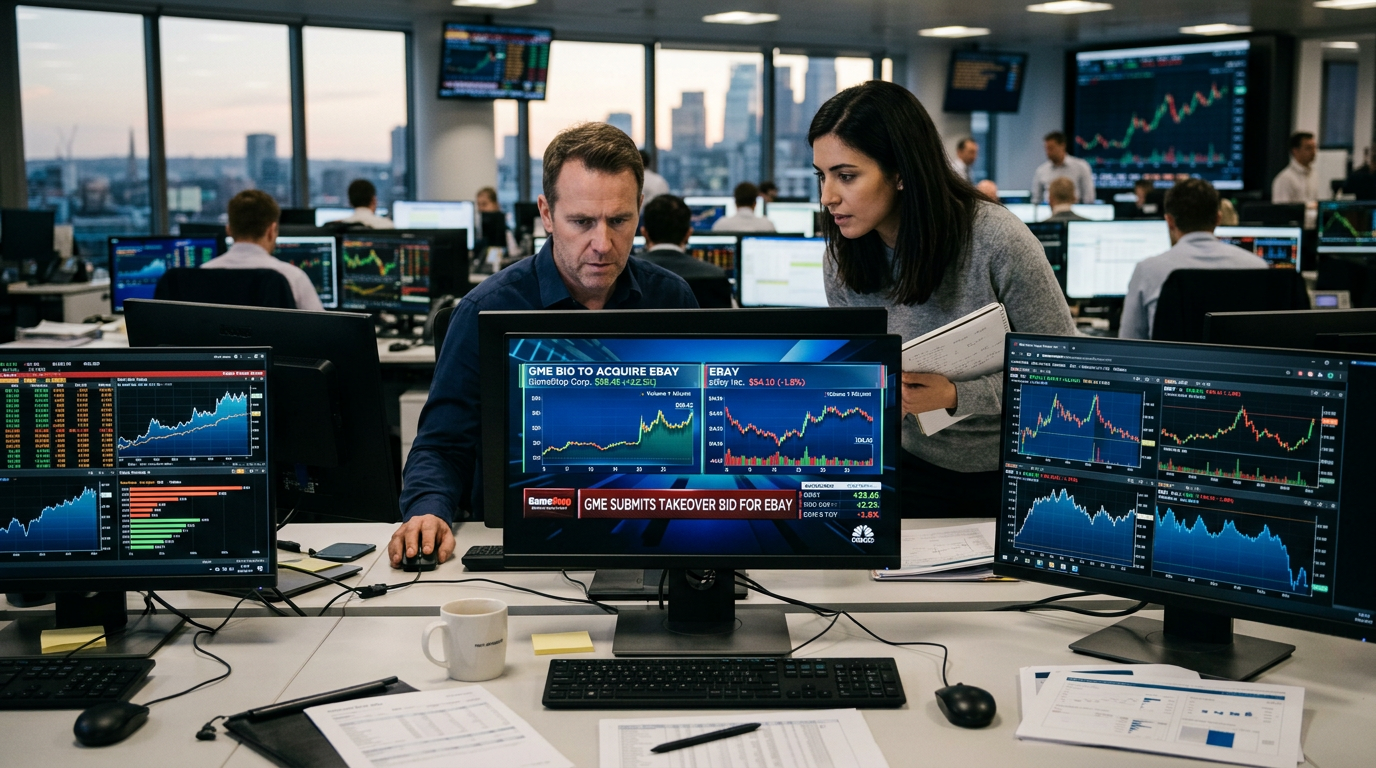
Sunday evening, GameStop Corp. (NYSE: GME) dropped a non-binding proposal to acquire eBay Inc. (NASDAQ: EBAY) for $125 per share – half cash, half GME stock – valuing eBay at roughly $55.5 billion. That’s a 20% premium to eBay’s Friday close of $104.07, and a 46% premium to where the stock was trading on February 4, when Ryan Cohen quietly started building a position.
The market’s Monday reaction told you most of what you need to know about how this was received: EBAY climbed ~5% to around $109, well short of the offer price. GME sank roughly 10%. That spread – and that asymmetry – is the entire setup in one sentence. Investors believe something might happen, but they don’t believe the deal closes as written.
Here’s the thing – the instinct to dismiss this as a meme stunt misses the nuance. And the instinct to chase it as a done deal misses the structural reality. The trade lives somewhere in between.
Rickards: “Trump’s Gold Mine” to Deliver 10X Gains In a Few Months
According to Jim Rickards – the world’s #1 gold expert and a man with close ties to Donald Trump’s “inner circle”…
The president is about to unleash a major new gold initiative…
One that opens up the largest gold deposit in the entire world – right here on U.S. soil…
And that is valued at over $1 TRILLION.
Today, Jim has revealed one of his favorite ways to play this gold boom – 100% FREE.
The Numbers First
Let’s actually look at what’s on the table. GameStop plans to fund the offer using its $9.4 billion of cash and liquid investments on its balance sheet and up to $20 billion in financing, backed by a letter from TD Securities. The company holds just over $9 billion in cash and has accounted for its $368 million Bitcoin stash as “receivables” after a Coinbase Prime transfer. Those two items form GME’s entire funding base before equity issuance enters the picture.
GameStop’s current market value sits just below $12 billion, while eBay’s is $46 billion. So a company worth $12 billion is trying to buy one worth $46 billion in a deal priced at $55.5 billion. The combined cash, market cap, existing 5% eBay stake, and $20 billion debt financing commitment would not amount to the $56 billion required – which raises serious questions about how they’d close the financing gap.
GME posted quarterly revenue of about $1.10 billion, with gross margin near 33% and operating income of $91.1 million – the company is profitable, not stressed. Since Cohen took over, GameStop swung from a $381 million net loss in fiscal 2021 to $418 million in net income in fiscal 2025. That’s the credibility foundation he’s standing on.
On the eBay side: eBay reported 135 million active buyers last quarter and Q1 2026 revenue guidance of $3.00 billion to $3.05 billion. The stock is up roughly 52% over the past year, which partly explains why the bid math is tight.
Why Cohen Is Doing This Now – And What He’s Selling
The strategic rationale isn’t invented. eBay has been pushing collectibles and used goods on its marketplace – categories directly relevant to video-game enthusiasts and overlapping with the GameStop customer base. Limited releases and hard-to-find items regularly sell at a markup on eBay, capitalizing on scarcity. Collectibles now represent 33.1% of GameStop’s Q4 net sales – that’s the customer overlap Cohen is selling.
Slight tangent, but it matters: the acquisition plan raises fresh questions about whether GameStop will sell its Bitcoin to help fund the deal. Cohen described the plan as “way more compelling than bitcoin” and left open the option of liquidating the company’s crypto holdings. If BTC gets sold into this, traders in that space are watching a different catalyst entirely.
In a memo to investors, Cohen’s company pledged to find $2 billion of annual savings within 12 months of closing. On cost alone, that would lift eBay’s diluted GAAP EPS from $4.26 to $7.79 in year one. That’s the bull case thesis in a single line. Whether you believe it depends on how you weight Cohen’s execution track record against the complexity of integrating a global marketplace at this scale.
Cohen has been explicit about his ambition: “I’m thinking about turning eBay into something worth hundreds of billions of dollars.” In January, the company unveiled a compensation package that would reward him with options on over 171 million shares if he lifted GameStop’s market value to $100 billion. The incentive structure is aligned with a go-big outcome, not a conservative one.
The Friction Points
eBay confirmed it received the offer and noted there had been no prior discussion or outreach from GameStop before receiving it. That matters. Cohen told CNBC on Monday he hadn’t started any conversation with eBay’s management. This is a cold, public, pressure-first approach – not a negotiated deal. Whether eBay’s board engages or stonewalls is the first binary.
The skeptics are loud and credible. Michael Burry – who holds GME shares and once compared Cohen to Warren Buffett – called the strategy “pedestrian” and said the intention must be to dominate collectibles and used goods rather than truly compete with Amazon. He noted he may sell some or all of his shares by end of week. That’s not a ringing endorsement from someone who knows the company well.
Bloomberg Intelligence analysts said they see “low probability of a deal,” noting the companies overlap in collectibles and resale but framing structural concerns around the combination. The arb spread – EBAY trading near $109 against a $125 offer – is the market’s way of saying the same thing without words.
- Offer price: $125/share (50% cash, 50% GME stock) – 20% premium to Friday’s close
- Implied deal value: ~$55.5 billion
- GME cash available: ~$9.4B (includes ~$368M BTC position)
- Committed debt financing: Up to $20B from TD Securities (non-binding)
- GME market cap: ~$11.9B vs. eBay market cap ~$46.2B
- Projected cost synergies: $2B annually within 12 months of close
- eBay active buyers: 135 million | Q1 2026 revenue guide: $3.0–$3.05B
- GME collectibles as % of Q4 sales: 33.1%
Your Download Link Will Expire
If you still haven’t downloaded my free “Simple Options Trading For Beginners” guide…
…please take a few seconds and download it right now before your new temporary download link expires.
I eventually plan to charge money for this training, so do yourself a favor and download it now…
That way, no matter what it costs in the future, you’ll have a free copy on your computer.
Make sense?
Technical Levels to Monitor
For GME: support is forming in the $24 area, with resistance around $26–$27. Until the market gets clarity on the eBay deal, expect GME to remain in a volatility band with sharp squeezes and flushes as headlines hit the tape. The 200-day moving average near $24.40 is the line that defines whether this holds as a technical base or breaks toward a deeper retest. Volume confirmation matters here – a sustained move above $27 without volume looks like a fade candidate.
For EBAY: the stock at ~$109 implies the market is embedding roughly a 30–40% probability that the deal closes at or near the stated terms. A credible counter or board engagement pushes EBAY toward the $115–$120 range. A rejection or financing failure pulls it back toward $95–$98, where it was trading before the deal leak. The spread right now is not wide enough to justify aggressive arb sizing – there’s too much binary risk packed into the structure.
Three Scenarios
Bull Case
eBay’s board engages after shareholder pressure builds. Cohen firms up financing commitments beyond TD Securities’ non-binding letter, potentially through equity issuance or BTC liquidation. A negotiated deal lands near $127–$132/share, EBAY trades to $122–$128, and GME stabilizes near $27–$30 as the market reprices Cohen’s execution credibility. The $2B synergy target, if modeled into consensus, re-rates eBay’s EPS trajectory meaningfully.
Base Case
The bid remains live but unresolved through Q2. eBay doesn’t formally reject, doesn’t formally engage. The deal enters a drawn-out standoff while Cohen builds shareholder pressure and potentially pursues a proxy fight. EBAY holds a modest premium in the $107–$112 range, GME consolidates between $23–$26. Both names stay noisy but range-bound. Event-driven traders find setups; positional traders find frustration.
Bear Case
Financing falls apart. TD Securities’ non-binding letter fails to convert into a committed facility. eBay’s board issues a formal rejection, framing the bid as inadequate and structurally unsound. EBAY retraces toward $95–$98, erasing the premium entirely. GME falls back toward $21–$23, testing and potentially breaking below the 200-day. Burry and other institutional holders begin reducing. Short interest re-accelerates. The failed bid gets framed as capital misallocation and Cohen’s credibility takes a hit heading into the back half of 2026.
How to Frame the Trade
Event-driven setups like this one punish traders who size too large before the structure clarifies. Implied volatility in GME options historically expands dramatically during announcement cycles – which means directional options plays right now are expensive. Defined-risk structures like vertical spreads let you express a view while capping premium bleed during the uncertain resolution phase.
For EBAY arb players: the math is tighter than it looks. A full deal collapse implies 12–15% downside from current levels. A clean deal confirmation adds only 14–17% upside to the stated offer. That’s not a compelling asymmetry for aggressive sizing. Conservative allocation, defined exits, and a clear invalidation level – EBAY below $101 is a signal the premium is evaporating – frame this more cleanly than momentum does.
For GME: the $24 level is the technical and psychological line. Below it, the deal thesis starts to lose market credibility. Above $27 with volume confirmation, speculative positioning has room. The part most traders skip is the middle – between $24 and $27, there’s no edge. Just noise.
The Man Who Called Nvidia Before It Soared 1,000% Issues New Elon Musk BUY Alert
Luke Lango was ranked America’s #1 stock picker in 2020. He was mentored by two hedge fund billionaires from the Soros network and trained at Caltech. His readers have had the chance to see gains as high as AMD +8,500%… Nvidia +5,000%… Tesla +3,500%… Palantir +1,000%… and Apple +890%.
Preparation Over Prediction
What’s interesting is that this deal is both more credible and more structurally challenged than it first appears. The strategic overlap is real. The financing gap is real. Cohen’s track record as an operator is real. The execution risk of integrating a $46 billion global marketplace into a $12 billion retailer is also very real.
The traders who navigate this best won’t be the ones who called the outcome. They’ll be the ones who defined their levels before the next headline, sized appropriately for a binary environment, and stayed willing to change their view when the evidence changed.
This isn’t a story to chase. It’s a framework to monitor – precisely, and with both hands on the risk controls.
For informational and educational purposes only. Not investment advice. Trading involves risk, including loss of principal.