May 10, 2026
The Semiconductor Arms Race Is Widening
Wall Street is rotating within AI chips. Here’s what the data is telling traders right now.
Something shifted in the chip trade this month, and it’s worth slowing down to look at it properly.
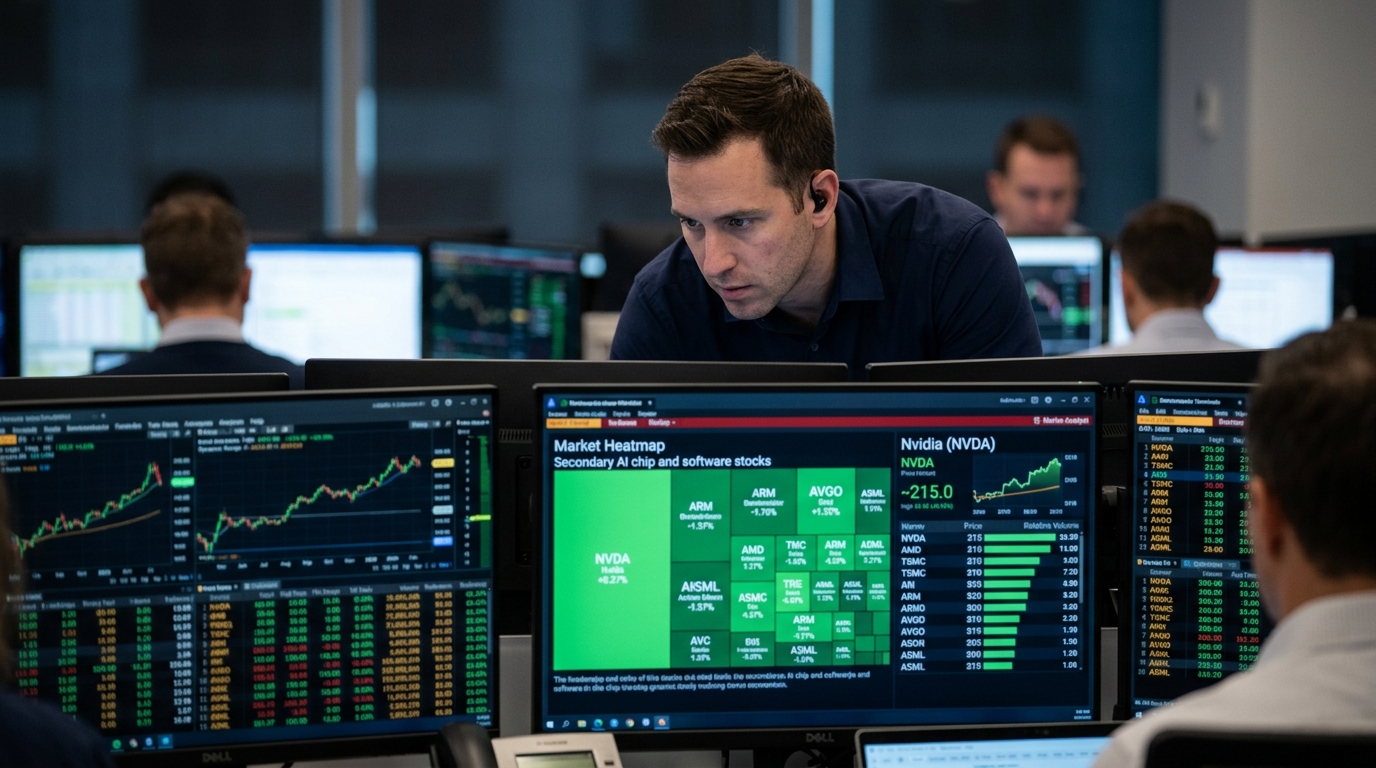
Nvidia is still the center of gravity for AI infrastructure — market cap around $5.23 trillion, stock trading near $215 and touching an all-time high of $217.80 on May 9. The company’s fiscal Q1 FY2027 results drop on May 20, and options markets are pricing in a 10%-plus implied move in either direction. Management already guided $78 billion in revenue for the quarter, which would represent 77% year-over-year growth. That’s the number Jensen Huang will be measured against. Analysts are watching for updates on the Vera Rubin timeline and any commentary on 2027 trajectory. But here’s the thing — Nvidia is up only about 15% year-to-date in 2026. That’s barely ahead of the Nasdaq.
AMD is up 66% over the same stretch.
That divergence is the real story. AMD reported Q1 2026 revenue of $10.3 billion — up 38% year-over-year — beating consensus estimates of $9.85 billion by more than 4%. Data Center revenue hit $5.8 billion, a 57% year-over-year increase, driven by strong demand for EPYC processors and the continued ramp of Instinct GPU shipments. The company raised Q2 guidance to approximately $11.2 billion, which at the midpoint implies 46% year-over-year growth — well ahead of Street expectations near $10.5 billion. CEO Lisa Su described the results as reflecting “a clear inflection in our growth trajectory,” pointing to inference and agentic AI as structural demand drivers for both CPUs and accelerators. Non-GAAP free cash flow hit a record $2.6 billion, tripling year-over-year. AMD also signed a 6-gigawatt GPU deployment agreement with Meta in February, with initial shipments of custom MI450-based chips on track for the second half of 2026.
FREE Gold Ticker to Buy ASAP: (NYSE:___)
Jim Rickards – the world’s #1 gold expert – has just revealed one of his favorite gold plays… 100% FREE.
As Jim sees it, we’re witnessing the biggest gold boom of the last 100 years – and those who keep their money on the sidelines are missing their chance at a fortune thanks to gold’s epic run.
But smart investors who get in now, could make 10X their money in the coming months.
Intel’s run in 2026 has been extraordinary by any measure. The stock is up roughly 170%–197% year-to-date depending on the date, recovering from deeply depressed levels after a multi-year slump. Q1 2026 revenue came in at $13.6 billion, up 7% year-over-year, with adjusted EPS of $0.29 — beating consensus estimates of roughly $0.01 by a wide margin. Data center revenue grew 22% year-over-year. A $5.7 billion CHIPS Act disbursement, a $5 billion equity investment from Nvidia, a Tesla foundry deal for 14A chips, and preliminary Apple chip manufacturing discussions have stacked up as catalysts. Intel’s market cap has surged past $585 billion as of May 9. CEO Lip-Bu Tan said plainly on the Q1 call: demand is outpacing supply across business segments. The 14-day RSI hit above 80 in early May — deep in overbought territory — and the average analyst price target still implies significant downside from current levels, which is worth keeping in mind.
Micron is the other name that demands attention. The memory maker’s market cap crossed $842 billion as of May 9 — up roughly 124% year-to-date and nearly 700% over the past twelve months. CEO Sanjay Mehrotra said on Micron’s most recent earnings call that key customers are receiving only “50% to two-thirds of their requirements” due to supply constraints. High Bandwidth Memory demand is structural, not cyclical — Nvidia’s upcoming Vera Rubin architecture co-designs HBM4 as a core component, and Micron is one of only three companies globally that can supply it at scale.
What the Sector Divergence Means for Positioning
The spread between semiconductor sub-sectors is widening in ways that matter for decision frameworks. Nvidia trades at roughly 26x forward earnings — actually the lowest forward multiple among its closest peers, partly because the China export control overhang is real. AMD’s forward P/E sits in the 45–57x range depending on methodology, well above its recent historical averages. That’s a significant premium for a company whose Data Center AI GPU ramp is still in early innings. Any execution miss on the MI450 timeline or Helios rack-scale rollout could compress that multiple quickly.
Broadcom rounds out the core watchlist. Rather than competing in general-purpose GPU acceleration, Broadcom specializes in custom AI processors — application-specific integrated circuits built for the hyperscalers’ proprietary AI architectures. Amazon, Google, and Microsoft are all deploying custom silicon at scale, and Broadcom sits in the middle of those procurement flows. Broadcom’s forward multiple is approximately 31x, sitting between Nvidia’s relative cheapness and AMD’s premium.
The upstream driver for all of this is hyperscaler capital expenditure, which has reached a scale that would have seemed impossible two years ago. Microsoft, Meta, Amazon, and Alphabet collectively committed to spending approximately $700 billion on AI infrastructure in 2026 — some estimates now put the figure closer to $725 billion after Q1 earnings updates raised guidance across the board. Meta raised its full-year capex to $125–$145 billion, Microsoft guided to $190 billion for calendar 2026, and Alphabet increased its target to $180–$190 billion. Amazon is spending an estimated $200 billion this year. The combined quarterly capex from these four companies roughly doubled year-over-year in Q1. That spending is the upstream demand signal for the entire semiconductor supply chain.
For context on where this ends up: Nvidia’s own fiscal 2026 annual revenue was $215.9 billion, up 65% year-over-year, with data center accounting for $193.7 billion of that total. Jensen Huang told analysts at GTC 2026 that he sees “at least $1 trillion” in purchase orders for Blackwell and Vera Rubin through 2027 — double the figure he cited a year earlier. Those numbers underpin the bull case.
Technical Framework
For NVDA into the May 20 report: the stock hit an all-time high of $217.80 on May 9 and pulled back slightly to close near $215. The $210–$212 zone represents near-term support. A clean hold above that level into the report maintains the bull structure. A break below $205 prior to results changes the risk picture materially. Options-implied move of 10%-plus means the market is pricing in a wide range of outcomes — position sizing should reflect that uncertainty. Volume has been running below the 157M daily average, which is worth watching as the date approaches.
For AMD: the stock surged roughly 16% after hours following the May 5 earnings report, briefly trading above $413. After that initial reaction, watch whether it can sustain levels above its prior 52-week high. A fade back below the breakout zone without consolidation is a caution signal for momentum-oriented positioning. AMD has now gained over 100% in some trailing twelve-month windows — that kind of run creates elevated expectations for every subsequent quarter.
For Intel: the RSI hit 80.5 on May 7, and the stock has moved so fast — 107% in a single month — that the technical picture is almost entirely about mean reversion risk. Wall Street’s average price target sits well below current levels. The fundamental thesis may still be intact, but the technical entry looks stretched by almost any measure.
Your Download Link Will Expire
If you still haven’t downloaded my free “Simple Options Trading For Beginners” guide…
…please take a few seconds and download it right now before your new temporary download link expires.
I eventually plan to charge money for this training, so do yourself a favor and download it now…
That way, no matter what it costs in the future, you’ll have a free copy on your computer.
Make sense?
Scenario Modeling
Bull Case: Nvidia’s May 20 report delivers $78B+ revenue and Q2 guidance above the $86.6B Wall Street consensus, signaling that Blackwell demand is absorbing the China export control headwind cleanly. AMD sustains Data Center revenue above $5.5 billion in Q2, confirming the MI450/Helios ramp is on track. Memory supply constraints support Micron margin expansion through Q3. The PHLX Semiconductor Index — which has already staged a meaningful year-to-date recovery — extends further as institutional flows broaden across the sector.
Base Case: Nvidia meets the $78B guidance but Q2 guidance is roughly in line with consensus near $86.6B, producing a muted reaction after an already extended run. AMD holds its valuation premium on continued hyperscaler demand but the stock consolidates rather than breaking out further. Intel and Micron give back some gains after parabolic moves but retain structural support from the AI capex cycle. The broadening within semiconductors continues but at a slower pace.
Bear Case: Nvidia’s May 20 results disappoint relative to the $78B guidance — perhaps on gross margin compression from the H20 export control hit or weaker-than-expected Blackwell shipment timing. AMD’s elevated forward multiple compresses sharply if MI450/Helios ramp timelines slip even slightly. Intel, after a 197% YTD run with a trailing P/E above 900x and persistent GAAP net losses, becomes vulnerable to a sharp reversal if any catalyst disappoints. The China revenue risk Nvidia has already flagged — approximately $50 billion in potential annual demand now effectively shut out — re-emerges as a broader sector concern.
Active Trader Framework
Nvidia’s May 20 date is the single most important near-term catalyst in this market. Position sizing into that event should account for the wide options-implied range. For traders not wanting binary earnings exposure, Broadcom and TSMC offer more diversified exposure to the AI infrastructure build with less event-specific risk in the immediate term. TSMC reported Q1 revenue growth of 41% year-over-year in USD terms and raised its 2026 revenue growth guidance above 30%. That’s a foundational data point for the entire AI thesis — and it doesn’t come with a single-day binary event risk attached.
The broadening within semiconductors — from Nvidia dominance toward Intel, Micron, AMD, and Broadcom capturing real institutional flows — is the defining rotation in tech right now. CNBC noted that Wall Street is already calling it a “changing of the guard in AI.” Whether that framing holds depends almost entirely on whether Nvidia’s May 20 results validate the demand story or raise questions about it. Either way, the answer will matter for everything else in this sector for the next quarter.
Preparation over prediction. The data is unusually clear right now — the numbers from AMD, Intel, and Micron all point in the same direction. The remaining question is whether Nvidia’s results confirm or complicate that picture. Knowing in advance which levels matter and how much risk you’re carrying into May 20 is more valuable than being right about the direction.
STOCK WARNING: Move Your Money This Monday
20-year trading veteran Tim Bohen just identified a dirt-cheap stock that could soar 100% or MORE this coming Monday…
Click here for the full details on this urgent opportunity now.
For informational and educational purposes only. Not investment advice. Trading involves risk, including loss of principal.