May 26, 2026
NIO Falls 7% on Its Best Quarter Ever
Record revenue, three brands, a real margin story — and traders sold it anyway
First a note from America’s Gold Company
Dear Reader,
JPMorgan. Goldman. Morgan Stanley. In total, 21 banks are brokering the SpaceX IPO.
They will collect billions in fees on a deal that was done before you heard about it.
By the time you can buy a single share, the people who built the system will have already made 30 times their money.
That’s not a surprise. That’s the plan.
But here’s what they’re not telling you…
While every financial newsletter in America is hyping SpaceX, the world’s central banks have been buying gold, 850 tonnes last year alone.
Not shares. Not funds. Not pie in the sky. Actual physical gold. The one asset that exists entirely outside the system.
Ask yourself why the institutions that created the paper money system keep moving their own reserves into the one thing that doesn’t depend on it.
Then ask yourself why your retirement is still 100% inside the system they’re quietly stepping away from.
We put together a free 2026 Gold Guide on exactly what they know and what you can do about it.
It costs nothing. Takes 30 seconds to request.
The insiders already made their move.
Now it’s your turn.


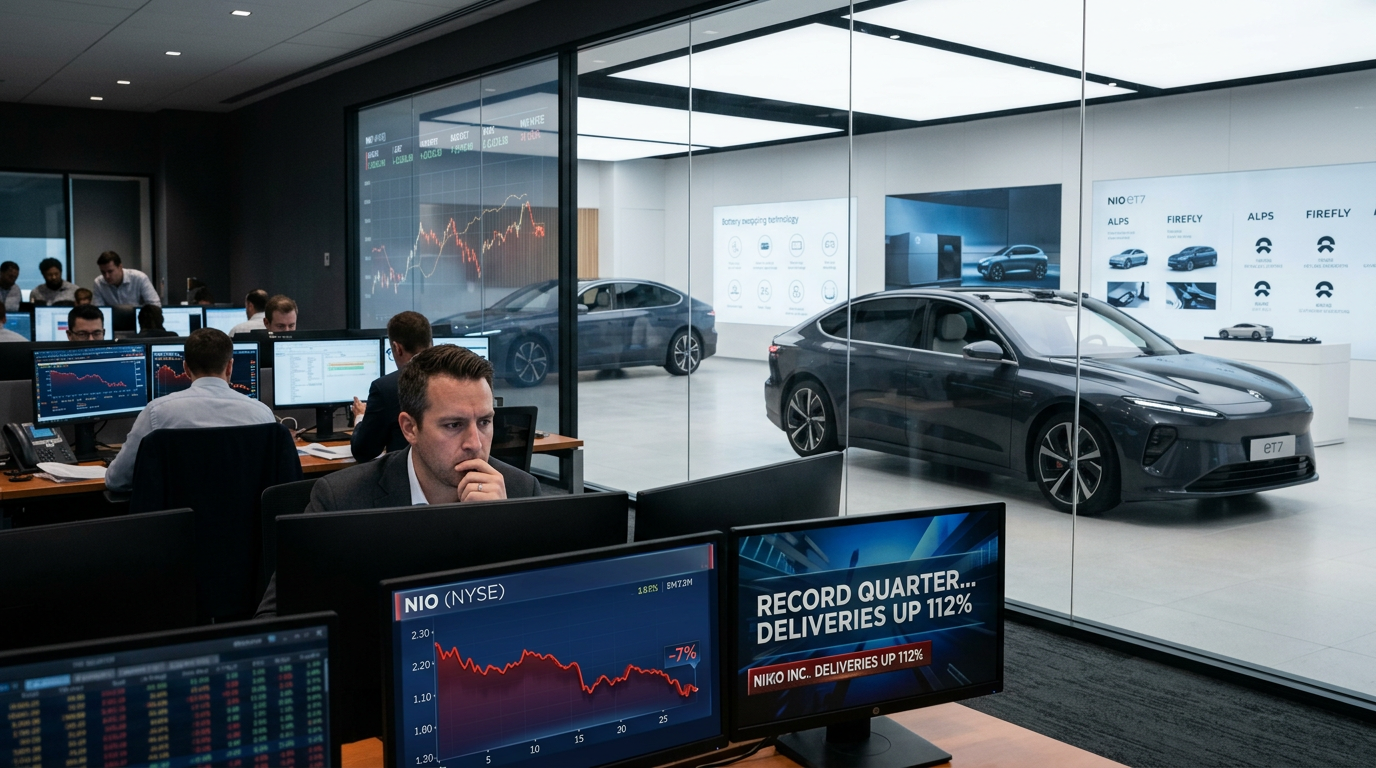
NIO Inc. (NYSE: NIO) | $5.20 | –7.14% | May 26, 2026
Revenue up 112%. Deliveries nearly doubled. Second consecutive quarter of non-GAAP profitability. The stock dropped 7%.
That’s the whole story, and it’s worth sitting with for a second.
NIO’s Q1 2026 totals came in with revenues soaring 112.2% year-over-year to RMB 25.5 billion, fueled by a 98.3% jump in deliveries to 83,465 vehicles. That delivery result exceeded the upper end of NIO’s own guidance range of 80,000 to 83,000 units. Vehicle margin climbed to 18.8% from 10.2% a year ago — the fourth consecutive quarterly improvement — while total gross margin reached 19.0%. The company swung to a non-GAAP operating profit of RMB 66.8 million and generated positive operating cash flow, ending the quarter with RMB 48.2 billion in cash.
So why is it down 7%? The honest answer: sequential optics and positioning unwind.
Total revenues were up 112% year-over-year but down 26.3% quarter-over-quarter. April deliveries came in at 29,356 vehicles — up 22.8% from a year ago but trailing March’s 35,486 units. That sequential step-down is what gave traders the opening they needed. When traders who positioned ahead of an earnings release begin unwinding bets after the numbers hit, the stock can fall even when the results are positive. Shares are still up 42% over the past year, so there was plenty to take off the table.
What matters is that the structural story didn’t change on Thursday. If anything, it got cleaner.
Who NIO Actually Is
NIO is a global smart electric vehicle company founded in November 2014 — and notably, the first car company listed simultaneously on the NYSE, HKEX, and SGX. Most people still think of it as a single-brand Chinese EV startup. That framing is a few years out of date.
NIO now operates three major brands: NIO for premium buyers, ONVO for family-oriented vehicles, and FIREFLY for compact high-end EVs. The company has filed for and obtained over 9,900 patents, and currently offers eight models under the NIO brand, two under ONVO, and one under FIREFLY.
As of March 31, 2026, cumulative deliveries reached 1,081,057 vehicles — crossing the one million mark and reinforcing its position as a leader in China’s smart EV industry.
The three-brand structure is essentially NIO’s attempt to occupy three different price tiers without cannibalizing itself. Whether that works at scale is still an open question — but Q1 showed all three contributing meaningful volume for the first time. NIO brand contributed 58,543 deliveries, ONVO 13,339, and FIREFLY 11,583, with each cited as market leaders in their respective segments.
In at 9:35 AM. Out by 10.
I call it the “Opening Bell Breakout.” It’s the same setup I used to catch moves like 113% on GOOGL and 240% on META. I trade one simple 15-minute window each morning – and I’m usually done by 10 AM.
Slight tangent, but it’s relevant: the battery swap network is the part of this company that still gets underestimated outside China. NIO’s swap infrastructure hit 100 million cumulative swaps earlier this year, with plans to add over 1,000 new stations in 2026. NIO currently operates 3,846 battery swap stations in China, with the main NIO brand having access to all of them and the ONVO sub-brand connected to most.
The fifth-generation stations represent a fundamental redesign of NIO’s swap infrastructure. The current fourth-generation system, deployed since June 2024, can store up to 23 batteries and complete a swap in under three minutes, but only supports the NIO and ONVO brands. The new stations are being built from the ground up to accommodate all three NIO Inc. brands from a single piece of infrastructure. The company plans to deploy five to ten pioneer fifth-generation stations between May and June for trial operations, with large-scale deployment set to begin in July and August.
CEO William Li reaffirmed that NIO expects to end 2026 with between 4,500 and 4,600 battery swap stations in total operation. That’s a network competitors cannot replicate quickly, and it creates real switching costs at scale.
On the autonomous driving side, NIO’s ES9 is powered by the company’s proprietary NX9031 — the world’s first 5nm automotive-grade chip for smart driving — alongside NIO WorldModel (NWM), described as China’s first world model for smart driving. Gross margin expanded to 19% from 7.6% year-over-year, while R&D fell 40.7% YoY and SG&A dropped 20.5% YoY — meaning NIO is getting more efficient, not just bigger.
The Competition Problem
The China EV market has roughly 50 brands fighting for position. Only a handful of those producers are actually profitable. Market concentration has increased sharply — the top ten manufacturers now account for around 95% of the Chinese new energy vehicle market, up from roughly 60–70% just a few years ago.
NIO’s direct competition comes from BYD, XPeng, Li Auto, Xiaomi, and Huawei-backed AITO. Each is pushing into the premium segment with different angles. Xiaomi delivered 39,000 vehicles in January alone, up 70% year-over-year, leveraging its electronics ecosystem for rapid market share gains. XPeng rolled out its new GX SUV — a full-size model priced between 279,800 yuan and 359,800 yuan — aimed directly at the same higher-end buyers NIO targets.
Experts note that NIO, XPeng, and Li Auto’s heavy investment in in-house smart driving R&D is largely aimed at supporting company valuations, positioning themselves more like AI firms developing automotive applications than traditional automakers. That framing has worked in certain quarters. Whether it continues to is less certain.
UBS China auto research head Paul Gong has called intense domestic competition an “enemy within,” referencing the Chinese concept of neijuan — the kind of competition that erodes sustainable growth and makes profits elusive even as sales volumes rise. NIO is closer to escaping that trap than it was 12 months ago. It’s not out of it yet.
The forward guide gives Q2 deliveries of 110,000 to 115,000 units. Management guided Q2 revenue at $4.75 billion to $4.99 billion, supported by the NIO ES9 SUV with deliveries beginning May 27, 2026, and the ONVO L80. That implies year-over-year delivery growth of 52.7% to 59.6%, with Q2 revenues projected between RMB 32.78 billion and RMB 34.44 billion — growth of 72.4% to 81.2% year-over-year.
The most significant piece of context is the longer arc: NIO spent more than a decade losing money at scale, and the past two quarters have produced the first credible evidence of sustainable profitability. A $5 stock with those numbers either re-rates or it doesn’t. The Q2 delivery ramp will tell you which way that’s heading.
— The Editors