July 2, 2026
USMCA Just Hit Its Deadline. The U.S. Didn’t Renew It.
The $2 trillion trade framework covering North America is now in limbo.
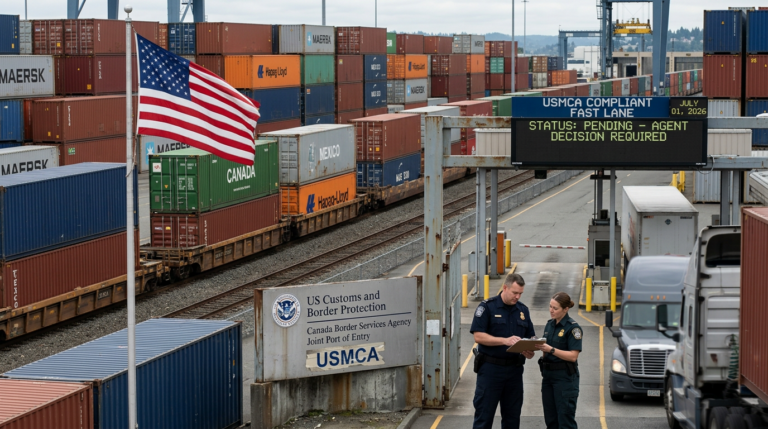
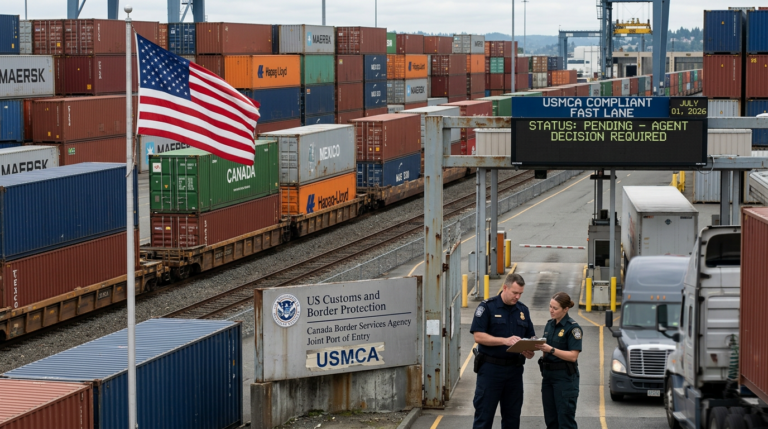
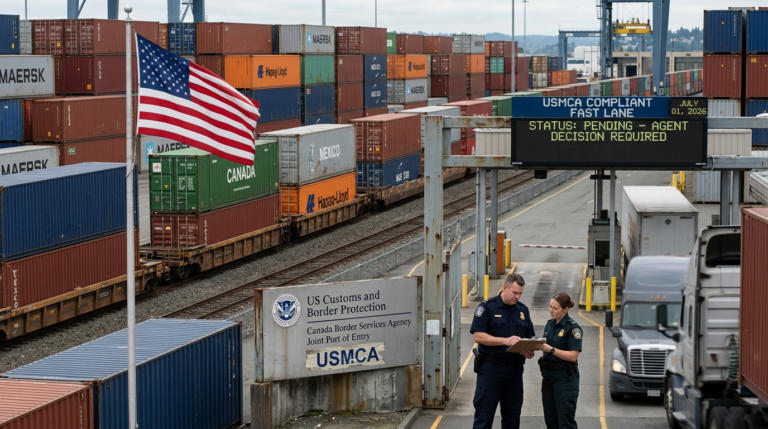
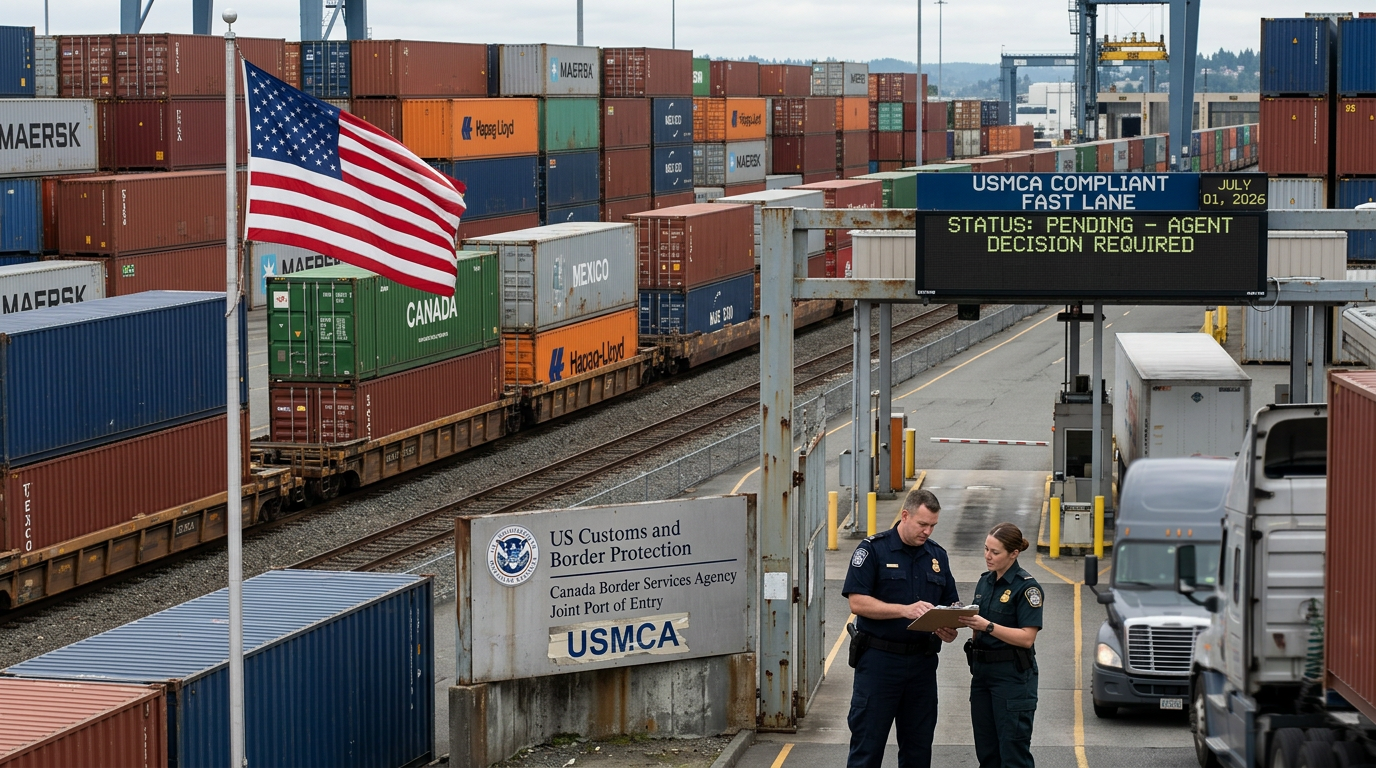
Today is July 1, 2026. Six years to the day since the USMCA took effect. And the U.S. missed the renewal deadline.
Markets barely moved. That’s probably a mistake.
Trump Just Executed a Bloodless Coup. Nobody Noticed.
For the first time ever, a sitting U.S. President has effectively seized control of the world’s most powerful financial institution.
Trump didn’t just stack the Fed board.
And when it starts on May 15th…
A handful of little-known stocks could deliver 1,000%+ gains in 12-24 months.
Discover details on 3 stocks that could explode imminently – and get one FREE ticker symbol today.
Trade representatives from the U.S., Canada, and Mexico faced today’s first review deadline for the US-Mexico-Canada free trade agreement — and President Trump has said he does not intend to renew the agreement in its current form. Which means what was supposed to be a procedural checkpoint has become something much messier. July 1, 2026 is a high-stakes day for North American trade. The Free Trade Commission convenes to begin the first formal joint review, and the outcome will either lock in 16 years of relative stability or trigger annual renegotiations through 2036, keeping organizations in a sustained state of uncertainty for the better part of a decade.
What’s Actually at Stake
The USMCA governs nearly $2 trillion in annual trade and supports millions of U.S. jobs. This is not a symbolic agreement. Together, Canada and Mexico accounted for more than $1.8 trillion in goods and services trade in 2024, largely supporting the manufacturing, agriculture, and energy sectors.
Here’s the part people are skipping past: The review provides the countries with just two options. Option A is choosing a 16-year extension, which would keep the deal in place until 2042. Option B is choosing not to extend, which would trigger a fresh round of renegotiating the agreement, with no clear end point until the three sides reach a deal. The U.S. just chose Option B. Effectively.
Slight tangent, but it matters: the auto sector is the nerve center of this entire negotiation. About 18% of trade with Canada and Mexico last year was in the auto industry, making it one of the key sectors in the discussions. And the auto sector has already faced an increase in tariffs of nearly 625% due to Section 232 tariffs, leading to a 10% drop in imports and a 19% drop in exports in the year after Liberation Day. Another round of uncertainty lands on an industry that’s already absorbing body blows.
The Sector Breakdown
Despite strong incentives for all three countries to maintain the agreement, the review creates real compliance and policy risks. Enforcement risks are unlikely to be spread evenly. Automotive carries the highest operational risk — rules of origin, labor enforcement, and tariff pressure will likely drive more frequent origin audits across manufacturers and suppliers.
Electronics faces growing scrutiny as nearshoring has expanded Mexico-based manufacturing. Products with components of Chinese origin will attract heightened attention — a direct byproduct of U.S.-China trade policy intersecting with USMCA enforcement.
That last point deserves more attention than it’s getting. China has been routing components through Mexico to bypass U.S. tariffs. U.S. Trade Representative Greer has made stopping that a top priority. China has been bypassing U.S. tariffs by importing American goods through Mexico, which is key to revamping the treaty. Any renegotiation that tightens rules of origin will directly disrupt electronics and EV supply chains that have spent the last three years building out Mexico-based capacity.
What the Negotiations Look Like Right Now
Formal negotiation rounds are already underway, including a first U.S.-Mexico bilateral round concluded in late May 2026, where negotiators discussed automotive rules of origin, steel and aluminum trade, and economic security. Additional discussions are expected to continue in the coming weeks, though talks have so far proceeded without Canada.
U.S. and Mexican officials are scheduled to have discussions in Mexico City during the week of July 20. Talks with Canada haven’t started, though relations with the northern country have soured over the past year and a half.
The political calendar complicates everything. The November 2026 midterm elections will add complexity. Although the new Congress takes office in 2027, campaign politics will dominate throughout 2026. Lawmakers from key manufacturing and agricultural states may pressure the White House to use the review to extract concessions from Mexico and Canada.
Three Scenarios for Traders
Bull Case: A deal framework is announced before Labor Day. Trump packages it as a major win. Markets re-rate North American-exposed industrials, automakers, and agricultural stocks higher. One school of thought is that it would be politically advantageous for the Trump administration to get a deal by Labour Day so Trump could sell it as a big win and give the Republican Party an opportunity to campaign on the new-and-improved agreement.
Base Case: Talks drag into Q4 2026 and beyond. Uncertainty weighs on cross-border capital investment. Supply chain decisions get delayed. Manufacturing stocks and Mexico-exposed names trade with a discount that isn’t fully priced yet. Even if additional tariff hikes don’t materialize, years of bargaining would come with their own consequences. Supply chains are built with thirty-year visibility, not five, and uncertainty could dissuade investment and growth.
Bear Case: Removing USMCA exemptions would raise taxes by $466 billion from 2027 through 2036 — or about $300 per U.S. household in 2027 — and shrink U.S. output by 0.1% and hours worked by the equivalent of 95,000 full-time jobs. The automakers hit hardest would be those with deeply integrated North American production footprints: GM, Ford, Stellantis. Mexico-domiciled manufacturers with Chinese component exposure face a double hit.
What Markets Are Missing
The VIX is at 16.45 today. That is not the behavior of a market pricing a protracted trade renegotiation over $2 trillion in commerce. Either the market believes this gets resolved quickly, or it isn’t paying attention yet.
The stocks most directly exposed if this turns contentious: Ford (F), General Motors (GM), Stellantis (STLA), Aptiv (APTV), BorgWarner (BWA) on the auto side. Deere (DE) and Archer-Daniels-Midland (ADM) on agriculture. Any electronics assembler with Mexico-based operations using Chinese inputs faces potential rules-of-origin reclassification risk.
Technical and Positioning Framework
Watch the IYT (iShares Transportation Average ETF) and XLI (Industrials SPDR) for early signals. Both are closely tied to cross-border goods flow. If the USMCA uncertainty begins seeping into guidance language during the Q2 earnings season starting mid-July, those sectors reprice first.
The options market is the most interesting place to look right now. Implied volatility on automakers is compressed heading into a period of acute trade policy risk. That kind of dislocation tends to correct when earnings calls start surfacing the language of uncertainty.
What happens next depends almost entirely on whether the Trump administration treats this as a campaign asset or a governing problem. History suggests it may be both. And that means the timeline is genuinely unclear — which is itself the risk.
For informational and educational purposes only. Not investment advice. Trading involves risk, including loss of principal.