July 4, 2026
The Rotation Is No Longer a Theory
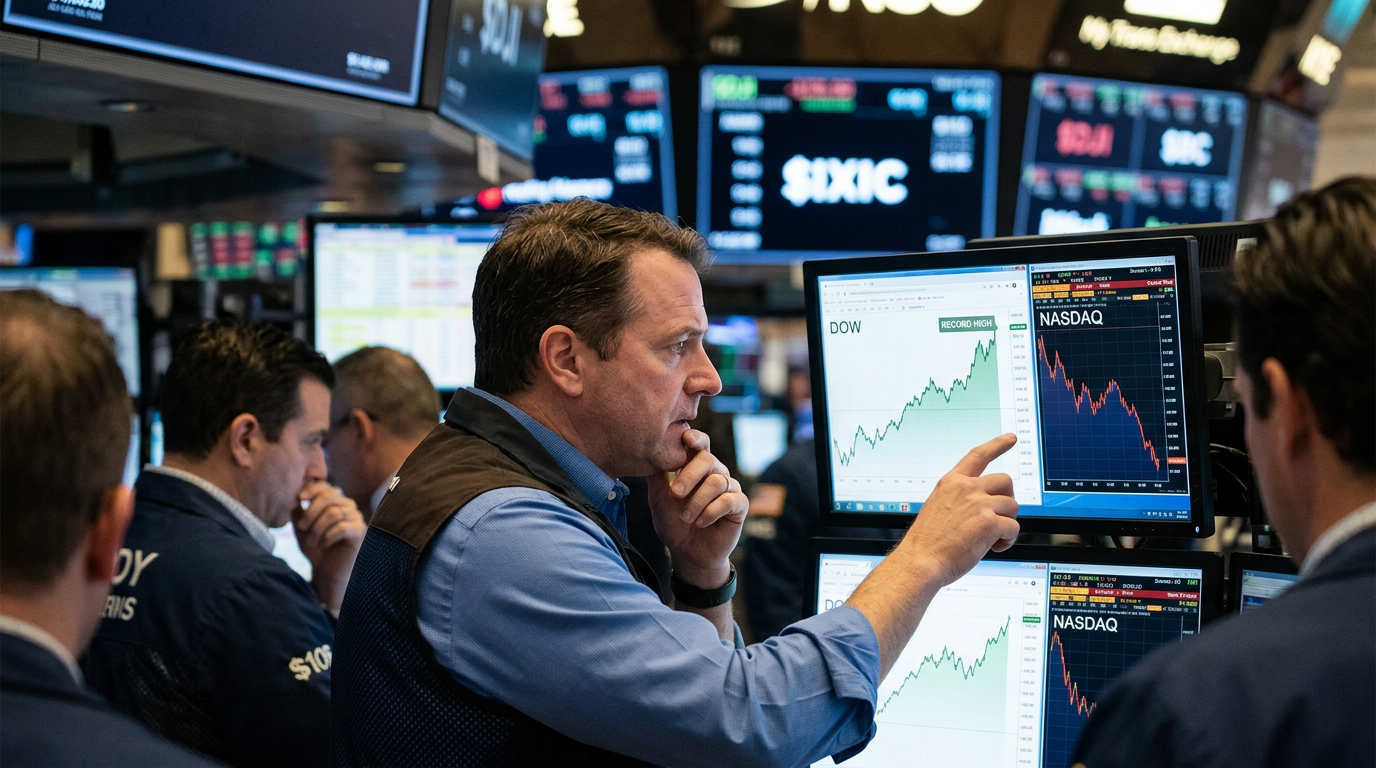
The Dow just hit a record while the Nasdaq sold off. That split has a message.
Hey there, bargain hunter.
Something shifted this week. Not gradually. Not in the background. Right out in the open, on July 2, while most of Wall Street was already checked out ahead of the long holiday weekend.
The Dow Jones Industrial Average closed at a record 52,900.07, up 1.14%. The Nasdaq dropped 0.80%. The S&P 500 finished the day essentially flat.
Those three numbers, side by side, tell you everything about what the market is actually doing right now.
America’s New AI “Mega Computer” to Span an Area Bigger than the State of Texas
The AI boom has been stalled for months. But according to legendary tech investor Louis Navellier, that’s about to change.
The world’s first AI “Mega Computer” – Golden Dawn – will come online in 2026. It will cover a territory larger than the state of Texas… and be more than 1 trillion times more powerful than Elon Musk’s Colossus. This company’s building it right now.
The catalyst most people focused on was the jobs report. The U.S. economy added just 57,000 jobs in June, roughly half of the 115,000 analysts expected. The unemployment rate dipped to 4.2%, though notably that drop came largely from a decline in labor force participation rather than new hiring. A softer labor reading pushed back expectations of an imminent Fed rate hike, and money rotated fast out of rate-sensitive semiconductor names and into traditional blue chips that had not needed the AI boom to perform.
But here is the thing. The jobs report was just the match. The kindling had been sitting there for months.
What Actually Happened
The semiconductor sector fell sharply on July 2, extending a two-day rout already underway before the jobs data hit. The VanEck Semiconductor ETF (SMH) dropped 4.5%, led by a 13.6% decline in Teradyne and an 11.5% slide in KLA. Micron lost another 5.5% after tumbling more than 10% the prior session. Sandisk fell more than 11% over two days, a combined drop exceeding 20%.
The real trigger was Broadcom. On June 3, Broadcom reported fiscal Q2 2026 revenue of $22.19 billion, up 48% year over year, with AI semiconductor revenue reaching $10.8 billion and growing 143% from the prior year. That was a beat on the AI number. But the stock cratered anyway. Management guided Q3 AI chip revenue at $16 billion, which came in below the $17.2 billion analysts had penciled in. Full-year fiscal 2026 AI chip guidance was held at $56 billion rather than raised. For a sector priced for perpetual beats, anything short of acceleration was treated as a warning.
The selloff that began in early June finally reached peak velocity around the time of the July 2 session. The Philadelphia Semiconductor Index (SOX) posted its worst single-day loss since the Liberation Day selloff in April 2025, dropping 10.3% on June 5 when the initial Broadcom reaction hit full force. The two-week bleeding wiped out an estimated $1.3 trillion in semiconductor market cap.
Meanwhile, Apple gained 4.8% on July 2. Visa rose nearly 3%. Walmart climbed. McDonald’s advanced more than 4% and Walt Disney gained more than 3%. Consumer companies, industrial manufacturers, healthcare businesses, and financial firms dominated the leaderboard. These are the unglamorous, dividend-paying, cash-generating companies that spent most of the last three years being ignored while the AI trade ran.
Why This Moment Feels Different
Sector rotations happen. They fade just as often as they stick. But this one is arriving at a specific moment with specific conditions behind it.
First, the broader index divergence over the first half of 2026 is striking. The Dow climbed 8.9% in the first six months of the year, its best first-half performance since 2021. The Russell 2000 surged 22% over the same period, its best first-half showing since 1991. That kind of small-cap outperformance signals renewed appetite for domestic, economically sensitive companies that have nothing to do with AI capex cycles. Consensus forecasts for Russell 2000 companies’ 2026 earnings growth have climbed to 38%, up from roughly 23% at the start of the year, according to LPL Financial.
Second, the valuation gap is extreme. Many high-quality companies in industrials, healthcare, consumer staples, and financial services are trading at multiples well below AI leaders while producing consistent cash flow, growing dividends, and stable earnings. Money coming out of 40x earnings names has to go somewhere.
Third, the macro is cooperating in a specific way. Slower job growth pushes back the odds of a near-term Fed move. The June FOMC meeting under Chair Kevin Warsh held the federal funds rate at 3.50% to 3.75%, but the dot plot showed nine of 18 officials favor at least one hike by year-end. Any softening in those hike expectations disproportionately helps the sectors left behind by the AI trade. The softer-than-expected June jobs reading shifted near-term rate hike odds lower almost immediately.
Millionaire warns: “Move your money now.”
Larry Benedict generated $274 million in profits for his clients by knowing where money flows when the Federal Reserve shifts.
He says Trump’s Fed Takeover is triggering the most significant shift in U.S. markets in nearly 20 years.
He’s already identified the one ticker he expects billions to flood into… and he’s giving away the name for free.
Click here to get the full details before the window closes.
The Dow crossed 50,000 for the first time on February 6. It just closed above 52,900. The index has now posted its best first half in five years. That is not noise. That is a market systematically rotating capital toward names that did not need the AI story to compound.
What the Market Is Missing
The TV debate is framed as tech vs. value. That framing misses the real question: is this rotation structural or cyclical?
The structural case is more compelling than it looks. U.S. equities now account for roughly two-thirds of global equity benchmarks, an extraordinary concentration. When allocations are that skewed, even modest rebalancing can have meaningful consequences. There is growing unease, particularly among European and UK allocators, about concentration risk in U.S. technology assets. Portfolio shifts often begin at the margin.
Here is where it gets interesting. The four major hyperscalers, Amazon, Google, Microsoft, and Meta, are projected to deploy approximately $725 billion in AI-related infrastructure in 2026, a roughly 77% year-over-year surge from roughly $410 billion in 2025. That capital flows into industrial, energy, and materials companies supporting the physical buildout. The AI trade has a second-order winner hiding inside it, and it looks a lot more like a Dow stock than a Nasdaq stock.
The Sectors Most Directly Affected
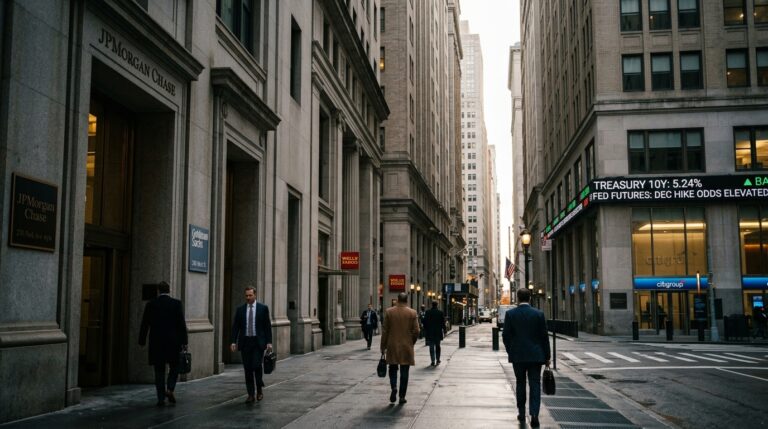
- Financials: JPMorgan, Goldman Sachs, Citigroup, and Wells Fargo all report Q2 earnings on or around July 14. If credit quality is holding, the rotation into financials has fundamental backing, not just momentum. Q2 earnings for major investment banks are expected to grow roughly 10% year over year on higher revenues.
- Industrials: Caterpillar remains a direct beneficiary of the $725 billion AI infrastructure capex cycle. The physical buildout behind AI runs through industrials. Power, data center construction, cooling systems, and grid infrastructure all trace back to companies in this sector.
- Consumer staples: The leaderboard on July 2 was littered with consumer names. McDonald’s and Disney up more than 3%, Apple up 4.8%. These are not exciting. That is the point. Capital looking for durability and yield has somewhere to land.
- Healthcare: XLV continues to attract inflows as money exits concentrated technology positions. Healthcare tends to benefit when rate hike fears cool and investors seek predictable cash flows.
What Could Go Wrong
Sector rotations often fade as quickly as they begin. A forceful resurgence in AI earnings starting with major bank reports on July 14 could reverse the flow overnight. Broadcom itself reiterated $100 billion-plus in AI semiconductor revenue for fiscal 2027. The long-term AI demand story is intact. If the July and September FOMC meetings bring renewed hike signals, rate-sensitive value plays could give back gains quickly. A sharp dollar rebound would also hurt some of the international-facing value plays currently catching bids.
There is also a less-discussed wrinkle in the small-cap story. The Russell 2000 just completed its annual rebalancing, and 43 companies graduated to the large-cap Russell 1000 after surging in market value. Many of those departing names were among the index’s top performers. The index will look and act differently in the second half than it did in the first.
The Bottom Line
This rotation has been talked about for two years. Now it has a scoreboard. The Dow at record highs while the Nasdaq sells off is not a one-day anomaly. It is the accumulation of a first half in which small caps delivered their best six months in 35 years, the Dow quietly posted its best first half since 2021, and a handful of overweight semiconductor names started running into valuation gravity after a staggering 80%-plus run.
One setup. One 15-minute window. Done by 10 AM.
It’s called the “Opening Bell Breakout” – the same strategy behind moves like 113% on GOOGL and 240% on META. I put the full setup into a short, free guide you can start using tomorrow morning.
The question is not whether the rotation is happening. It is whether you are positioned for it, or still holding the trade that already ran.
Q2 earnings season kicks off July 14. Watch what the banks say about credit quality and loan growth. Watch what the industrials say about AI infrastructure demand. Those numbers will tell you whether this rotation has the fundamental backing to last through the second half, or whether it fades the moment tech earnings remind everyone why they bought in the first place.
For informational and educational purposes only. Not investment advice. Trading involves risk, including loss of principal.