July 6, 2026
The Invisible Part Inside Every AI Power Plant
The real bottleneck in the AI energy race is not the chip. It is what is inside the turbine.
Key Takeaways
- Howmet Aerospace (HWM) reported record Q1 2026 results: revenue up 19% year over year to $2.31 billion, EBITDA up 32% to $740 million at a 32% margin, and adjusted EPS up 42% to $1.22, all above the high end of guidance.
- Industrial gas turbine (IGT) revenue surged 39% in Q1 2026, driven directly by data center electricity demand. Management is guiding for IGT revenue to roughly double from approximately $1 billion to $2 billion within three to five years.
- Howmet controls over 50% of the global market for high-end turbine blades. Alongside Precision Castparts (private, owned by Berkshire Hathaway), the two companies account for an estimated 70% to 80% of single-crystal and directionally solidified blade production worldwide.
- Spares revenue reached 23% of total revenue in Q1 2026, up from 21% for full year 2025 and just 11% in 2019. As AI data centers push existing turbine fleets harder, blade replacement cycles accelerate, creating a durable recurring revenue stream.
- Full-year 2026 guidance was raised to $9.575 billion to $9.725 billion in revenue after Q1 outperformance. Six of seven key IGT customer contracts have now been finalized.
- Global data center electricity consumption is projected to more than double to roughly 945 TWh by 2030, according to IEA estimates, with natural gas as the largest single source of additional supply in the United States through the end of the decade.
- HWM trades near $270 with a 52-week range of $169.45 to $290.63. Analyst price targets from major firms range from $290 (UBS, Neutral) to $320 (Jefferies, Buy), with JPMorgan at $310 (Overweight) and Morgan Stanley at $315 (Overweight). Next earnings report is expected July 30, 2026.
Monday: The MOST PROFITABLE Day of the Week?
Imagine making ONE simple trade every Monday morning…and potentially making 100% or MORE within 24 hours. Sounds crazy? This new algorithm spotted SEVEN 2X “Money Monday” trades in ONE MONTH.
Market Context: The Demand Shock Is Not Slowing
Start with the demand shock.
Global AI capital expenditure is running at extraordinary scale, and almost every dollar of it creates incremental demand somewhere along the supply chain. Everyone is talking about chips. The smarter conversation is about what powers the building that runs the chips.
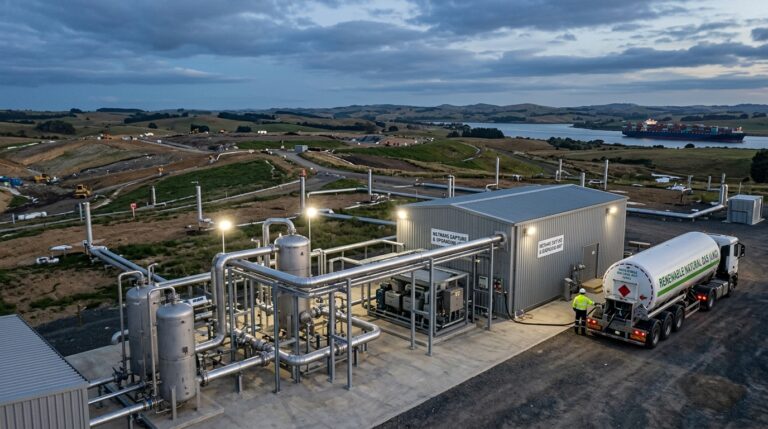
The grid is sold out. AI infrastructure cannot wait for the grid’s multiyear transmission upgrades. So what happens instead? Hyperscalers build their own power plants. Meta recently added seven natural gas power plants to a data center site in Louisiana, bringing that location’s total capacity to 7.46 gigawatts. Microsoft is partnering on a five-gigawatt natural gas facility in West Texas. According to the IEA, global data center electricity consumption is on track to more than double from 460 TWh in 2024 to roughly 945 TWh by 2030. In the United States, data centers are expected to account for nearly half of all electricity demand growth between now and the end of the decade.
Natural gas is filling the gap. Planned non-renewable capacity additions surged 71% from 2025 to 2026, while renewable capacity additions grew just 2% over the same period. The total planned natural gas project pipeline now stands at 64 gigawatts by 2030, with 16 gigawatts added to the queue in Q1 2026 alone. Wall Street caught the first-order version of this story. GE Vernova now carries a $163 billion backlog with 2026 revenue guidance of $44.5 billion to $45.5 billion. Siemens Energy holds a record order backlog of roughly 154 billion euros. Gas turbine builders are consensus longs across most institutional desks.
Here is what they are missing.
The Real Bottleneck: What Is Inside the Turbine
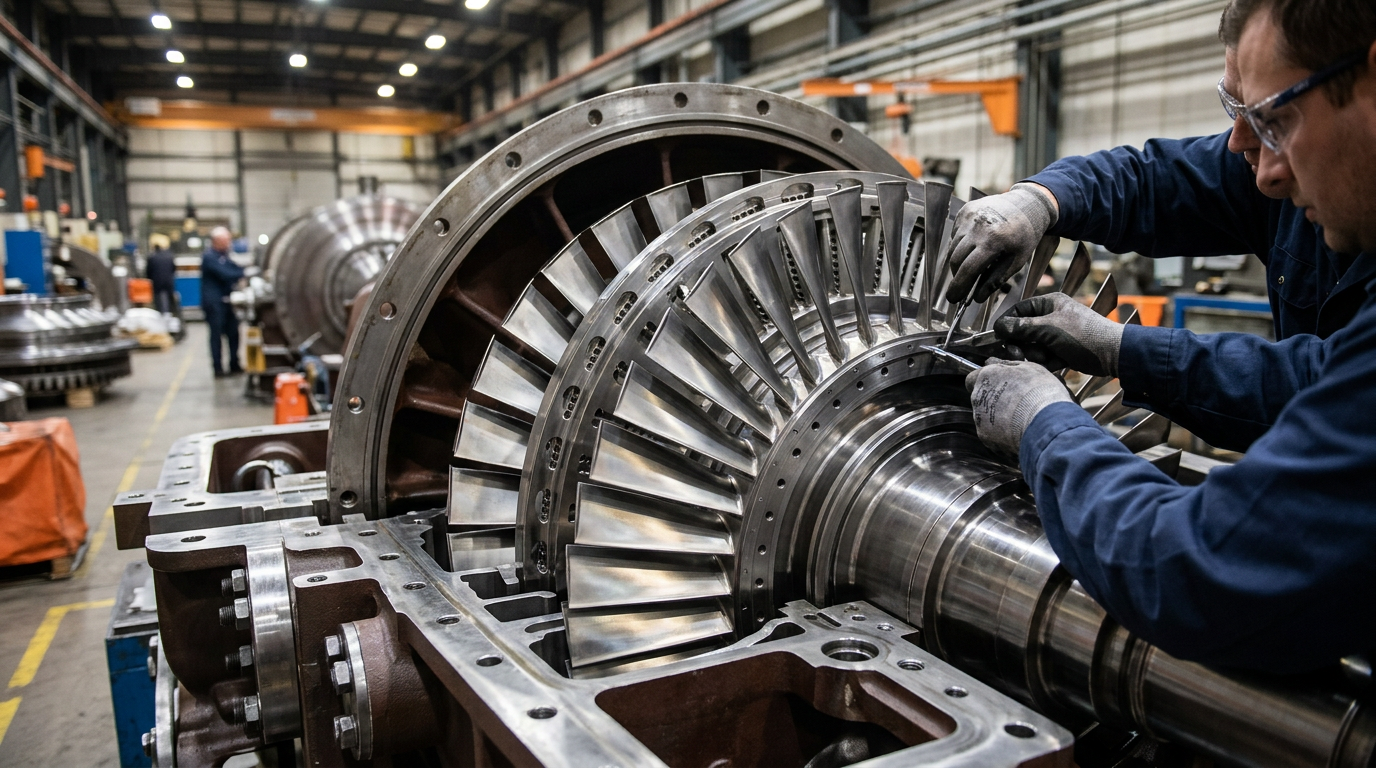
Unlike GPUs, turbines are physical machines whose manufacturing requires high-alloy castings, precision heat treatment, and specialized testing that cannot be easily scaled. Some components have lead times measured in years. A single large gas turbine has thousands of hand-assembled parts, and final testing can take weeks.
The turbine is not the bottleneck. The blade is.
Turbine blades need to operate stably for tens of thousands of hours in temperatures exceeding 1,400 degrees Celsius, while bearing centrifugal forces tens of thousands of times their own weight. Single-crystal superalloys must be used. Expensive rare elements including rhenium and hafnium must be precisely added to maintain high-temperature resistance. There are only a handful of companies in the world that have mastered this manufacturing process at meaningful scale.
Slight tangent, but it matters. The process of qualifying a new turbine blade supplier, from materials development to testing to OEM certification, takes years and costs hundreds of millions of dollars. The incumbent cannot be easily displaced. The moat is not a brand or a patent. It is physics, time, and accumulated metallurgical knowledge that cannot be replicated quickly. That is a different kind of competitive advantage than most industrial stocks carry.
Two American companies dominate this market: Precision Castparts Corp (PCC), which is private and buried inside Berkshire Hathaway, and Howmet Aerospace. Together, they account for roughly 70% to 80% of the global high-end turbine blade market, including single-crystal and directionally solidified blades. They are the primary suppliers to GE, Siemens, and Mitsubishi for these components.
PCC is not accessible to public market investors.
Howmet Aerospace trades on the NYSE under ticker HWM. And the numbers coming out of Pittsburgh right now are not subtle.
The Numbers: What Q1 2026 Actually Said
Howmet delivered a record Q1 2026: revenue up 19% year over year to $2.31 billion, EBITDA up 32% to $740 million at a 32% margin, and adjusted EPS up 42% to $1.22, all exceeding the high end of guidance. The company then raised full-year guidance to $9.575 billion to $9.725 billion in revenue, with the midpoint roughly $550 million above the prior target. Free cash flow for the quarter came in at $359 million after $94 million in capital expenditures.
Here is the specific number that matters most. IGT revenue was up 39% in Q1 2026, driven by the increased demand for electricity generation, particularly from natural gas for data centers. Management described this as structural, not cyclical. They provided an outlook for IGT revenue to double from roughly $1 billion to approximately $2 billion in three to five years. On the Q1 earnings call, CEO John Plant confirmed that six of seven key gas turbine customer contracts had been finalized, up from four on the prior call.
The spares piece is the part most analysts gloss over. When a gas turbine runs harder because data centers demand 24/7 baseload uptime rather than the peaker-plant cycling turbines were originally designed for, blades degrade faster. Replacement cycles accelerate. Every existing turbine running at higher utilization becomes a recurring revenue stream for the company that makes its blades. Spares revenue reached 23% of total revenue in Q1 2026, up from 21% for full year 2025 and just 11% in full year 2019. Total spares across commercial aerospace, defense aerospace, and gas turbines were up 36% to approximately $520 million in the quarter.
That is not a story about new units sold. That is installed base monetization accelerating as AI infrastructure pushes the existing fleet harder than anyone modeled.
The Ultimate Passive Income Play
The #1 income play for 2026 is NOT a stock, bond or private company…
Rather, it’s a little-known alternative investment that could hand you big monthly income from oil and gas.
The Derivative Map
This is what second-order thinking looks like in practice.
- First order: AI needs compute. Nvidia.
- Second order: Compute needs power. GE Vernova, Siemens Energy.
- Third order: Power plants need gas turbines. Turbine manufacturers.
- Fourth order: Gas turbines need blades made from single-crystal superalloys that almost nobody on Earth can produce at scale. Howmet Aerospace.
The fourth derivative is where the moat is widest. Howmet’s expertise in manufacturing high-performance components for jet engines translates directly to the requirements of industrial gas turbines. This cross-application of technology, including its extensive patent portfolio and materials knowledge accumulated over decades, positions the company to capture demand that most equity investors are not modeling as a primary investment thesis.
Wall Street knows the aerospace story. It knows the defense story. Those are the headlines. What is less widely reflected in price is the specific convergence happening in industrial gas turbines, where data center demand is colliding with limited global production capacity and an installed base that is being worked harder than it was designed for.
Technical and Trading Framework
HWM is trading near $270, within a 52-week range of $169.45 to $290.63. The stock hit a record intraday high of $280.74 following the Q1 2026 earnings beat on May 7, then pulled back and found support near the $250 area before recovering. The current price sits roughly 27% above its 52-week low and within approximately 4% of the 52-week high.
From a structural standpoint, HWM has been in a sustained uptrend since mid-2025, with the 200-day simple moving average now around $212 and the 50-day moving average near $246. The stock is well above both on a longer-term basis. A technical support zone has formed between roughly $256 and $261, representing a confluence of trend lines and key moving averages across multiple timeframes. The 20-week moving average has acted as trend support since May 2025, and two recent pullbacks found buyers in that vicinity.
Near-term, the stock is consolidating after the post-earnings breakout. The area around $270 is acting as both a pivot and an overhead level to watch. A sustained move above $270 to $271 on volume would be the near-term trigger for a potential retest of the $280 to $291 range. A failure below $256 support would shift the short-term tone and invite a deeper look at the $246 to $250 zone.
Next earnings are expected July 30, 2026. The consensus EPS estimate is $1.24. That is the next catalyst to watch. Any guidance raise on the IGT doubling timeline or further contract announcements could be a meaningful price driver.
The Most Guarded Building Outside of D.C.?
This is a $500 billion AI mega-project. The largest in history.
It will be surrounded by armed guards – barbed wire – 24/7 surveillance. You won’t get near it without special clearance.
But the real secret isn’t what’s going inside – it’s the $810 million river of money flowing underneath it.
Most of that will be siphoned off by Big Tech and Wall Street insiders.
BUT – there’s a backdoor way to collect your share before the first brick is laid.
Actionable Trade Framework
This is not a call to buy or sell. It is a framework for thinking about how to position around a high-conviction structural thesis at a technically precise moment.
The Core Thesis in One Sentence: Howmet Aerospace controls the scarcest, least-replaceable component in the gas turbine supply chain at the exact moment when gas turbine demand is inflecting structurally higher because of AI data center power buildout.
Entry Consideration: The stock is consolidating after a post-earnings breakout with support holding in the $256 to $261 zone. Traders looking for a lower-risk entry relative to recent highs might monitor a pullback toward that support band as a potential add point, provided the broader trend structure remains intact. A break and hold above the $270 to $271 level on meaningful volume is an alternative trigger for those waiting for momentum confirmation.
Risk Management: A close below $246 (near the 50-day moving average) on volume would be a technical invalidation of the near-term constructive view and should prompt a reassessment. Maximum position sizing should reflect the valuation premium the stock already carries: HWM trades at roughly 62 to 63 times trailing earnings. This is not cheap. The bull case requires continued execution on IGT revenue growth and margin expansion. A miss on July 30 earnings or a guidance cut would likely be punished sharply at this multiple.
Time Horizon Considerations: The IGT doubling thesis management outlined is a three-to-five year structural event. Short-term traders should treat the July 30 earnings report as the primary near-term catalyst. Longer-term holders should track quarterly progress on the IGT revenue ramp, spares growth as a percentage of total revenue, and management commentary on the seventh and final customer contract.
Levels to Monitor:
- Support: $256 to $261 (confluence zone, multiple moving averages)
- Secondary support: $246 to $250 (50-day moving average, recent consolidation lows)
- Near-term resistance: $270 to $271 (current pivot and Kijun line)
- Breakout target zone: $280 to $291 (52-week high and analyst target cluster)
- Key catalyst: July 30, 2026 Q2 earnings, consensus at $1.24 EPS
Scenario Modeling
Bull Case: IGT revenue accelerates toward the $1.5 billion annual run rate by 2027, driven by continued data center gas turbine orders and the locked-in customer contract pipeline. Spares growth continues to expand as a percentage of total revenue, supporting margin. July 30 earnings beat on both the top and bottom line, and management raises guidance again. The stock moves toward the $300 to $320 analyst target range. The primary condition required: continued execution on the IGT ramp and no slowdown in hyperscaler data center commitments.
Base Case: HWM continues compounding at the current trajectory. IGT revenue grows 30% to 40% annually over the next two to three years, in line with management guidance. Commercial aerospace and defense continue supporting the overall revenue base at double-digit growth rates. The stock consolidates in the $260 to $290 range as the market digests the valuation premium while waiting for earnings to grow into the multiple. Analyst consensus targets of $297 to $310 represent a reasonable one-year price outcome.
Bear Case: The multiple compresses. At roughly 62 times trailing earnings, any deceleration in growth rates gets punished. Specific risks include: a slowdown in hyperscaler capex commitments (already being monitored closely after mixed signals from some cloud providers), rising natural gas prices shifting the long-term data center power mix toward nuclear or other alternatives, and execution risk from the $1.8 billion Consolidated Aerospace Manufacturing acquisition pushing net leverage to 1.6 times. A miss on July 30 earnings, combined with any guidance reduction, could push the stock toward the $230 to $245 range quickly. Insider selling has also been notable, with insiders net sellers by approximately $25 million over the past twelve months.
The Risks Worth Naming
A few things could interrupt this. Higher natural gas prices don’t kill turbine blade demand outright, but they could shift the mix toward nuclear or other alternatives over a longer horizon. Nuclear power is increasingly part of the data center power conversation, with tech companies having announced plans to finance more than 20 gigawatts of small modular reactors, though the IEA doesn’t expect the first SMRs to come online until around 2030.
The stock has already moved substantially. HWM is up approximately 52% over the past year, well ahead of the iShares U.S. Aerospace and Defense ETF (ITA), which gained 34% over the same period. Buying a stock that has already moved meaningfully requires a clear view on whether the current price already reflects the IGT doubling thesis or whether the market is still underweighting it.
The case that it is not fully reflected: global data center electricity consumption is projected to more than double to roughly 945 TWh by 2030 per the IEA base case. Natural gas is the largest single source of additional supply in the U.S. through the end of the decade, adding over 130 TWh of annual generation. The pipeline of planned natural gas projects tied to data centers now totals 64 gigawatts. That is a multi-year structural demand curve for blades that almost no one is currently modeling as a primary investment thesis for HWM, which most equity investors still categorize as an aerospace supplier.
Most people looking at HWM see an aerospace and defense name with strong earnings momentum. The more interesting angle is a hidden tollbooth on the power generation buildout for AI, one that controls over half the global market for the single component that makes the whole machine run.
Whether that angle is fully reflected at $270 is the question worth sitting with heading into July 30.
Pilots Use One. Smart Traders Should Too.
A pilot never takes off without running a checklist. Not because they don’t know how to fly – because they know that the moment something feels routine is the moment a step gets skipped.
Options trading punishes skipped steps faster than almost anything else. So, I put the 7 that matter most on one page.
It’s called the Smart Trade Options Checklist. Normally $29.97. Free today.
Run it before any options trade. Takes about 30 seconds. You’ll catch the bad ones before they cost you.
For informational and educational purposes only. Not investment advice. Trading involves risk, including loss of principal.