August 14, 2026
SanDisk Is Rewriting the Memory Hierarchy
The $93.9B contract floor answered the cycle question. High Bandwidth Flash is the one Wall Street hasn’t priced yet.
AI Data Platforms Could Be The Next Winners
Wall Street just sent a clear signal: software rallied while the AI chip trade cracked.
As semiconductor names sold off, software stocks surged, reminding investors that the next AI winners may not be hardware makers, but platforms that own valuable user relationships.
Mode Mobile fits that shift. Its EarnOS turns everyday smartphones into income-generating devices while collecting permissioned first-party data that can be monetized for AI model training. Deloitte named Mode the #1 fastest-growing software company in North America after 32,481% three-year revenue growth, with 490M+ users and $115M+ cumulative revenue.
Invest in Mode at $0.52/share before the pre-IPO window closes today.
Please read the offering circular at invest.modemobile.com. This is a paid advertisement for Mode Mobile’s Regulation A Offering.
SanDisk Is Rewriting the Memory Hierarchy
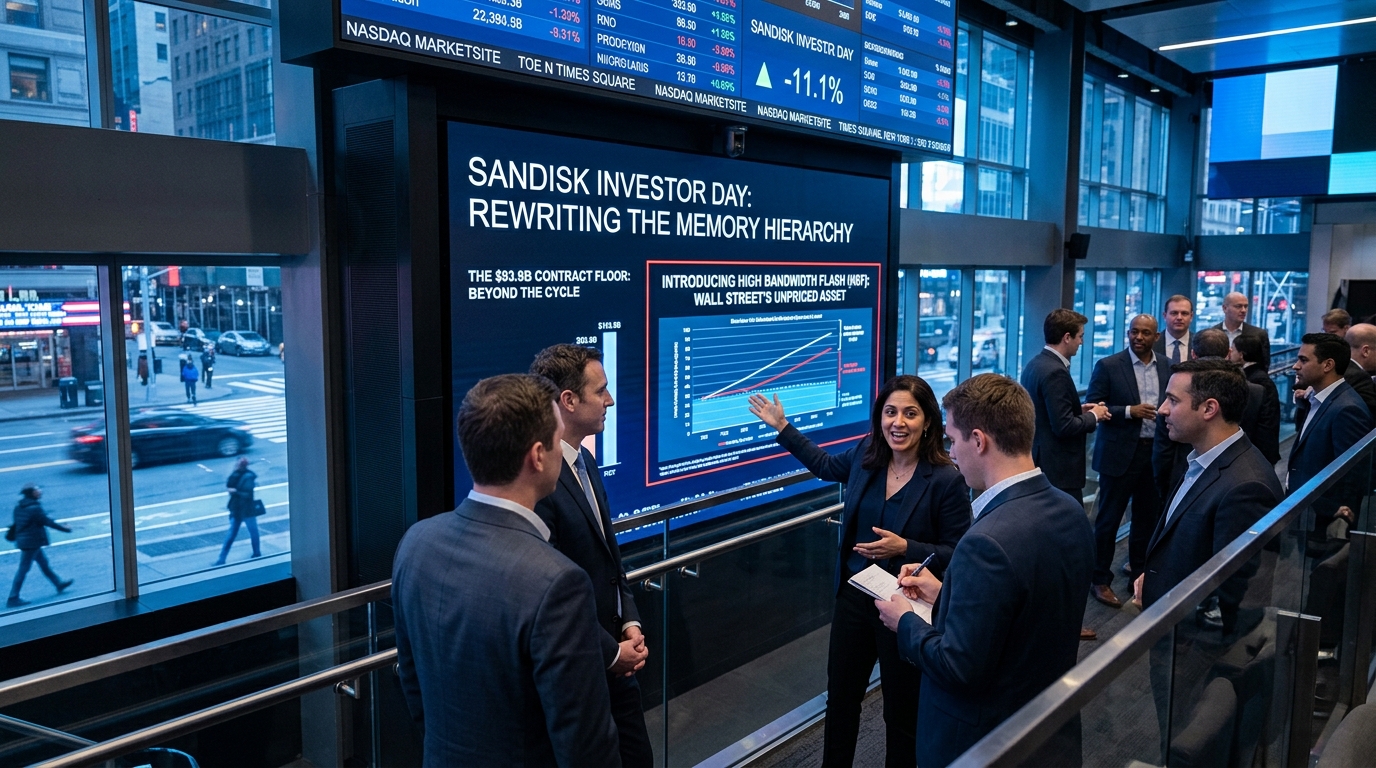
Thursday’s Investor Day in New York did exactly what SanDisk’s management needed it to do. The event drove a sharp rally in SNDK as long-term financial targets and a roughly $94 billion New Business Model agreement exceeded expectations. But traders who stop at that headline are reading the wrong story. The deeper development from the week of August 11 is not a contract. It is an architecture. SanDisk is attempting to insert itself between High Bandwidth Memory and traditional SSDs in a new tier that doesn’t yet exist in volume production. If it works, the addressable market changes fundamentally. If it doesn’t, the current valuation still rests on one of the most unusual earnings profiles in semiconductor history.
Where Memory Sits in the AI Capital Cycle
As hyperscale cloud providers and enterprise customers pour hundreds of billions into capital expenditures this year, predominantly directed at AI infrastructure, memory chips have emerged as a critical bottleneck. The specific constraint driving SanDisk’s pricing power is structural, not cyclical. The shortage stems from a structural reallocation of manufacturing capacity. Memory manufacturers SK Hynix, Samsung, and Micron have shifted wafer production toward High Bandwidth Memory for AI accelerators. That reallocation comes with a mechanical consequence: every wafer diverted to HBM is a wafer not producing conventional NAND.
TrendForce estimates that the NAND Flash market will record a 4% to 5% supply deficit in 2026, resulting in continued shortages. The market is not in equilibrium, and supply relief is not arriving on the typical cycle. TrendForce also expects the supply-demand balance to turn positive in the second half of 2027, allowing supply constraints to gradually ease. That window, roughly five quarters of structural undersupply from today, is the operating envelope inside which SanDisk is compounding its earnings base and signing long-duration contracts at current price floors.
The macro backdrop reinforces the urgency. Precedence Research predicts that the AI-powered storage market could jump from $36 billion in 2025 to $255 billion in 2034, implying a roughly mid-20% compound annual growth rate. TrendForce has also argued that AI data centers will represent a majority share of NAND flash demand later this decade. SanDisk is not riding a wave so much as it is attempting to define the wave’s next form factor.
Why This Is Not a Simple Commodity Play
The NAND flash market remains highly concentrated among a handful of suppliers, and that concentration matters because the top players are all exhibiting supply discipline simultaneously. In 2026, manufacturers have broadly emphasized production discipline and mix shift toward higher-value products to protect margins.
TrendForce and Gartner have both highlighted the unusual tightness in memory markets. Gartner estimates NAND flash annual prices in 2026 will increase by 234%, with meaningful pricing relief not expected until late 2027. Limited incremental supply helps maintain pricing power.
The sector read-through from Thursday’s Investor Day was immediate and broad. In Friday’s Asian trading session on August 14, memory-linked names broadly strengthened as the market digested SanDisk’s long-duration pricing framework and long-term targets, which were read as a sector-wide validation of the current pricing environment.
The Most Radical Transformation of Money in Modern History
If your money lives inside one bank, pay close attention. On December 1st, 2025, a Congressional committee published a report that documented at least 30 companies and individuals who lost their bank accounts between 2022-2024.
A government digital currency would make banks’ abilities to freeze accounts instant and automatic.
FedNow, created by the Federal Reserve, has been installed into over 1,500 banks already.
The rails for a digital dollar could already be live. But a parallel system already exists where no bank, no government, can freeze you, allowing you to opt out of any government control… or potential Digital Dollar.
Click here to learn more about the parallel system many of the elites are already using >>>
The Numbers Behind SNDK
The Q4 FY2026 earnings report, released August 5, delivered numbers that illustrate how quickly SanDisk’s financial profile has transformed since its February 2025 spinoff from Western Digital. SanDisk reported non-GAAP EPS of $39.25 on revenue of $8.97 billion.
Data center revenue surged 103% sequentially to $2,977 million, driven by strong AI inference demand and the ramp of the QLC Stargate platform. That sequential surge is not a one-quarter anomaly. Management also indicated that full-year data center revenue increased sharply year over year, with the segment representing a much larger share of the portfolio than it did a year ago.
The company also reported exceptionally large adjusted free cash flow in Q4 FY2026 and significant share repurchases, alongside a sizable incremental authorization. While the exact net cash per share figure varies by methodology and period-end definitions, the company has repeatedly emphasized a zero-debt balance sheet in 2026 communications.
Looking forward, SanDisk expects revenue of $10.3 billion to $10.8 billion for the first quarter of fiscal year 2027, with non-GAAP diluted earnings per share of $44 to $46. The multi-year contract architecture underpinning that guide is worth understanding precisely. At Investor Day, the company described agreements with eight data center and edge customers that correspond to approximately $93.9 billion in minimum contract revenue under minimum price conditions, with a weighted average term of more than four years and approximately $16.5 billion in financial guarantees.
SanDisk also described floor pricing in the neighborhood of $0.29 per gigabyte, broadly in line with recent average selling prices. Analysts have argued that these long-term agreements could meaningfully mute earnings downside in later years if memory prices soften. That protection is why the Investor Day landed so forcefully with the buy side.
The long-term financial model disclosed on August 13 is equally significant. During fiscal 2028 through fiscal 2030, the company expects revenue to grow mid-to-high teens, consistent with bit growth, and expects non-GAAP gross margins to sustain at approximately 80%, with non-GAAP operating margins at approximately 75%. Operating at 75% margins for three consecutive fiscal years, if achieved, would represent a structural departure from the commodity economics that defined NAND for its first three decades.
Valuation context: third-party consensus snapshots vary by provider and update cadence, and exact analyst counts and target ranges can shift daily. In broad terms, sell-side targets in August 2026 span a wide range and include several high-dollar targets that implicitly assume the contract model and data center mix shift persist.
The HBF Layer: The Trade Wall Street Is Still Pricing In
The $93.9B contract floor is the known variable. High Bandwidth Flash is the unknown one, and it may be the more consequential of the two.
At the start of the August Future of Memory and Storage conference in Santa Clara, SK hynix and SanDisk released the first standard specifications for High Bandwidth Flash through the Open Compute Project. The specification is intended to establish HBF as an open standard aimed at memory bandwidth and capacity constraints in artificial intelligence inference workloads.
The architecture problem HBF addresses is real. HBM is fast but expensive and capacity-constrained. Traditional SSDs are dense but too slow for inference workloads generating massive key-value cache demands. In published HBF materials and early coverage of the specification, HBF is described with 8-high and 16-high stacking options, capacities up to 512GB per module, and performance classes ranging from roughly 0.4 to 3.0 TB/s. It also uses a UCIe interface, enabling a direct connection to GPU and CPU packages. That direct attachment to compute silicon is what separates HBF from conventional SSD storage architectures.
SanDisk has also described early ecosystem participation during the standardization process, including hyperscaler and accelerator-adjacent interest. Early validation from hyperscalers matters because it signals that at least some of the buyer base is treating HBF as a serious architectural candidate rather than a research curiosity.
The enterprise flash memory market is expected to reach 1.2 ZB by 2030, a target SanDisk disclosed at Investor Day. If HBF claims even a narrow slice of that total available market at premium pricing, the earnings model extends materially beyond the scenarios analysts are currently modeling.
The technology roadmap leading to HBF production is not speculative. At FMS 2026, Kioxia and SanDisk demonstrated a ninth-generation 2Tb QLC 3D flash part running a 4.8 Gb/s NAND interface, a step up versus the prior generation. The company has also said it began sampling BiCS10 1Tb TLC, citing a 59% bit density improvement compared to BiCS8.
Built on the foundation of CMOS directly Bonded to Array technology, SanDisk has also outlined a two-dimensional scaling strategy aimed at producing custom derivatives to meet rapidly changing market requirements in a capital-efficient manner. The company has described BiCS9 QLC as an early example of this strategy, combining an established array with a newer CMOS wafer approach to improve performance for AI-driven workloads while maintaining manufacturing efficiency.
Technical and Trading Framework
On the chart, SNDK has moved sharply in recent weeks, and the dual-catalyst sequence matters for active traders. The Q4 earnings beat on August 5 and the Investor Day on August 13 were the two defining events.
After a run of this magnitude, the technical structure warrants precision. The Q4 earnings release on August 5 initially sent SNDK lower before recovering into Investor Day. That sell-the-news dynamic on a record quarter established a meaningful short-term support zone in the $1,250 to $1,344 range. SNDK closed Wednesday August 12 at $1,344.29, with an intraday range of $1,308.53 to $1,389.28, before the Investor Day gap higher.
The August 13 close near $1,528 represents the new reference level. Volume-weighted analysis of the post-Investor Day session will be critical. A healthy continuation sees the stock hold above the August 12 close at $1,344 on any near-term pullbacks, with the mid-$1,400s serving as an intermediate support band. Resistance sits at the June 52-week high of $2,354, which is roughly 50%+ above Thursday’s close. The distance between current price and that level tells you how much of the cycle revaluation has already been surrendered.
The 50-day moving average has been trending steeply higher since May. A corrective move that holds the 50-day would preserve the trend structure; a break below the August 5 post-earnings lows near $1,200 would signal that the market is pricing in meaningful deterioration in the 2H27 supply normalization risk.
Momentum indicators on the weekly timeframe remain extended but have not yet reached the extreme readings seen at the June high. The Investor Day gap represents a fresh catalyst, not a continuation of old momentum. That distinction matters for sizing and timing.
Scenario Modeling
Bull Case
The $93.9B contract floor holds at or near current price floors through 2028. BiCS10 ramps on schedule through late 2026, driving bit growth in the mid-teens in FY2027. HBF customer sampling accelerates, with one or two additional hyperscalers joining the ecosystem by Q1 FY2027. The NAND market’s 2H27 supply normalization proves milder than TrendForce projects because AI inference demand absorbs incremental bits faster than consumer electronics demand recovers. SNDK approaches widely cited sell-side targets, with upside targets clustered above $2,500 entering 2027. Price target for this scenario: $2,200 to $2,500.
Base Case
The Q1 FY2027 guide of $10.3 billion to $10.8 billion is delivered near the midpoint. Gross margins compress modestly from Q4’s peak levels toward the low-to-mid 80% range as mix shifts and component costs normalize. The supply-demand balance in NAND begins easing in 2H27 as TrendForce projects, but the contract floor keeps SanDisk’s realized prices above spot. HBF remains in pre-commercial development through FY2027. The stock trades in a range between $1,400 and $1,900 as the market weighs contract durability against cycle normalization.
Bear Case
NAND supply normalization arrives earlier than the 2H27 consensus, driven by faster-than-expected capacity ramp from Samsung and YMTC. Contract price floors hold in nominal terms but prove below market, reducing the economic advantage of the New Business Model agreements. PC and smartphone demand, which SanDisk noted is expected to decline mid-teens in calendar 2026, fails to recover in 2027, pressuring blended realized prices. HBF commercialization slips to 2028 or later, removing a key re-rating catalyst. The stock tests the post-earnings lows near $1,200, with a sustained break risking a move toward $1,000, a level that has appeared in the low end of certain published target ranges. Catalyst for this scenario: any major hyperscaler publicly reducing AI infrastructure capex guidance or a Samsung capacity announcement that signals faster-than-expected supply recovery.
Active Trader Strategy Framework
The post-Investor Day session on August 14 is the first real test of conviction buying. Traders watching the opening should pay particular attention to whether the pre-market gap near $1,590 holds through the first 30 minutes of trading. A gap-and-go that maintains above $1,550 would signal institutional accumulation. A gap-and-fade back below $1,528 would indicate the market is treating the Investor Day rally as another selling opportunity, consistent with the August 5 pattern.
For traders considering positioning, the risk management framework starts with the August 12 close at $1,344 as the logical stop reference for any long entered on Investor Day strength. A position sized to risk back to that level implies approximately 12% maximum adverse excursion from Thursday’s close. Given SNDK’s demonstrated tendency toward sharp reversals on even positive catalysts, position sizing should reflect that volatility profile.
The $14 billion buyback authorization provides a structural floor of a different kind. Management has said it plans to return 100% of excess free cash flow to shareholders after investing in the business, which implies sustained mechanical demand for the stock when the company is generating large free cash flow. That buyback cadence can compress drawdowns during corrections in high free-cash-flow-margin businesses, but it does not eliminate volatility.
Key levels to monitor in the near term: $1,590 as pre-market resistance and the first test of post-Investor Day momentum, $1,528 as the August 13 closing reference, $1,450 as the midpoint of the August consolidation range, $1,344 as the critical structural support from August 12. On the upside, $1,900 is the first significant resistance cluster based on prior target clustering, and $2,354 represents the June 52-week high.
Options implied volatility will likely remain elevated following the dual-catalyst week. Traders using options for defined-risk positioning should account for elevated premium when structuring directional positions. Selling volatility into this environment carries meaningful event risk, given the HBF standardization process, BiCS10 ramp updates, and quarterly earnings all sitting on the calendar within the next six months.
Conclusion
SanDisk’s Investor Day delivered what the market needed after the post-earnings selloff: a credible long-term financial model, a contract structure that defines the floor, and a technology roadmap that extends the growth trajectory beyond the current shortage cycle. The $93.9 billion in minimum revenue under minimum price conditions is real, the 80% gross margin target is a structural claim, and the BiCS10 roadmap is moving through sampling and early ramp milestones.
The part that requires ongoing monitoring is the HBF layer. A new memory tier between HBM and SSD, co-developed with SK hynix and tied to an OCP standardization effort, is the kind of architectural bet that either re-rates a semiconductor company or fades into a footnote. The OCP specification released in early August is a first step, not a product. The gap between standard and revenue is wide.
Disciplined traders will distinguish between what is already priced, the contract floor, the Q4 beat, the 80% margin target, and what is not yet priced: HBF volume adoption, the full magnitude of the 2030 TAM expansion, and the competitive response from Samsung and Micron as the shortage normalizes. Preparation over prediction means keeping the scenario framework current and letting the BiCS10 production data and HBF sampling updates do the work of informing the next position decision.
The memory hierarchy is being rewritten. Whether SanDisk writes the final architecture or cedes that ground is the question the next four quarters will answer.
For informational and educational purposes only. Not investment advice. Trading involves risk, including loss of principal.