
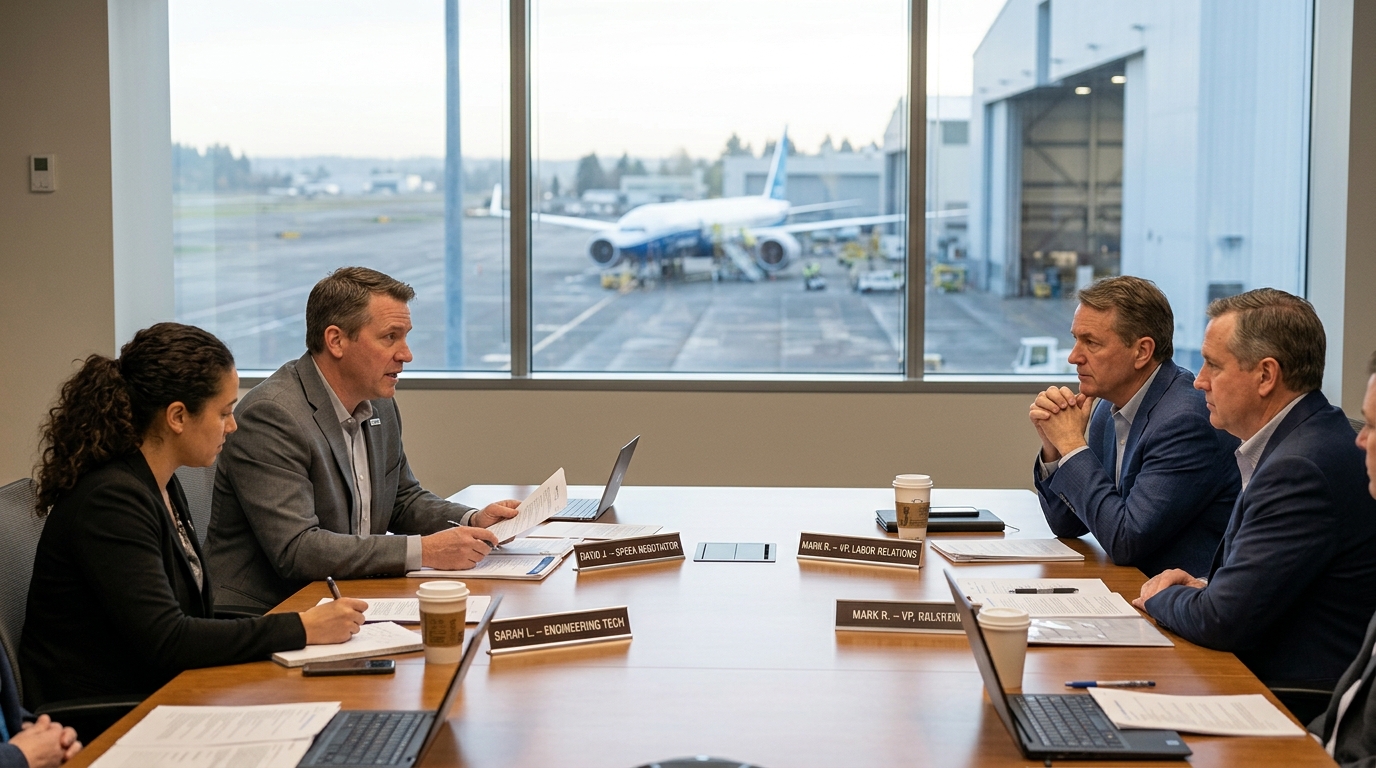
Boeing and the Society of Professional Engineering Employees in Aerospace resume contract talks Monday, September 8, with a hard deadline hanging over the process. The union representing approximately 17,000 engineers and technical workers returns to the table giving both sides less than a month to reach an agreement before the current contracts expire. A strike cannot begin until those agreements expire on October 6, making October 7 the earliest possible date for a walkout.
SPEEA members rejected Boeing’s proposed four-year contracts on August 21 despite the union’s negotiating team initially endorsing the offers, with roughly 64 percent of engineers and 72 percent of technical workers voting against. The pushback from the rank and file was stronger still on the strike question. Strike authorization passed by wider margins: 88 percent of the professional unit and nearly 90 percent of the technical unit voted yes.
The rejected offer included wage pool increases totaling 29.4 percent over four years. Unlike most union contracts, the SPEEA agreement does not specify fixed pay rates; raises are distributed under a merit system at management discretion. Union negotiators said there appeared to be deep mistrust of Boeing among members, a dynamic that matters because it means a revised number alone may not close the gap. Work-from-home policies, on-call requirements, overtime, and incentive payments for certain roles will also return to the bargaining table.
Boeing’s response after the vote signaled it is not taking the possibility of a stoppage lightly. Boeing said it is implementing its strike contingency plan, diverting money it had wanted to invest in its SPEEA-represented team toward preparations for a possible work stoppage. The company also posted contractor positions for engineering and technical roles on job sites, a move SPEEA said could set back progress.
That is the piece of this situation equity traders need to weigh carefully. SPEEA is not the machinists’ union. Production workers are not in this group; a strike would hit engineering and technical work tied to certification and regulatory deliverables on new airplanes. A work stoppage would further delay Boeing’s certification campaigns for its 737 Max 10 and 777-9, both of which are already several years behind schedule.
Those programs are not abstractions on Boeing’s balance sheet right now. The 737-10 is in the final segment of flight testing and development assurance work, with certification flight testing 98 percent complete across roughly 2,060 flight hours and 972 test flights. Boeing has said it remains on track to complete 737-10 certification by year-end. Boeing delivered 367 aircraft through July 2026, 39 more than at the same point in 2025. Any interruption to the engineering workforce that underpins those approvals risks that momentum.
What Traders Should Watch
- September 8 talks: Whether Boeing tables materially improved wage guarantees or merely repackages the rejected offer. A quick breakdown raises October 7 walkout risk substantially.
- BA price action: Shares slid about 1 percent to roughly $207.78 on the Reuters report about talks resuming. A breakdown in talks would likely produce a sharper move, particularly given how close the 737 Max 10 and 777-9 certifications are to the finish line.
- SPR exposure: Spirit AeroSystems, now being reabsorbed by Boeing, supplies 737 fuselages. Certification delays lengthen the timeline before the combined entity can convert inventory into deliveries and revenue.
- GE Aerospace: GE engines power both the 737 Max and 777-9 programs. A prolonged stoppage pushes delivery slots and revenue recognition later for its commercial engine business.
Investors should watch whether Boeing increases guaranteed wage growth, how quickly SPEEA schedules a vote on any revised offer, and whether the company continues expanding its strike-contingency preparations. Boeing spent most of 2025 convincing the FAA and its customers it had stabilised. A second major work stoppage in two years would test that story harder than any quarterly report.