September 17, 2026
Bonus Content: Wall Street’s Top Bull Just Cut His S&P 500 Target
Why Did Trump Just Ban America’s Most Powerful AI?
It’s not Nvidia. It’s not OpenAI. It’s not Google.
It’s a San Francisco AI lab whose technology is used by eight of the ten largest companies in America – and which Bloomberg calls the highest-revenue AI company on earth.
Trump banned it from every federal agency and the Pentagon blacklisted it. The reason isn’t what you think. Full details here.
AI COULD KILL US ALL!
That’s not my prediction.
It’s what people building AI are now warning.
A former Anthropic researcher just quit, saying AI labs are “gambling with our lives.”
Then Anthropic’s own alignment lead went further…
He says there’s a greater than 10% chance advanced AI could kill all humans within the next decade.
Terrifying?
Absolutely.
But here’s what caught my attention as an investor…
Washington is already treating Anthropic’s technology as a national-security issue.
And if these warnings accelerate Washington’s intervention will become inevitable.
Investors positioned before this happens stand to benefit most.
Addison Wiggin has put his extensive presentation right here…
This ad is sent on behalf of Banyan Hill Publishing.
If you would like to unsubscribe from receiving offers for Market Rebellion, please click here.
Wall Street’s Top Bull Just Cut His S&P 500 Target
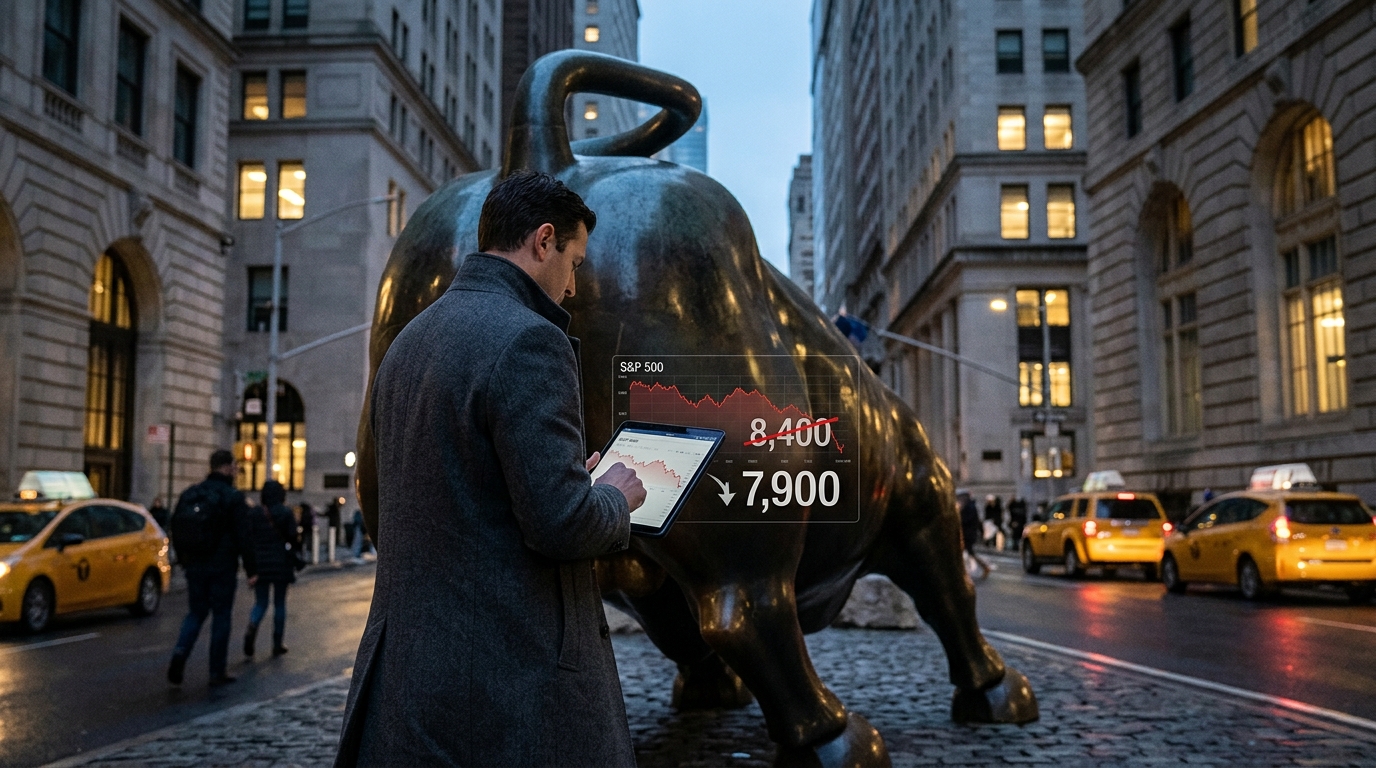
Wednesday compressed a month of macro anxiety into a single session. The Federal Reserve hiked rates for the first time in three years, pushing the fed funds target to 3.75%–4.00%. The S&P 500 closed at 7,551.81, its lowest close since July. And Ed Yardeni, who until recently held one of the highest year-end targets on Wall Street at 8,400, cut that figure by 500 points.
Read those facts together. They matter more than any one of them alone.
The Macro Environment
The Fed’s quarter-point hike was widely expected. Futures pricing via CME’s FedWatch implied roughly a 93% probability of a hike going into the decision. What rattled markets was Fed Chair Kevin Warsh’s press conference commentary on persistent inflation, which sent the Dow down 631 points, or 1.21%, to 51,461.90. The 10-year Treasury yield has been at or above 5% this week, a level not seen since 2007. Brent crude has traded above $100 per barrel this month amid Middle East supply disruptions, reinforcing inflation anxiety. The Fed’s updated projections imply at least one additional hike this year, meaning the rate environment traders face for the remainder of 2026 is more restrictive than markets were pricing even a month ago.
What Yardeni’s Cut Actually Says
Yardeni Research lowered its year-end S&P 500 target to 7,900 from 8,400, directly citing the backup in bond yields. The firm cut its forward P/E estimate to 18.6x from 19.8x. From Wednesday’s close of 7,551.81, that 7,900 target leaves just 4.6% of upside over the next three and a half months.
That is not a bull case. That is a holding pattern dressed as one.
Yardeni also raised his probability of a bearish scenario to 30% from 20%, and pushed his prior 8,400 year-end target out to mid-2027. He kept his end-of-decade target at 10,000 and still expects the economy to avoid recession, but the near-term framing has shifted materially. Wells Fargo’s Ohsung Kwon cut his own year-end target to 7,700 from 7,950 this week, citing slowing earnings momentum and rising technology-sector risks.
The Sovereign Fund Signal
In the same window that Yardeni moved, two sovereign wealth funds added institutional weight to the caution argument. The New Zealand Superannuation Fund reported a 14.2% return for the year ended June 30, 2026, and warned that strong U.S. equity performance has been a major driver of multi-year results, making forward returns more challenging from elevated starting valuations. The fund has also highlighted mean-reversion dynamics as a core part of how it thinks about markets.
That view echoes Nicolai Tangen, CEO of Norges Bank Investment Management, which manages Norway’s roughly $2.3 trillion oil fund. After the fund posted a record first-half profit of nearly $185 billion, Tangen told CNBC last month that investors should not expect a repeat of recent returns. When two of the most influential sovereign pools in global markets issue near-identical warnings within weeks of each other, it is a positioning signal, not background noise.
Bank of America’s Correction Framework
BofA’s Savita Subramanian had already framed the structural risk cleanly. The S&P 500 has suffered only one pullback of 5% or more in all of 2026, against a historical average of roughly three per year. Subramanian’s published year-end targets for 2026 have varied across notes, but the core message has been consistent: valuation, rates, and concentration risk can tighten the trade-off between upside capture and drawdown control. She has also noted that the share of BofA’s bear-market signposts triggered has eased from the 70% area earlier this year, but remains high enough to keep risk management in the foreground. September and October together average the weakest two-month return of any period going back to 1928.
Scenario Framework
Bull Case: Oil pulls back below $90 as Middle East tensions ease, taking pressure off yields. The 10-year retreats toward 4.5%, the Fed signals a pause, and the S&P recovers toward 7,900 by year-end. Yardeni’s revised target becomes consensus.
Base Case: Yields hold near 5%, the Fed delivers one more hike, and the index trades in a 7,400–7,800 range through Q4. The S&P ends the year near 7,400, with limited directional conviction and elevated volatility around each data release.
Bear Case: Oil sustains above $105, inflation re-accelerates, and the Fed signals additional tightening beyond what the projections currently imply. The S&P breaks the 7,490 support level cited in recent Schwab technical commentary, opening a move toward 7,200 or lower.
Technical and Trading Framework
The 50-day moving average near 7,600 was tested repeatedly going into Wednesday’s Fed decision. The close at 7,551 represents a break below that level. Support below sits near 7,490, per Schwab’s technical framing. The VIX was trading around 17, elevated relative to the low-volatility regime that characterized much of 2026 but not yet at levels that historically signal capitulation. Options traders should watch the 7,500 strike as the near-term battleground; a sustained close below it shifts the conversation from pullback to correction territory.
Active Trader Strategy Framework
The convergence of Yardeni’s target reduction, sovereign fund caution, BofA’s warning framework, and the Fed’s hawkish lean is not a reason to panic. It is a reason to size accordingly. With only 4.6% of upside to the street’s former high-end bull target and multiple risk indicators still elevated, asymmetry favors reduced gross exposure and tighter stops on long positions. Watch the 7,490–7,500 zone as the line that separates a shallow reset from a deeper unwind. Volatility around each CPI release and Fed speaker appearance will likely remain elevated through October.
Preparation built before the next catalyst always outperforms reaction built after it. The data as of Thursday, September 17, 2026 argues for a more defensive posture, not an abandonment of equity risk, but a disciplined recalibration of how much of it to carry.