September 22, 2026
Bonus Content: China’s Rare Earth Grip Is the One Risk Markets Have Not Priced
Dear Reader,
Most investors don’t realize this, but Nvidia is not just the world’s largest stock…
It’s become one of the biggest investors.
Just last year, it invested in 67 companies.
Now, most of these are what you’d expect…
AI labs, data centers, robotics…
But they’ve made ONE big investment in an emerging field you’d never guess…
Nobel Prize winner Demis Hassabis believes it could become “Ten times bigger than the Industrial Revolution.”
Yet…
At the center of it all is a tiny publicly traded company… one that Nvidia took an eight figure stake in it.
Click here to discover why Nvidia invested and find out how to get the company’s name and ticker.
It doesn’t make chips or build data centers… instead it’s something far more important.
Wall Street veteran Matt McCall believes November 14th could be the moment the rest of Wall Street begins paying attention to this tiny stock.
Click here now to get the full story.
To your wealth,
Stephen Prior, Publisher
Monument Traders Alliance
P.S. Nvidia has backed 11 companies in this field. But this is one of the few ordinary investors can buy. Click here to see why Matt has November 14th circled.
China’s Rare Earth Grip Is the One Risk Markets Have Not Priced
Markets have spent the past week buying the deal. Equities drifted higher on expectations that Thursday’s Trump-Xi summit at the White House would produce at minimum a formal extension of the November 2025 Busan trade truce. The tariff suspension deadline arrives at 12:01 a.m. Eastern on November 10, 2026, with rare earths sitting at the center of every negotiation. That consensus is now the most dangerous position in the room.
US Trade Representative Jamieson Greer on Monday blamed China for creating uncertainty over the pact’s extension, saying Beijing was still holding out on supplying enough strategic mineral exports. “They have limited rare earth exports. They’ve controlled them,” Greer told Bloomberg News. Greer and Treasury Secretary Scott Bessent did not cite a breakthrough on critical-minerals flows to US companies, which officials have said remain insufficient despite Beijing’s commitments under last year’s truce.
The Macro Frame
Trump has taken a less combative approach than usual ahead of the summit, a sign of Beijing’s growing leverage thanks to critical minerals. The administration has so far not threatened steep tariffs or technology export bans, in contrast to postures preceding previous summits. Analysts and policy researchers tie that caution to China’s dominance across the rare earth supply chain, a key input for tech and auto manufacturing. Since November 2025, China has suspended some of its expanded rare earth export-control measures through November 10, 2026, while keeping other licensing controls in place. Suspension is not resolution. The distinction matters enormously for positioning.
Separately, Bessent and Chinese Vice Premier He Lifeng concluded talks in New York on Sunday with the US side proposing a new AI safety notification mechanism for Trump and Xi to consider at the summit. Bessent said the two sides discussed setting up a US-China AI dialogue with a particular emphasis on national security concerns, covering AI-related incidents that rise to a national security level. AI and fentanyl precursors are on the agenda. Rare earths are the sticking point.
Sector Exposure
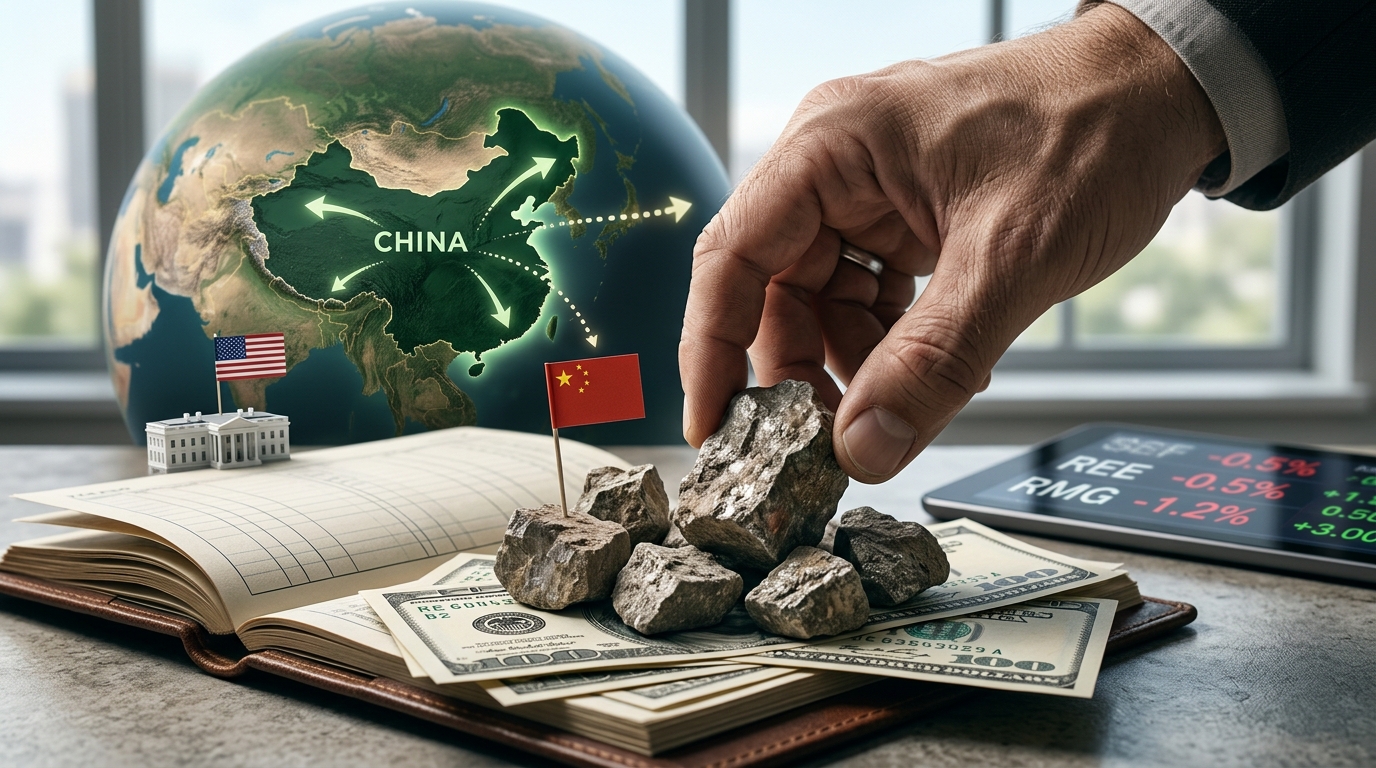
On January 6, 2026, China announced tighter export controls on dual-use items to Japan, including seven medium and heavy rare earth elements and products containing them, including rare earth permanent magnets. The real chokepoint is processing: China controls an estimated 85 to 90 percent of global oxide separation capacity and roughly 90 to 95 percent of rare earth metal refining. That processing dominance feeds directly into two sectors carrying significant US equity weight: autos and semiconductors.
Neodymium-iron-boron magnets power many electric vehicle motors, and China accounts for the vast majority of global sintered NdFeB production. Ford’s CEO has described the company as “hand-to-mouth” on magnet supplies, and Ford previously paused production of its Explorer SUV for about a week in May 2025 due to a rare earth-related magnet shortage. General Motors has signed a multi-year supply agreement with Texas-based Noveon Magnetics for NdFeB magnets for its full-size trucks and SUVs, reducing reliance on imported critical materials. The GM hedge is real but partial. Both F and GM trade at single-digit forward P/E multiples precisely because the market already prices some supply-chain discount. A truce collapse would widen that discount sharply.
For Nvidia, AMD and Nvidia are fabless, contracting fabrication almost entirely to TSMC. That structural difference matters less for rare earth and gallium exposure than it does for other supply risks, since the materials tend to enter the supply chain through specialized component suppliers, packaging houses, and equipment vendors. A fabless company like Nvidia is not automatically insulated just because it doesn’t operate a wafer fab.
The Long Positions: MP and Lynas
MP Materials has been reporting a ramp in downstream initiatives alongside its traditional concentrate sales, but the specific claim that its “onshore processing revenue” nearly quadrupled to $94.4 million in Q2 cannot be verified as stated against the company’s published Q2 2026 results. What is verifiable is the policy backstop: MP has disclosed a long-term Department of Defense-backed structure that includes a 10-year NdPr price floor commitment and a magnet offtake framework with an earnings support mechanism, and MP also has a $500 million definitive, long-term supply agreement with Apple. According to S&P Global-compiled analyst data cited by multiple market-data services, MP has a “Strong Buy” consensus with an average 12-month price target of $74.29 based on 19 analysts.
Lynas remains the most sophisticated rare earth operation outside China. The draft’s specific Lynas valuation math is not supportable as written: Lynas’s market capitalization has recently been cited around A$14 billion by market-data services, and any “times sales” multiple depends on which sales base and exchange rate is used. Both names are already pricing a degree of supply friction. A formal truce breakdown would accelerate re-rating; a clean deal could trim the geopolitical premium sharply in the near term.
Scenario Modeling
Bull Case: Xi and Trump announce a truce extension at Thursday’s summit, with China providing a credible rare earth supply commitment and the two sides formalizing the AI dialogue. Automakers rally on reduced supply uncertainty; MP and Lynas pull back 8 to 12 percent as the sovereignty premium partially unwinds. Nvidia’s licensed H200 pipeline clears some of its remaining legal limbo.
Base Case: A partial agreement emerges covering tariff mechanics and AI safety language, but rare earth commitments remain vague and unverifiable. The truce gets a 90-day extension rather than a full renewal. Markets treat this as progress, equities hold, but MP and Lynas stay elevated. The November 10 deadline becomes a second catalyst to monitor.
Bear Case: No rare earth concession emerges and the truce extension stalls past the Xi visit. The US and China continue to wrangle over extending the 2025 Busan agreement, even as they report progress on a narrow tariff-reduced trade mechanism. If that wrangling produces nothing by November 10, DFARS 252.225-7052 expands effective January 1, 2027, and for neodymium-iron-boron magnets the restriction explicitly covers the entire supply chain from mining through finished magnets for covered defense procurement. Ford and GM face renewed line disruption risk. MP and Lynas re-rate materially higher.
Trading Framework
Heading into Thursday’s summit, the asymmetry favors defense: the market has priced a deal, so the upside from confirmation is modest, while the downside from a Greer-flagged breakdown is not in consensus. Key levels to monitor include Lynas on the ASX around its 12-month range, with volume patterns in MP likely to be informative as Washington sessions open Wednesday. Volatility should be expected to compress Monday and Tuesday as positioning firms, then spike around any summit communique. For autos, watch F and GM intraday moves on any rare earth headline as the most immediate signal of how the physical supply situation is being read. Position sizing should reflect the binary quality of summit outcomes.
Preparation is the product here. The branch nobody is positioned for is the one Greer named in public on Monday morning. That is precisely why it deserves a framework before Xi’s plane lands.