

October 1, 2026
Bonus Content: The Fed’s Inflation Gauge Reset Rate Odds. What Traders Watch Next.
Most traders have never noticed the weird market anomaly that happens at 9:35 AM every morning.
They’re too busy with lagging indicators trying to predict the next move… when the market makers have already set the tone for the trading day.
It’s this weird anomaly that points us to the market maker’s key levels above and below.
And by playing the move within that range…
Regular folks like you have been able to reach for $100 or more (on a $1K stake) over 600 times in the last 2 years.
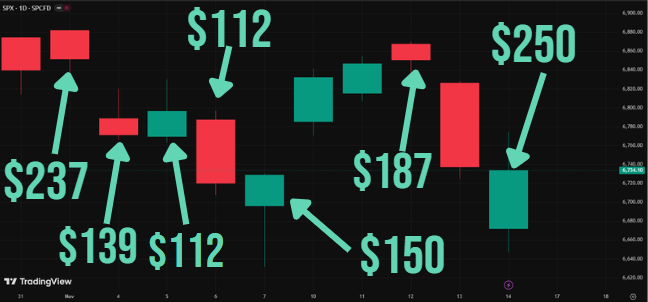
We’ve seen this straightforward approach play out whether the market broke out… broke down… or stayed choppy.
Granted, I can’t make trading guarantees here.
But I’ve opened up the data behind those trades, as well as how you can get in on the very next morning opportunity.
You’ll find the full details right here.
See you in the market.
Chris Pulver
The Fed’s Inflation Gauge Reset Rate Odds. What Traders Watch Next.

Wednesday morning delivered the most consequential macro data point of the quarter, and the market responded in two distinct phases: a sharp relief rally that partially reversed by the close. Traders who understand why that reversal happened are better positioned for the rest of the week.
Market Context
The Bureau of Economic Analysis reported August core PCE at 0.2% month-over-month and 3.0% year-over-year, against consensus forecasts of 0.3% and 3.3% respectively. Reuters noted that market expectations for an October hike slumped to about 39%, according to CME’s FedWatch tool, from roughly 51% in the prior session and nearly 71% a week ago. By the time Kalshi settled, the prediction market priced the Fed holding in October at 65% and a 25 basis point hike at 33%.
On September 25, the same Kalshi market priced a 25 basis point hike at 65%. That 32-point swing in four trading days is the volatility regime active traders are operating in right now.
The initial move in rates told the full story. The Dollar Index hit a session low near 101.06 at 8:30 a.m. ET as the softer core PCE reading landed. A softer core PCE reading pushed the dollar and Treasury yields lower Wednesday morning, but both recovered by afternoon, a move that appeared to reflect stronger growth and hiring data, firmer oil, and quarter-end flows. The S&P 500 erased much of its morning strength before the close.
Sector Breakdown
On September 16, the Fed raised the target range for the federal funds rate by 25 basis points to 3.75% to 4.00%, its first hike since July 2023. Wednesday’s softer PCE briefly flipped the tape intraday. Cooler core PCE inflation data lifted interest-rate-sensitive names early. Utilities, REITs, and long-duration assets like TLT caught a bid at the open before the afternoon reversal.
TLT invests primarily in U.S. Treasury bonds with remaining maturities of more than 20 years; because those bonds carry long durations, their prices move significantly when market yields change, making TLT particularly relevant when inflation data reshapes Fed expectations. TLT’s next move remains heavily dependent on whether the cooler core inflation trend translates into lower and more persistent Treasury yields.
What the Data Does to the 33% Hike Probability
Speaking in Buffalo, Williams said that, after raising rates in September, he sees “no need for urgency” and that “we have time to gather more information.” Williams also said one more rate hike may be appropriate “late this year,” and to many observers “late this year” implies December rather than October.
Three catalysts can still shift that 33% probability materially before the October 27-28 FOMC meeting. Today’s calendar includes initial jobless claims, forecast around 200,000, and ISM Manufacturing PMI, expected near 54 versus a prior 54.6. If the ISM Manufacturing PMI comes in below expectations, concerns about a U.S. economic slowdown could resurface and weigh on equity markets. Conversely, a beat on both claims and ISM would partially reverse Wednesday’s rate-odds move.
The larger binary arrives Friday. The Bureau of Labor Statistics is scheduled to release the September employment report on Friday, October 2, at 8:30 a.m. ET. A stronger Q2 GDP revision from 1.5% to 2.2% kept a December hike in play, and a payrolls number that beats on both jobs and wages would put October back on the table regardless of Wednesday’s relief.
Scenario Modeling
Bull Case (SPY above $766, TLT continues bid): Jobless claims tick above 210,000, ISM prices paid sub-index decelerates, and Friday payrolls print below 70,000 with unemployment at 4.2%. October hike odds fall below 20%, the 2-year yield tests 4.70%, and rate-sensitive sectors extend the Wednesday morning move. December becomes the clear base case for the next hike.
Base Case (Consolidation): Claims land near 200,000, ISM holds around 54, payrolls print 80,000-100,000 with unemployment steady near 4.1%. October hike odds remain in the 30-40% range. The 2-year yield oscillates between 4.85% and 4.95%, and SPY trades without directional conviction until the October 27-28 meeting.
Bear Case (TLT retests lows, dollar recovers): Claims drop to 185,000-190,000, ISM beats materially, and Friday payrolls top 130,000 with average hourly earnings accelerating above 3.2% year-over-year. As TradeStation’s David Russell noted, the PCE report “bolsters the case for not hiking in October,” but it is also relatively old data that does not reflect late-September energy moves. A hot labor print combined with energy-driven inflation risks could push October hike odds back above 55%, the 10-year back toward 5.40%, and TLT to new lows.
Active Trader Framework
The rate probability distribution is unusually wide heading into Friday. Traders watching TLT should note that a renewed push higher in long-end yields would keep duration under pressure. On the equity side, SPY’s $764.50 pivot and $762.35 previous low represent near-term decision levels for risk-on and risk-off confirmation.
Position sizing should reflect that claims and ISM this morning carry genuine repricing potential, not just noise. The asymmetry favors preparation over direction: a trader who knows their levels across the 2-year yield, DXY, and SPY before the 8:30 a.m. ET release is better equipped than one reacting to the headline. Friday’s payrolls report is the week’s final arbiter. Until then, 33% is not a verdict on October. It is a market price with more data points left to land.