The market did not wait for a signed contract. When Bloomberg reported Thursday evening that SpaceX is negotiating access to at least 80,000 U.S. cell sites, traders drew an immediate conclusion: the tower owners collect rent no matter who loses the subscriber war. The carriers absorb the competitive threat. Friday’s price action reflected that logic with unusual precision.
Friday’s Split
American Tower surged, while Crown Castle and SBA Communications also jumped. The carriers went the other direction. AT&T and T-Mobile fell sharply, while Verizon was down more modestly. That is not a subtle divergence. It is a sector re-rating compressed into a single session.
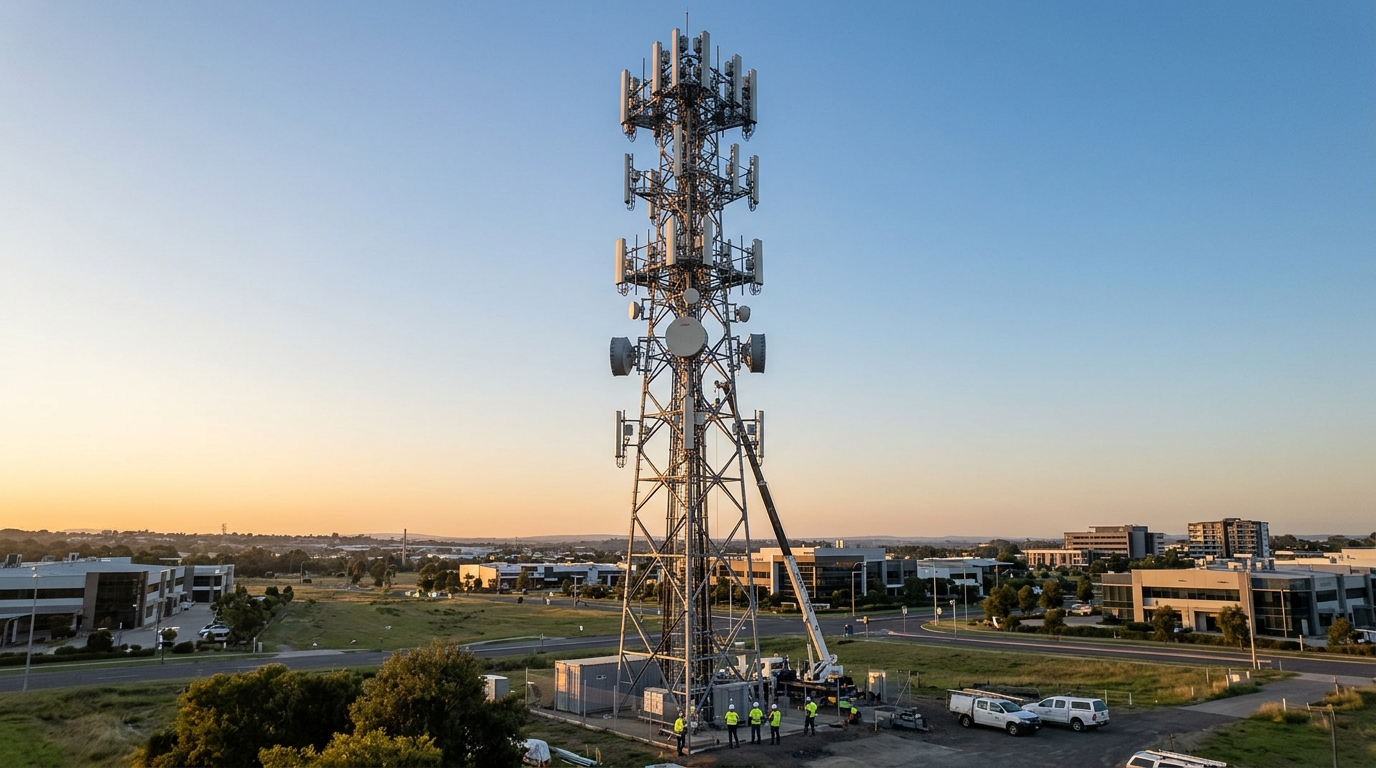
The stakes behind that move are large. The Wireless Infrastructure Association has pegged the U.S. at roughly 158,500 purpose-built cellular towers, and an 80,000-site target would be roughly half of that total. Reuters reported that Crown Castle operates about 40,000 U.S. cell towers, while American Tower has about 42,000 U.S. sites, and privately held Vertical Bridge owns around 18,000. SpaceX would likely need multiple counterparties to reach that scale. Every tower company at the table collects a lease. The incumbents watching from the sidelines do not.
The Capital Stack Behind the Threat
SpaceX’s carrier ambition is not a rumor. It is a funded strategy with a documented capital commitment. The Wall Street Journal reported, and Reuters later highlighted, that SpaceX struck a deal to acquire a nationwide low-band spectrum portfolio from Grain Management for about $8 billion in cash. That spectrum is prized because low-band signals generally travel farther and penetrate obstacles better than higher frequencies, the core limitation that has kept satellite-only coverage from threatening terrestrial carriers. Now add the reported 80,000 macro-site push on top. Bernstein analyst Laurent Yoon framed it directly, writing that committing roughly $30 billion into spectrum is serious enough, and committing to 80,000 macro sites could be a point of no return, broadly consistent with the scale required for a nationwide terrestrial wireless network.
TD Cowen has estimated that a competitive nationwide terrestrial network could cost more than $80 billion. Bernstein has examined scenarios ranging from $50 billion to $130 billion, including spectrum. Nothing is signed yet, and the legal structure of any prospective arrangement remains unclear. But markets rarely wait for paperwork on this scale of a structural shift.
Crown Castle’s Position
CCI entered Friday already showing the strain of churn tied to prior consolidation and tenant changes. In its second-quarter 2026 update, Crown Castle reported organic contribution to site rental billings of $38 million, or 3.9% organic growth, excluding an unfavorable $49 million DISH termination impact and a $5 million Sprint cancellation impact. Management has repeatedly said it expects 2026 to mark the low point for organic growth. A SpaceX lease relationship changes that calculus entirely: a SpaceX network would add a large new potential tenant just as management expects 2026 to be the low point for organic growth. The analyst consensus price target for CCI sits near $103.
Verizon Monday: The Catalyst That Bends the Trade
Verizon will report Q3 2026 earnings on Monday, October 26, with results on a webcast beginning at 8:30 a.m. ET. Published estimates ahead of the report have clustered around $1.27 in EPS and roughly $34.8 billion of revenue, but those figures can vary by data vendor and update as analysts revise models. Verizon has frequently exceeded consensus revenue expectations in recent quarters, but the SpaceX overhang makes this report structurally different from any recent prior quarter.
A clean beat with raised guidance may temporarily stabilize VZ and compress the tower-carrier gap. A revenue miss, or a guidance cut accompanied by management commentary acknowledging elevated competition risk, could widen it sharply. The key for traders is not whether SpaceX has paperwork today, but whether management frames the risk as theoretical or as an actionable constraint on subscriber growth, pricing, or capital intensity.
Scenario Framework
Bull case for carriers: Verizon beats on both revenue and EPS Monday morning, raises full-year guidance, and executives convey confidence that SpaceX faces multi-year buildout delays. VZ rallies toward $43, compressing the tower-carrier spread opened Friday.
Base case: Verizon reports in line at roughly $34.8 billion in revenue and about $1.27 EPS. Management acknowledges the competitive landscape without quantifying impact. The tower-carrier spread holds. CCI, AMT, and SBAC consolidate Friday’s gains. VZ treads water near $40.
Bear case for carriers: A revenue miss or reduced subscriber guidance reignites the SpaceX competition trade. VZ tests the $38 level. Tower REITs extend their lead, with CCI approaching its 52-week high near $100.
Active Trader Framework
The asymmetry in this trade sits with the towers, not the carriers. CCI, AMT, and SBAC benefit from any scenario in which SpaceX accelerates its network build. The incumbent carriers have no equivalent hedge. Traders monitoring the tower-carrier spread should treat Verizon’s pre-market release as the primary risk event: a strong beat narrows the spread; weakness or cautious commentary extends it. Volume patterns in CCI and AMT on Monday’s open will reveal whether institutional positioning from Friday carries forward or fades on VZ strength. Key levels to watch: CCI $83 support from Thursday’s pre-news close; AMT $185 as intraday consolidation support; VZ $41 as a technical line that, if broken on a miss, likely invites follow-through selling. Risk management demands defined exits before the report, not after.