October 30, 2026
Two days, a combined 14% lower. The valuation hasn’t been here in 14 years and the capex path isn’t getting shorter.
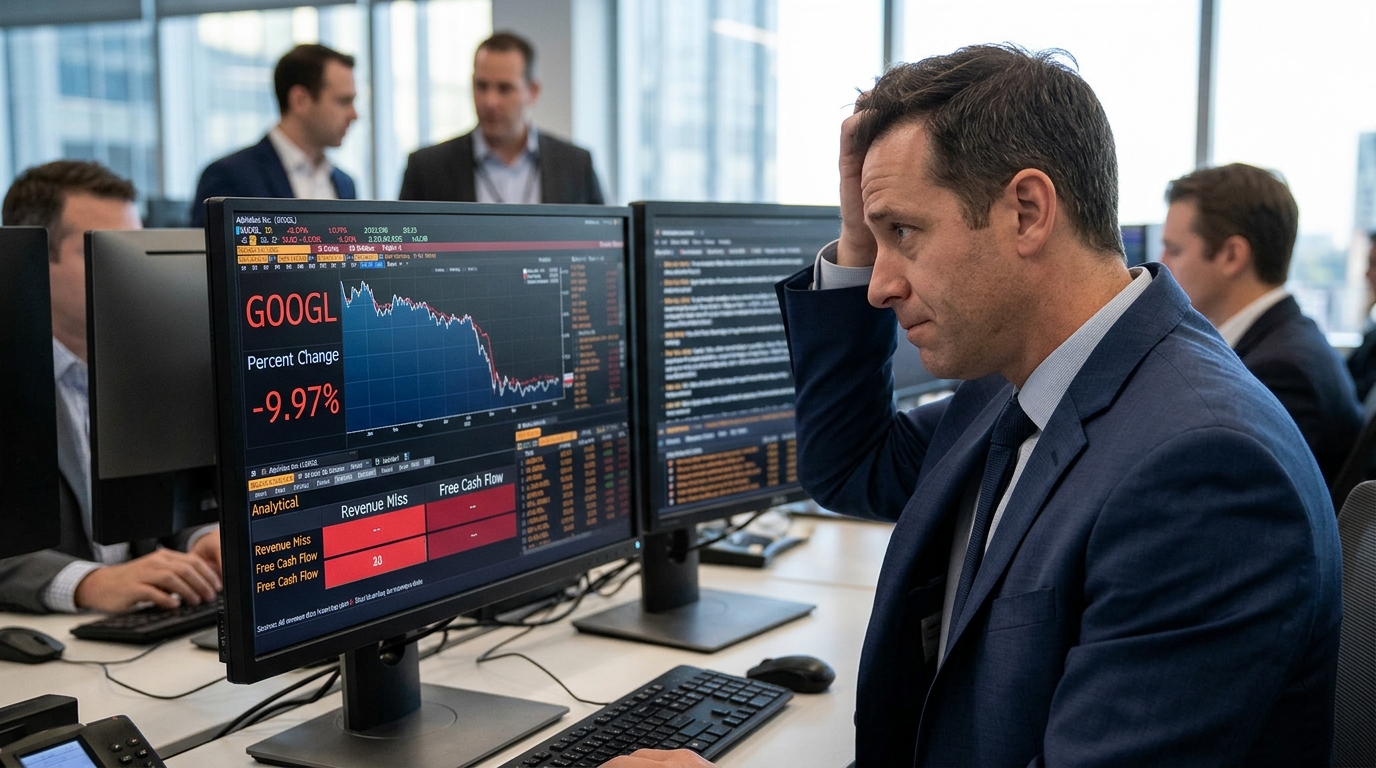
Thursday was the worst single day for GOOGL since March 2020, a 12.64% collapse that took the stock from $324.89 to $283.82. Friday added another 1.4%, closing at $279.84. Two sessions, two rounds of institutional repositioning, and a valuation that TipRanks noted this morning has not been seen since 2012. The question active traders face today is not whether the quarter was bad. It was. The question is whether the market has now priced the full damage or only the first wave of it.
Elon Musk’s Insane Projection: 7,692,207%
Where should you invest $100 right now?
Elon Musk just invented and patented this new AI technology…
And he’s predicting it will launch a NEW industry that will grow more than 7 million percent in the coming years.
Even if he’s only 10% right, that would still be enough to grow $100 into more than $700,000.
Click here to see the details on what Elon Musk called “an infinite money glitch.”
What the Quarter Actually Said
Alphabet reported Q3 revenue of $127.58 billion, up 25% year over year, missing the $127.96 billion consensus by $385 million. EPS came in at $2.12 versus a $3.02 expectation. The revenue gap was narrow. The earnings gap was not, and the explanation sits inside two lines that the market spent two days digesting.
The first is free cash flow. Alphabet posted negative free cash flow of $9.07 billion in Q3, far below the near-breakeven figure analysts had modeled. Capital expenditures totaled $51.36 billion for the quarter alone, and CFO Anat Ashkenazi confirmed full-year 2026 capex guidance stays at $195 to $205 billion, with 2027 expected to rise significantly from there. The second line is the collapse in Other Income. In Q2, Alphabet booked a $99 billion windfall from unrealized gains on equity stakes including SpaceX and Anthropic. In Q3, the same category generated an $8.66 billion loss. Net income fell from $34.98 billion a year ago to $26.17 billion, and EPS followed it down.
Google Cloud delivered its fastest growth on record, revenues up 103% to $30.7 billion with Cloud operating income tripling to $11.1 billion. The Gemini app crossed 1 billion users. The backlog hit $561 billion. None of it was enough to offset the capex trajectory and the OI&E reversal in the same report.
Their Retirement Home Cost $81,000. Wait Until You See Where…
Picture this –
Your own private chalet on a country club – with a golf course, tennis courts and nine swimming pools.
That’s what one Californian couple got for $81,000 in Western Europe.
What Analysts Did With Their Targets
Wells Fargo cut its price target from $417 to $371, keeping an Overweight rating. Citi moved from $447 to $375, holding Buy. The consensus across 58 analysts sits at $408.09, implying roughly 46% upside from Friday’s close. Ratings held. Targets dropped. That combination tells traders the institutional view is that the selloff overshot on valuation while the capex math remains a legitimate concern through 2027.
Technical Framework
GOOGL’s 52-week range is now $270.70 to $408.61. Friday’s close at $279.84 puts the stock 3.4% above the 52-week low, a level that was set in November 2025 and has not been seriously tested since. The 20-day, 50-day, and 200-day moving averages all sit well above current price, with each more than 16% higher according to Finviz data. That moving average spread reflects the speed of the breakdown, not a stock in base-building mode. Volume on Thursday ran to 64 million shares against a daily average of 27 million. Friday’s session saw 65 million shares change hands. Two days of institutional distribution at elevated volume typically require several sessions of absorption before a directional read becomes reliable.
5 Stocks Built for a Strong Finish to 2026
Higher interest rates, a reshuffled Washington and a market that wants proof of AI profits will all test stocks before the year is out. These 5 companies have the earnings to handle it. Download our free report for the catalysts, recent results and analyst price targets behind each one.
Scenario Modeling
Bull Case: The 52-week low at $270.70 holds as institutional buyers step in at a P/E of 14.6, the cheapest valuation since 2012. Cloud re-rating takes hold as Q4 backlog conversion accelerates. A recovery toward $310 over the next three to four weeks is achievable if the broader tech complex stabilizes and the equity portfolio does not generate further losses.
Base Case: GOOGL consolidates in the $270 to $295 range through November as the market waits for 2027 capex specifics on the Q4 call. Sellers defend any bounce into the $295 to $300 area. Volatility remains elevated but the pace of distribution slows.
Bear Case: The 52-week low at $270.70 fails on a Nasdaq-wide tech rout, amplified by AI capex contagion spreading to MSFT and NVDA. A close below $265 would invite systematic selling and mark the first time GOOGL has traded in that range since late 2024. The $195 to $205 billion capex commitment limits buyback flexibility and reduces the natural floor that has historically supported the stock.
Active Trader Positioning Framework
Two-day selloffs of this magnitude on record-high volume rarely produce clean directional trades in the immediate sessions. VWAP relative to $280 is the first intraday anchor worth watching. A sustained hold above VWAP through mid-session would be the earliest signal of demand absorption. Position sizing should reflect that implied volatility remains elevated after a gap of this size, and that the next meaningful catalyst is the Q4 earnings call, not anything scheduled before December. Risk to defined levels. The capex path is known. The equity portfolio swings are not.
The most disciplined framing for this stock right now is simple: Alphabet’s operating business is growing fast and its Cloud unit is accelerating. The market’s concern is not the business. It is the cost of building the business, and whether the free cash flow math works before 2027 capex guidance arrives. Preparation over prediction. That is the only edge available in a name moving this fast.