
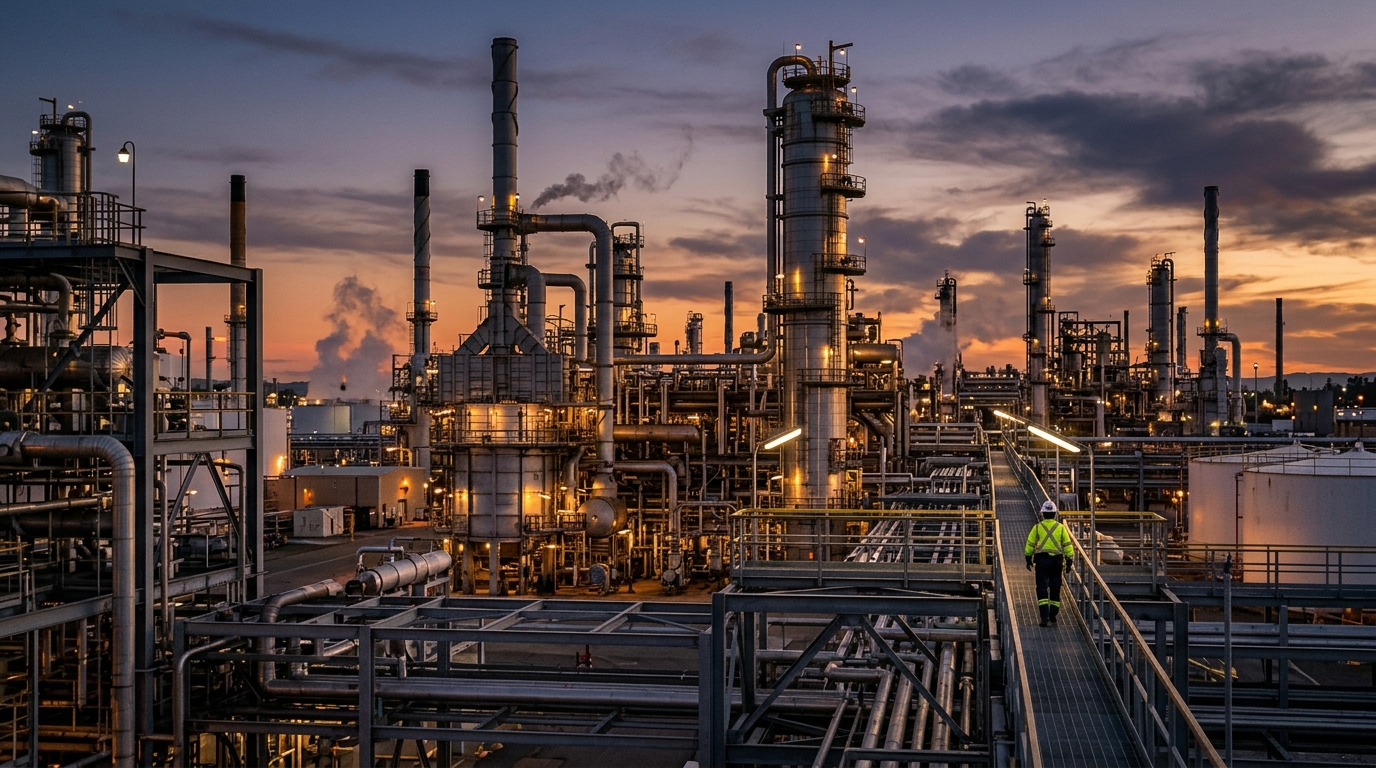
Chevron posted its third-quarter results this morning, and the number that matters most has nothing to do with crude oil. It has everything to do with a refinery running near capacity.
- Adjusted EPS: $5.28 vs. $4.78 consensus, a 10.5% beat; up 185% year-over-year from $1.85
- Net income (attributable to Chevron): $9.924 billion; adjusted earnings $10.361 billion
- Free cash flow: $12.0 billion; adjusted FCF $14.2 billion, about double the year-ago level
- ROCE: 17.7%, up from 7.6% in Q3 2025
- Downstream earnings: $4.931 billion vs. $1.137 billion a year earlier
- Capex: $4.0 billion in Q3, down versus $4.4 billion a year ago; year-to-date capex of $12.6 billion keeps full-year tracking toward the low end of $18-19 billion guidance
- Net debt: $20.730 billion at quarter-end vs. $34.461 billion at year-end 2025
Where the Profit Actually Came From
Upstream earnings rose to $5.698 billion, up from $3.302 billion a year ago, supported by better realizations. But the structural surprise was downstream. U.S. refining drove it: downstream earnings of $3.585 billion against $638 million a year earlier. Record U.S. crude throughput of 1.09 million barrels per day, alongside reliable crude unit capacity utilization of nearly 98%, explain most of that lift.
Upstream production was steady rather than growing. U.S. upstream production exceeded 2 million barrels of oil equivalent per day for a fifth consecutive quarter, while total net output of 3.98 million barrels of oil equivalent per day was lower than a year earlier, primarily due to lower entitlements from higher prices and impacts from the conflict in the Middle East.
The Capital Discipline Signal
This is the angle the beat-versus-miss headline misses entirely. Chevron is trending toward the low end of its annual capex guidance, and in places like the Permian, the company is signaling it can deliver its plan with less capital. Management said on the Q3 call it will provide additional color on the 2027 capital program in December after meeting with the board, but the directional signal is already visible: quarterly capex of $4.0 billion versus $4.4 billion a year ago.
The company reduced total debt by $3.5 billion in the quarter, and net debt at quarter-end stood at $20.730 billion, down from $34.461 billion at year-end 2025. That deleveraging pace, combined with $3.482 billion in common dividends paid and $2.502 billion of shares repurchased in the quarter, frames this as a capital return story first and a volume growth story second.
What Traders Should Watch Next
The December update on the 2027 capital program is now the critical date. If Chevron formalizes a 2027 capex target below the current $18-21 billion multi-year range, that widens the implied buyback capacity materially given a $12 billion quarterly free cash flow run rate.
One risk deserves explicit attention: on the Q3 call, management said it expects refining margins to eventually moderate as refinery runs recover and export flows increase, which could pressure downstream earnings going forward. Q3’s downstream result of $4.931 billion may prove the cyclical peak of this refining cycle. If crude realizations also soften, Chevron’s earnings will depend increasingly on cost execution and volume reliability.
Position sizing into December’s capex update matters. The direction of the 2027 budget will set expectations for buyback pace and dividend growth well into 2027. Chevron’s streak of consecutive years with higher annual dividend payouts per share remains the floor; the ceiling is a function of how aggressively it shrinks the capital program while oil holds above its stated breakeven.