From the man who tabbed NVIDIA before it soared 6,271%
over 7 years at its peak
Wall Street’s Hottest Stock Has a Waiting List. Here’s How to Skip It.
Wealthy investors are lining up for Anthropic shares and coming up empty. Tech Visionary, Matt McCall, says you can get into a backdoor opportunity today for less than $100 a share.
Anthropic, the company behind Claude, is set to go public at a record $2 trillion valuation.
It could top SpaceX as the biggest IPO in history.
And right now, almost nobody can buy a single share.
One Wall Street broker, whose firm trades about 1,000 private stocks, told TechCrunch:
“The hardest stock to source in our marketplace is Anthropic. There’s just no sellers.”
Even Goldman Sachs is charging clients 15% to 20% of their profits just for a way in.
The Line Is Out the Door
Meanwhile, people who already own a piece of Anthropic are holding on tight.
While everyone else is stuck in line. Even wealthy investors are struggling to get shares.
And it’s all leading to the most anticipated IPO in history.
When Anthropic finally goes public, millions of regular folks will rush to buy whatever they can get.
But tech legend Matt McCall isn’t getting in line.
“Most people are going to wait for Anthropic to go public and then buy as many shares as possible,” he says. “But I think that’s a huge mistake.”
Who Is Matt McCall?
There is a short list of analysts in America who were early on the AI boom.
Matt McCall is one of them.
He’s the Head Innovation Strategist at Monument Traders Alliance and editor of The McCall Innovation Report.
Over the past two decades, McCall has written about 50 stocks that went on to peak gains of 1,000% or more. Including:
- Tesla, before it climbed as high as 3,129%
- NVIDIA, before it soared a peak 6,271% in 7 years
- AMD, which he singled out in 2009
That’s why people call him “Mr. 1,000%.”
On March 6, 2009, McCall went on FOX Business and gave away nine stocks. One was AMD, trading around two dollars. By 2026 it rose 25,000%, enough to turn a $5,000 stake into more than $1.28 million.
No Waiting List Required
McCall’s play isn’t Anthropic. It’s a stock linked to Anthropic that you can buy right now in a regular brokerage account.
No waiting list. No special broker. No fighting Wall Street for scraps.
He calls it a “Second IPO.”
It may sound too good to be true. But it has happened before.
When Rivian went public in 2021, Ford owned a 12% stake. In the six months around Rivian’s IPO, Ford shares roughly doubled.
Yahoo quietly built a huge stake in Alibaba. In the two years around Alibaba’s IPO, Yahoo shares could have tripled your money.
It happened again shortly after EchoStar acquired $8.5 billion in SpaceX shares. In the months leading up to the SpaceX IPO, its shares soared 600%.
Now it’s happening again!
Anthropic’s “Silent Partner”
Years before the IPO frenzy, a much smaller firm took a $100 million stake in Anthropic. It beat Apple, NVIDIA, Amazon and Google to the punch.
Today, the entire company is valued at less than $15 billion. That’s 100x smaller than Anthropic.
McCall believes its early stake could cause it to double or triple in the years ahead.
And you can buy it for less than $100 a share.
We sat McCall down in front of our cameras to get the whole story. He even gave away the name and ticker.
For the time being, you can watch it free.
|
“If history repeats… investors could double or triple their money in the years ahead.” – Matt McCall
Iran Peace Talks Are Moving Oil More Than the War Did
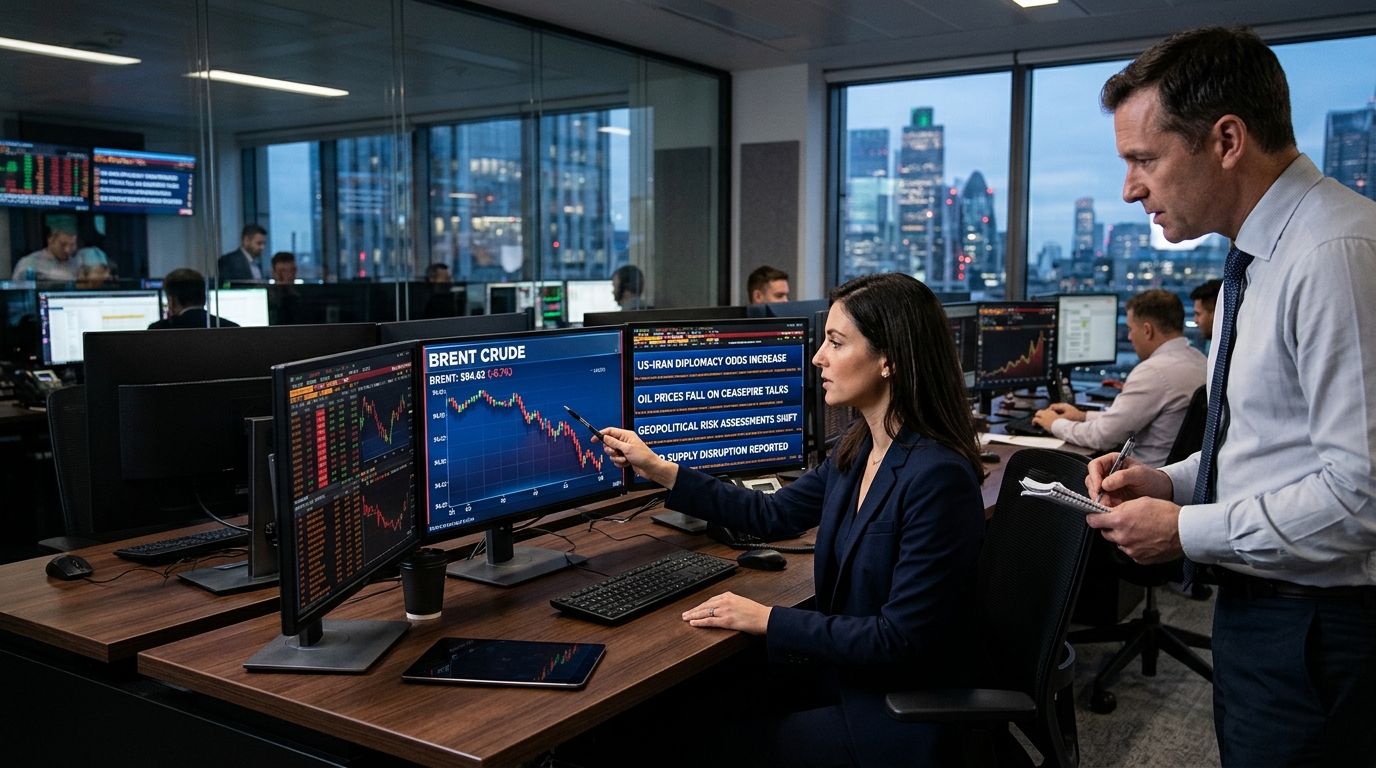
Oil fell sharply on November 4 as traders leaned into the idea that U.S. politics could force an offramp from the Iran war. Brent dropped 8.7% to $94.62 a barrel that day, according to pricing reported by the Associated Press, reversing a late-October spike that had pushed prices into the mid-$110s. The move did not require a new supply shock. It required a change in perceived policy risk.
That compression matters more than the number itself. When a social media post and election math move crude more than months of Strait of Hormuz disruption did, the market is no longer trading fundamentals alone. It is trading political optionality, and that changes the risk calculus entirely.
The Supply Picture Is Still Broken
Crude flows through the Strait of Hormuz remained impaired into early November, with the latest shock coming from shipping incidents rather than a clean normalization. Iran’s state media, citing the Revolutionary Guard, said on November 5 that two oil tankers and a towboat caught fire after striking mines in the strait. The IEA has not projected a full-year 2026 demand drop of 2.6 million barrels per day in its standard outlooks, and the available public forecasts vary widely by source and month, so traders should treat any single-point demand number with caution. What is clearer is that strategic reserves have been drawn down and distillate balances, including diesel, have stayed tight versus pre-war norms, leaving the system fragile even when headline Brent gaps lower.
The fragility runs deeper than the strait itself. Saudi Arabia’s only pipeline bypass around Hormuz was knocked out by drone strikes, removing the last physical workaround for Gulf crude exports.
Politics Is the Volatility Engine Now
Democrats won control of both chambers of Congress in the November 2026 midterms, tightening the political constraint set facing the White House. Vice President JD Vance added fuel to the market’s “offramp” thinking in a postmortem on social media after the election, arguing Republicans needed to end the war and refocus on cost of living pressures. Meanwhile, President Trump told the Financial Times in comments reported by Reuters on November 3 that the U.S. had no immediate plans to strike Iran, even as reporting has described advisers debating whether to intensify action before the new Congress takes office in January.
Three Scenarios for Active Traders
Bull Case for Crude: Diplomacy stalls and the war premium rebuilds. A renewed round of Qeshm Island-style incidents or strikes pushes Brent back toward $105 to $110. The trigger is a clear breakdown in mediator-led talks that removes the market’s assumption of near-term de-escalation.
Base Case: A broad consolidation range holds as the market balances a diplomacy discount against structurally impaired flows through Hormuz. Brent oscillates on headlines rather than trend. OPEC+ said on November 1 it would maintain September 2026 required production levels for December 2026, keeping policy supply steady into year-end.
Bear Case for Crude: A ceasefire deal is announced before the new Congress convenes in January, collapsing the war premium again. The price target is a retest of the low-$70s, with the key catalyst being an enforceable deal plus visible improvement in shipping safety through the strait.
The Framework
The asymmetry here is not directional, it is volatility itself. When a VP post and post-election positioning can move crude in high single-digit percentages and a tanker incident can yank it back, implied volatility in crude options deserves attention regardless of which side of the trade you hold. Position sizing around Hormuz headlines requires treating each session as event risk. The refinery crack spread, particularly diesel, remains the more structural expression: even if Brent mean-reverts on diplomacy, tight distillate balances can stay sticky.
Preparation beats prediction when the catalyst is a social media post from the second-highest office in the country. Know your levels, know your size, and know what changes your thesis.