By Andrea Shalal
WASHINGTON, Feb 23 (Reuters) – Rebuilding Ukraine’s economy will cost an estimated $588 billion over the next decade, the World Bank, United Nations, European Commission and the Ukrainian government said on Monday, a day before the fourth anniversary of Russia’s full-scale invasion.
The latest assessment by the institutions, based on data from February 24, 2022 through December 31, 2025 showed a 12% increase from last year’s estimate, based in part on a 21% jump in damaged or destroyed energy infrastructure from a year ago.
The study does not include data from Russia’s intensified attacks on Ukrainian energy facilities in January and February, which have left tens of thousands across Ukraine without heat, power and water during the coldest winter on record in decades.
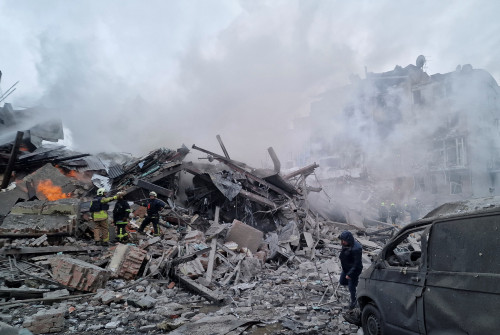
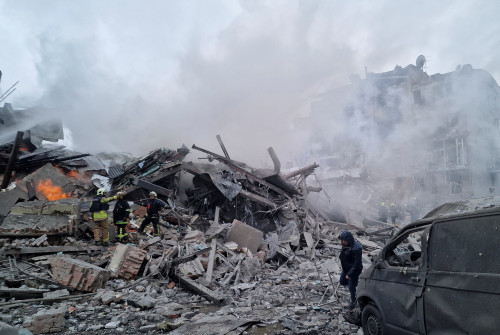
The estimate, the fifth conducted since the start of the war, found direct damage in Ukraine had reached $195 billion, up nearly 11% from the previous assessment, with housing, transport and energy sectors most affected, the groups said. That is more than double the damage reported in the first report in 2022.
“The damage is immense and increasing continuously,” the report said, noting that damages were concentrated in frontline areas and metropolitan areas including the capital Kyiv.
Ukrainian President Volodymyr Zelenskiy has faced sustained pressure from U.S. President Donald Trump to agree to a ceasefire deal that could entail painful concessions of land captured by Russian forces. But talks between Russia and Ukraine in Geneva last week failed to produce a breakthrough.
The war, which will enter a fifth year this week, has triggered the largest refugee crisis in Europe since World War Two, with more than 6 million Ukrainians living as refugees outside the country, and 4.6 million more displaced inside its borders, as of December 2025, the report notes.
It has also taken a huge toll on Ukraine’s economy, with its gross domestic product now 21% smaller in real terms than in 2021, before the Russian invasion. If the war continues this year, Ukraine’s GDP growth is seen limited to around 2%, but growth could pick up modestly to 4% in 2027 and 4.5% in 2028 if a ceasefire was in place by the end of the year.
“Four years into Russia’s full-scale invasion, the total cost of Ukraine’s reconstruction and recovery is now estimated at nearly $588 billion over the next decade, nearly three times the country’s projected nominal GDP for 2025,” Ukrainian Prime Minister Yulia Svyrydenko said in a statement.
“Amid unprecedented Russian attacks on energy infrastructure and homes across Ukraine this winter, our people show resilience, our entrepreneurs keep working. We still manage to recover fast and develop further,” she said.
BIGGEST DAMAGES SEEN IN HOUSING, TRANSPORT
Damages have been highest in the housing sector, with 14% of total housing stock damaged or destroyed, or about $61 billion, followed by the railways and other parts of the transport sector, amounting to $40.3 billion in damages, the report said.
The energy sector, targeted heavily this past year by Russian missile strikes and attacks, had suffered close to $25 billion in damages, with some citizens facing electricity disruptions of up to 18 hours per day.
The report estimated socioeconomic losses at $667 billion, a 13% jump from last year, reflecting the extensive and prolonged disruption to economic activity, public services and jobs.
The government of Ukraine was already taking steps to meet its reconstruction needs for this year, including earmarking some $15.25 billion for various programs. Ukraine and its partners have already spent $20.3 billion since February 2022 through urgent repairs in various sectors, including housing.
The report noted that Ukraine could cover some 40% of its growing reconstruction needs through the private sector if it carried out targeted reforms to attract capital investments in productive sectors such as agriculture, industry and tourism.
“Ukraine’s old economic model, with its weak competition, large informal economy, and heavy state footprint, will not generate the business dynamism needed for recovery,” the report said.
Matthias Schmale, the U.N. humanitarian coordinator in Ukraine, said taking steps to return refugees, reintegrate veterans and expand women’s labor force participation would be critical to ensuring Ukraine’s economic future.
“Ukraine’s most critical asset is its people,” Schmale said. “Recovery must be human-centered and community-based.” U.N. data show that Ukraine now has 2.4 million fewer children than it did before the war.
(Reporting by Andrea Shalal; editing by Diane Craft)