May 22, 2026
FLEX LNG Just Raised Guidance Mid-Conflict
19 straight dividends, 91% contracted, and barely a mention anywhere.
Your Complimentary Dividend Package
Today, you can claim the Ultimate Dividend Package… For FREE. (No credit card required!)
Inside, Marc Lichtenfeld – bestselling author of Get Rich with Dividends and world-renowned income expert – is giving away his top dividend picks for 2026.
You’ll get details on…
• Marc’s No. 1 dividend stock
• The safest 9% dividend in the world
• The top three “Extreme Dividend” stocks
• And much, much more!
May 13th. FLEX LNG drops Q1 earnings. Beats estimates. Raises full-year guidance. Declares its 19th consecutive quarterly dividend of $0.75 per share.
The financial media barely noticed.
That’s worth sitting with for a second, because the backdrop when this report dropped was not calm. The Strait of Hormuz was still effectively shut. U.S.-Iran ceasefire talks were stuck on two foundational issues with no resolution in sight. Brent was oscillating between $105 and $110 on every headline out of Islamabad. The energy sector broadly was behaving like a coin flip, and most analysts were focused entirely on crude-linked names. FLNG, trading around $32 on the NYSE with a market cap of roughly $1.6 billion, was not on most people’s screens. That’s been a recurring theme with this company.
The numbers first, because they’re the part people skip.
Q1 revenue came in at $80.5 million. Net income of $19.5 million. EPS of $0.36, which beat consensus. But the more important data point wasn’t the quarter itself – it was what management did with the forward guidance. Full-year 2026 revenue is now projected at $345 million to $370 million, roughly 10% above where they had it before. Time charter equivalent rates – the per-day profitability metric that actually tells you how the business is running – were raised to $73,000–$78,000 per day, up about 8% from prior guidance. Adjusted EBITDA guidance came in at $255 million to $280 million for the full year. You don’t raise guidance 10% in the middle of an active regional war unless the underlying contract structure is holding up in a way that gives you real visibility. That’s what’s happening here.
And then there’s the dividend. $0.75 per share, quarterly, 19th consecutive quarter. At current prices that’s a 9.4% annualized yield. Nineteen quarters. Through COVID recovery, multiple rate cycles, and now a conflict that shut down one of the most trafficked energy corridors on the planet. The consistency there is not accidental.
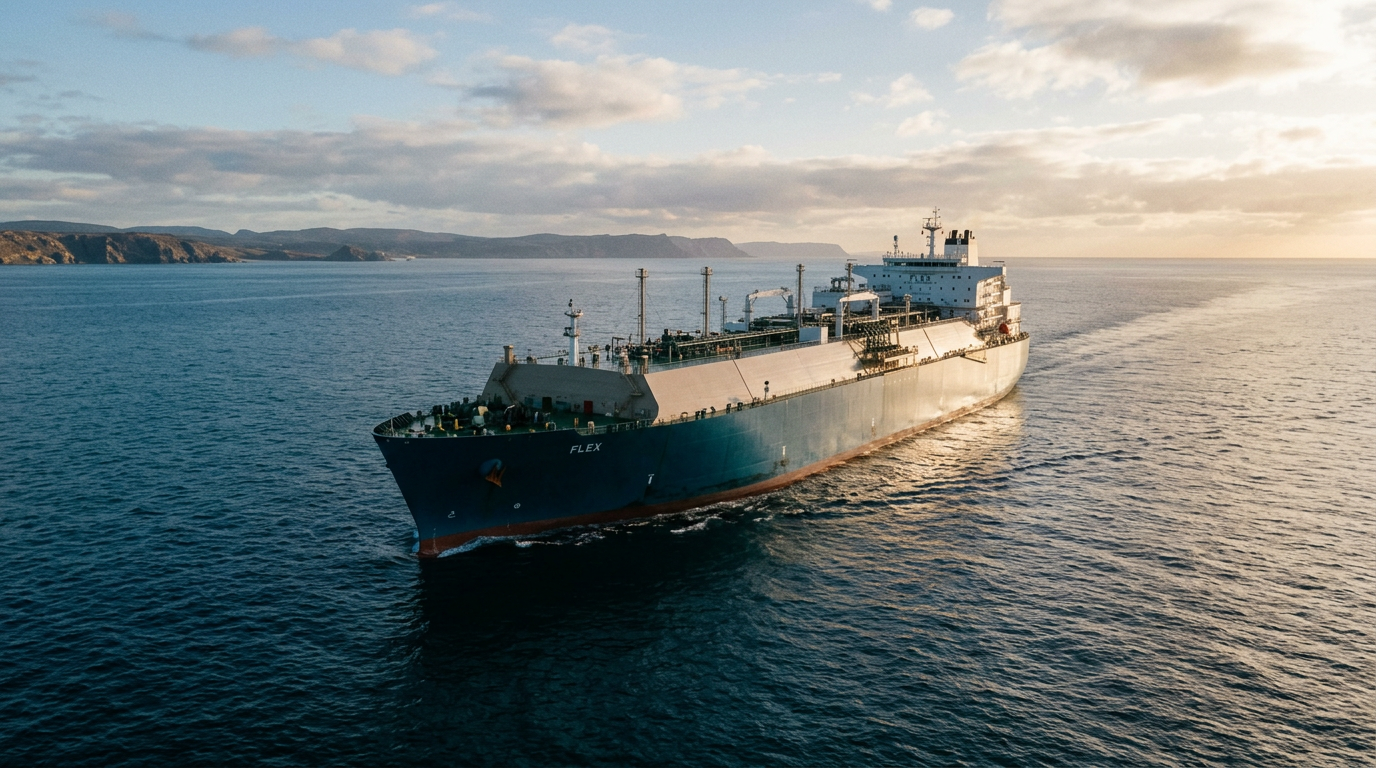
Here’s how the Hormuz situation actually benefited them, because it’s not as obvious as it sounds. Qatar accounts for roughly 20% of global LNG export capacity. When the conflict hit in late February and the strait effectively closed, Qatari production largely froze. That wasn’t just a rerouting problem – it was a supply gap. Europe was importing aggressively to rebuild storage ahead of winter. Asia was scrambling for replacement volumes. Both required longer voyages from alternative supply sources. Longer voyages mean more ship-days consumed per cargo delivery, which means tighter fleet utilization across the entire LNG carrier market. For a company with 13 vessels and available tonnage, that’s a direct rate tailwind.
Slight tangent, but it matters: there’s a version of this story where a shipping company benefits from conflict because its ships are right in the middle of the action, taking on war-zone risk for premium rates. That’s not what FLEX LNG did. Management confirmed on the Q1 call that none of their vessels operated inside the Strait of Hormuz during the conflict. Charterers elected alternative routes from the start. The company captured tighter market conditions without putting ships or crews in a war zone. That distinction actually matters for how you think about the risk side of this.
They also used the volatility window to lock in long-term contracts. Extensions on Flex Resolute and Flex Courageous secured employment through 2032 with options to 2039. Flex Aurora was fixed on a two-year deal with options extending up to eight years. As of Q1 close, 91% of 2026 vessel days were already contracted. That number is important because it means the near-term cash flow picture doesn’t really change based on what happens in the next headline cycle. Deal signed or not, the 2026 revenue base is largely locked.
The part that actually gives me pause is the 2027 picture, and this is where I’d push back on the pure bull case. The LNG carrier orderbook-to-fleet ratio is now sitting at 40%. Thirty-eight new vessels were ordered in 2026 alone. If a peace deal holds, Qatar restarts meaningfully, and those newbuilds start delivering simultaneously, the supply dynamics for LNG shipping flip fairly quickly. Management flagged this on the Q1 call as a genuine uncertainty for the 2027–2028 window. The CFO was direct about it. That’s not a reason to dismiss the stock right now, but it is a reason to be honest about what the holding period looks like and where the risk actually lives.
Kepler Cheuvreux downgraded FLNG to Reduce recently with a $25 target. The stock is near $32. That’s a $7 gap between where one of the more cautious sell-side voices thinks fair value is and where the market is currently trading. The downgrade thesis is essentially the newbuild overhang story. It’s a legitimate concern. It’s also the kind of analyst call that tends to be right eventually but wrong on timing, especially when the company just raised guidance and the market conditions driving that guidance upgrade haven’t changed.
As of this week, the U.S.-Iran talks are still unresolved. Iran’s Supreme Leader has blocked any deal that requires shipping enriched uranium stockpiles abroad. The newly announced Persian Gulf Strait Authority – Iran’s attempt to formalize toll collection on Hormuz traffic – was called “unacceptable” by Rubio. Pakistan’s Army Chief Asim Munir flew to Tehran this week to keep the conversation alive. It’s moving, but it’s not close. And even when it does close, the unwinding of rerouting patterns, insurance frameworks, and buyer diversification strategies doesn’t happen in a week.
What’s interesting is that FLNG doesn’t really need the conflict to continue in order for the 2026 numbers to hold. The contracts are already signed. The guidance is already raised. The dividend is already declared. The stock just needs the next six months to look roughly like the last three – which, given 91% contracted vessel days, seems like a reasonable base case even in a scenario where headlines start moving against energy.
Whether the 2027 picture justifies holding through the newbuild cycle – that’s the question nobody is asking yet. Which probably means it’s the right one to start thinking about now.
For informational and educational purposes only. Not investment advice. Trading involves significant risk, including potential loss of principal. Always conduct your own due diligence before making investment decisions.