May 23, 2026
Fluence: Two Hyperscalers, One $5.6B Backlog
First a message from Oxford Club
I almost dismissed this the first time I saw it.
Because an investment account that dates back to 1888 does not exactly sound exciting at first glance.
But then I looked at who has been quietly using it.
BlackRock.
JP Morgan.
Bank of America.
And according to the research, this overlooked account has delivered average annual returns of 29% over the last 25 years.
That got my attention fast.
Because if something like this has been sitting in plain sight for decades… why have so few ordinary investors heard about it?
Why is it never mentioned in the same breath as stocks, crypto, or the usual retirement products people get pushed toward?
Why do the biggest institutions seem to know exactly what it is… while everyone else gets left in the dark?
That is the question I want you to consider.
Not because I expect you to take my word for it.
But because there is a free presentation that lays the whole story out for you.
It explains what this so-called “29% Account” is, why major financial players have used it for years, and how regular investors may be able to access it with just a few hundred dollars.
If you are curious, I think this is worth seeing for yourself.
Good investing,
Marc Lichtenfeld
Chief Income Strategist, The Oxford Club
FEATURED
Fluence: Two Hyperscalers, One $5.6B Backlog
The AI power constraint is not a “someday” issue. It is already showing up in interconnection queues, upgrade timelines, and the unglamorous reality that electrons still have to arrive on time, every day.
Fluence Energy (Nasdaq: FLNC) quietly moved closer to the center of that problem on May 6, 2026, when it reported fiscal Q2 2026 results and, more importantly, disclosed commercial progress with two hyperscalers. The headline revenue number was light, but the market reaction told you what participants cared about.
Fluence reported Q2 FY2026 revenue of $464.9 million. Management also reaffirmed full-year FY2026 guidance for revenue of $3.2 to $3.6 billion and adjusted EBITDA of $40 to $60 million. The quarter’s adjusted gross margin was 11.1%.
Those are the hard numbers. The soft part is the shift in who is calling Fluence, and why.
The market ignored the miss and stared at the backlog
On the surface, the quarter gave skeptics plenty of oxygen: reported revenue of $464.9 million versus the Street expectation that many desks were carrying closer to the low $600 millions. Fluence attributed the shortfall largely to port and shipping delays rather than demand softness.
But the contract picture stayed firm. Fluence exited the quarter with a record contracted backlog of $5.6 billion, and management explicitly stated that this backlog covers the midpoint of FY2026 revenue guidance. For traders, that matters because it shifts the near-term question away from “can they sell it?” and toward “can they deliver it cleanly?”
One nuance worth keeping in mind: backlog coverage does not automatically equal margin quality. It is a visibility tool, not a profitability guarantee. Still, in a sector where timelines slip and procurement cycles can get noisy, $5.6 billion of contracted work is not trivial.
Most $5 Stocks Are Noise. These 5 Are Different
There’s a reason most investors avoid stocks under $5. But not every company at this level fits that stereotype.
These five Nasdaq names are tied to real markets and long-term trends. They are still early, still developing, and not widely followed, which may be exactly why they stand out.
Two hyperscaler MSAs, and a data center pipeline around 12 GWh
This is the part that moved the stock.
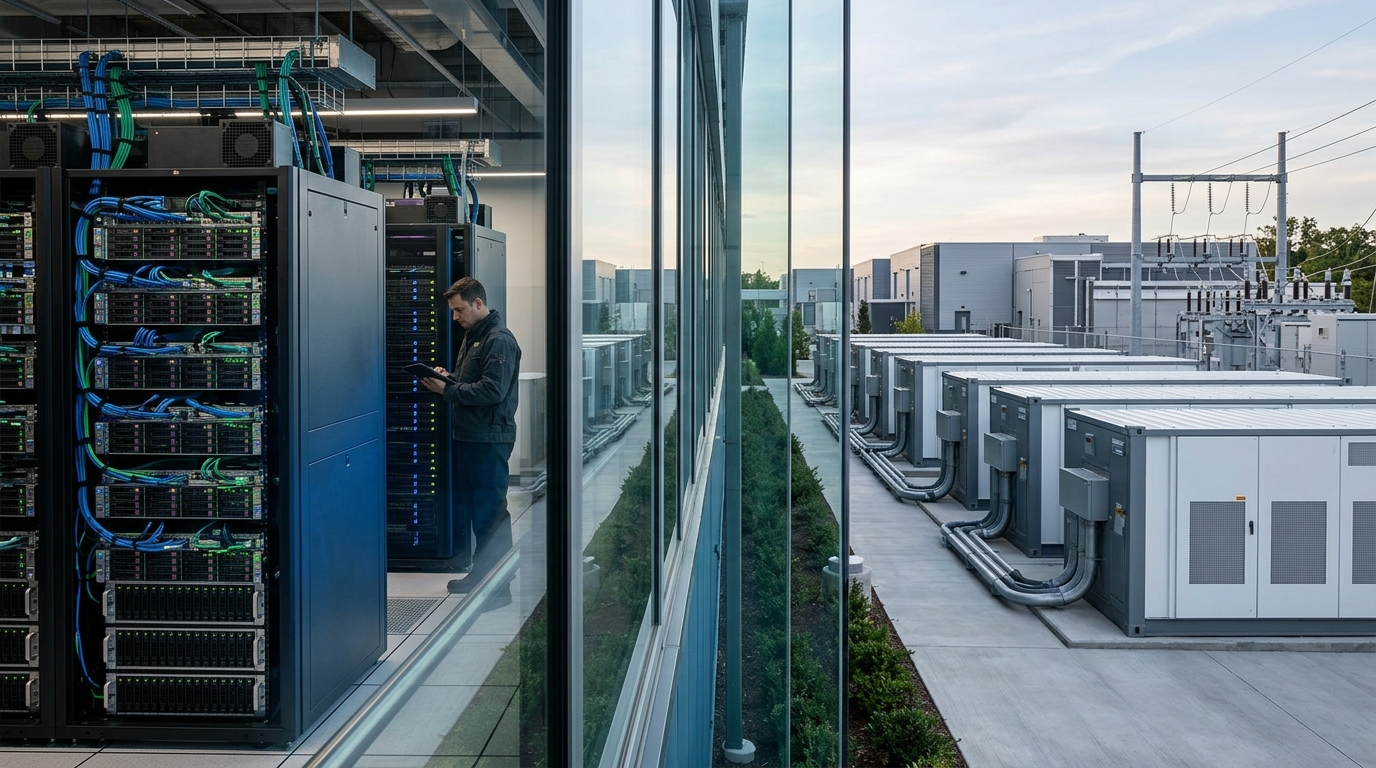
On the Q2 FY2026 earnings call, Fluence discussed executing two master supply agreements (MSAs) with major hyperscalers following competitive qualification processes. Management indicated the company is positioned for near-term data center project orders, with an expectation to convert the first order in fiscal Q3.
They also characterized the data center specific pipeline at roughly 12 gigawatt-hours, with most of that connected to those two MSAs. That number is large enough to change the way you think about Fluence’s “who are the end customers?” mix over the next several quarters, even if conversion timing is lumpy.
Slight tangent, but it matters: the data center conversation tends to get framed as “generation solves it” or “nuclear solves it.” In practice, a lot of the next 12 to 24 months will be solved by boring bridging capacity and flexibility. Storage is one of the few tools that can be deployed faster than a new plant, and it can be sized modularly. That is why these MSAs land differently than a typical utility procurement headline.
Smartstack: product execution is now part of the thesis
Fluence noted it reached substantial completion on its first delivery of Smartstack during the quarter. Traders should treat this as a practical milestone: new products are rarely about the brochure, they are about manufacturing flow, commissioning timelines, and whether the field data matches the spec sheet.
If Smartstack materially improves energy density and installation logistics, it can show up later as better cycle economics for customers and, potentially, better gross margin structure for Fluence. That “potentially” is doing work there. New SKUs can also introduce learning-curve costs early, which is why the next couple of quarters matter.
Where the skepticism still lives
Even with the backlog and hyperscaler angle, there are three points that can still bite:
- Delivery timing risk: management blamed shipping and port delays for the Q2 revenue miss. Those issues can clear, but they can also roll forward and create follow-on compression in scheduling flexibility.
- Margin risk: adjusted gross margin in Q2 FY2026 was 11.1%. For FY2026 adjusted EBITDA to land in the $40 to $60 million range, the second half needs cleaner execution and some mix help.
- Sentiment risk: the stock’s 52-week range has been wide, with sources showing a low around $3.93 to $4.40 and a high of $33.51, depending on the data vendor. That alone tells you how quickly positioning can flip.
That last bullet is not academic. When a name has traded from single digits to the low $30s inside a year, you do not need a fundamental disaster to see a 20% move. You just need the wrong crowd leaning the wrong way.
MAJOR BUY ALERT: Mar-a-Lago/Trump/Elon
I recently visited Mar-a-Lago…
And now I’m prepared to put my reputation on the line.
Since 1998, my proprietary system would’ve returned 13,126% in backtests.
(That’s 13X the S&P and 106X the average investor, according to JP Morgan.)
However, one investment I just uncovered could be my biggest winner of all…
It involves President Trump, Elon Musk, trillions of dollars, China…
And a MAJOR upgrade to the artificial intelligence revolution.
What I would watch next (simple, but not easy)
Three near-term items matter more than opinion:
- First hyperscaler order conversion in FY Q3: size, delivery window, and any language around repeatability.
- Backlog conversion pace: not just total revenue, but whether project timing looks smoother than it did in Q2.
- Gross margin progression: does adjusted gross margin hold around low double digits and drift higher, or does it stall while the company absorbs execution friction?
If those come through, analyst models will naturally change. If they do not, the market will stop giving “backlog credit” and start demanding proof quarter by quarter.
Worth a closer look into Q3.