May 26, 2026
The Silent War Between Remote Workers and Corporate Surveillance
Mouse movers, fake keystrokes, and the AI watching your every click
Something strange is happening inside corporate America right now, and most investors aren’t paying attention to it.
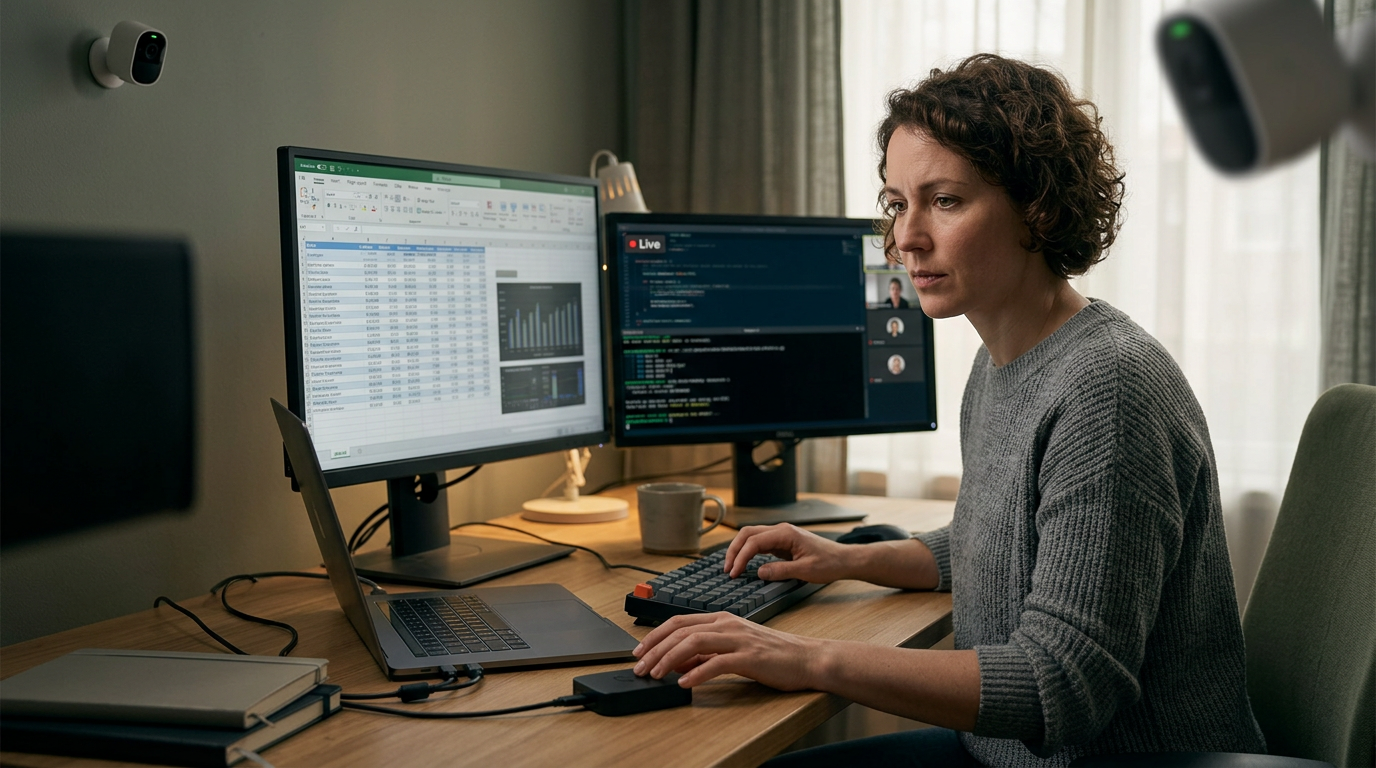
On one side of the battlefield, a growing segment of remote workers has quietly figured out that their actual productive output – the real work, the thinking, the decisions – takes maybe two to four hours a day. The rest? Theater. Scheduled Slack drafts timed to fire at 2pm so it looks like they’re grinding. Mouse-mover devices plugged into USB ports, simulating cursor activity to keep Teams status permanently green. Automated spreadsheet macros running in the background, generating the appearance of active engagement while the employee makes lunch or takes the dog out. This is the fake-busy economy. It’s real, it’s widespread, and the data behind it is uncomfortable for a lot of CEOs to sit with.
On the other side, corporations are deploying AI surveillance at a pace that would have seemed dystopian five years ago. And one publicly traded company is positioned squarely at the center of this arms race in a way that very few analysts are framing correctly.
RIP Tesla (Elon just confirmed the unthinkable)
At a recent shareholder meeting…
Elon Musk announced the END of Model S and X production lines at Tesla’s Fremont Factory…
So that they can convert them into a 1 million unit per year line of ‘Elon’s iPhones’ – a breakthrough technology that could generate “INFINITE PROFITS” for Tesla, according to Elon.
And he said the new production-ready version could be revealed as soon as July 22nd.
So you don’t have much time…
The Numbers Behind the Theater
Start with the BLS data, because it’s the cleanest signal available. Workers who go to an office on a typical day average 7.79 hours on the job. Remote workers? About 5.14 hours. That’s a 2.65-hour daily gap – which compounds to nearly 1.65 additional days of productive output per week for in-office employees compared to their remote counterparts, according to U.S. Bureau of Labor Statistics figures cited in a July 2025 Fortune analysis. That is not a rounding error. At 50 weeks a year, that’s roughly 82 extra hours of work per year, per person, just by being in a room with other people.
Slight tangent, but it matters: none of this is purely about laziness. A significant portion of remote workers are genuinely productive in compressed windows. Stanford economist Nicholas Bloom’s landmark randomized trial found that remote call center workers showed a 13% increase in performance, working more minutes per shift and handling more calls per minute due to fewer interruptions. The data is legitimately mixed. What the data is not mixed about is this: 30% of Millennials and Gen Z admitted to faking work activity, per a 2024 Workhuman survey. And Wells Fargo fired more than a dozen employees in 2024 after internal review confirmed they had been simulating keyboard activity to create the impression of active work, as documented in a memo to FINRA.
This isn’t anecdotal. It’s structural.
Is This the Fastest Way to Make Millions in America Today?
Find Elon Musk’s next big launch and grab yourself an early stake, before the mainstream catches on and it becomes impossible to make huge gains. Tesla soared 20,000% over 15 years. xAI grew 250X in two years. SpaceX has made early backers 2,000X their money since 2010.
What Mouse Movers Actually Are
Mouse jigglers – also called mouse movers – are either physical USB devices or software applications that simulate cursor movement at regular or randomized intervals. Their core function is simple: prevent a computer from registering as idle. On platforms like Microsoft Teams and Slack, user status automatically shifts to “Away” or “Idle” after a period of inactivity. A mouse mover defeats that detection entirely. Some software versions include advanced settings allowing users to specify timing patterns and even inject occasional keystrokes to mimic natural typing behavior. More sophisticated versions include stealth features designed to hide the application from system process monitors.
Search queries for mouse movers and mouse jigglers spiked dramatically after March 2020 when desk workers shifted to remote, and demand has remained persistently elevated. The virtual shelves of major online retailers carry plug-and-play versions that require zero technical knowledge to deploy. Employers are, in many cases, paying full salaries for workers whose activity data is entirely fabricated. One calculation from monitoring software firm Time Doctor put it bluntly: if just 10 employees each fake one hour of activity per workday, you lose 200-plus hours monthly in payroll exposure and receive fundamentally corrupted productivity analytics as a result.
That corrupted data problem is what makes this more than a compliance issue. It’s a capital allocation problem. Companies making headcount decisions, performance evaluations, and resource distribution choices based on activity metrics that are partially or fully artificial are flying blind. The cost compounds invisibly until someone gets caught.
The Surveillance Buildout
Corporate America’s response has been swift, AI-powered, and – depending on your perspective – either sensible accountability or the opening chapter of something far more troubling. As of a February 2025 survey of 1,500 U.S. employers, 74% now use online tracking tools including real-time screen monitoring at 59% adoption and web browsing logs at 62%. A separate 2025 Gartner survey found that over 70% of large employers now deploy some form of digital monitoring on remote workers, up from just 30% in 2019. That’s a doubling-plus in roughly six years.
The tools themselves have become more sophisticated than basic idle-time detection. AI productivity scoring systems now aggregate keystroke cadence, mouse movement patterns, application usage sequences, meeting attendance, and email response timing – then compress all of it into a single productivity score that influences performance reviews and termination decisions. According to Gartner’s 2024 predictive outlook, by 2028, 40% of large enterprises will deploy AI specifically to measure and, in some cases, actively influence employee mood and behavior patterns. That is not science fiction. In April 2026, Meta announced it is installing tracking software on all U.S.-based employee computers to capture keystrokes, mouse movements, and screenshots – data that feeds directly into AI model training. No opt-out available.
Employees working in high-surveillance environments report 45% stress rates compared to 28% in lower-surveillance settings. And 42% of monitored employees plan to leave their employer within a year, versus 23% of unmonitored peers. The retention math alone should give any CFO pause. But the surveillance market keeps expanding because the alternative – trusting productivity data that may be fabricated – is perceived as worse.
The employee monitoring software market was valued at approximately $5.4 billion in 2024 and is projected to reach $12.5 billion by 2028. Multiple research firms peg the CAGR at roughly 8.5% to 12.1% through the early 2030s. Private-market leaders like ActivTrak closed 2025 with over $1 million users and 26% revenue growth, backed by Francisco Partners. Teramind hit $16 million in annual revenue in 2025 with consistent expansion across regulated industries. These are strong private-market signals, but for traders, the play isn’t in private SaaS. It’s in the publicly traded platform company that these tools, and this entire category of corporate behavior, runs through.
Elon’s $4 Trillion Takeover Target, Revealed
Banking. Cars. Rockets. The Internet itself. Each time, the same pattern: Elon targets an industry the world says can’t be disrupted, the experts call him crazy, the short sellers pile in… and then he does it. Now he’s preparing for his biggest takeover yet.
The Stock Worth Watching: Microsoft (MSFT)
Here’s where it gets interesting. The entire fake-busy arms race – the mouse movers trying to fool Teams status indicators, the AI surveillance tools trying to detect them, the keystroke analytics, the idle-time scoring – virtually all of it runs on Microsoft infrastructure. Teams is the status platform workers are gaming. Microsoft 365 is the productivity suite their employers are monitoring. Viva Insights is the enterprise analytics layer measuring collaboration patterns, after-hours work, meeting load, and behavioral signals. And Microsoft Copilot is the AI layer increasingly embedded in every workflow being watched.
The financial results reflect this positioning directly. In Q3 fiscal year 2026 (ended March 31, 2026), Microsoft Cloud revenue grew 29% year over year to $54.5 billion for the quarter. Azure and other cloud services grew 40% year over year – now for the second consecutive quarter at that growth rate. Microsoft 365 Commercial cloud revenue increased 19%, and the commercial remaining performance obligation surged 99% to $627 billion, suggesting extraordinary forward visibility in enterprise contract commitments. For the nine months ended March 2026, total revenue grew 18% to approximately $242 billion on a run-rate basis, with operating margins remaining well above 40%.
Microsoft 365 Copilot, the AI assistant embedded directly into Word, Excel, Teams, and Outlook, is now in use across more than 90% of the Fortune 500. Over 26 million developers use GitHub Copilot. Commercial bookings jumped 112% in Q1 fiscal 2026, driven in part by large Azure Copilot commitments. What few people are framing clearly: Copilot is also the mechanism through which Microsoft is deepening its employee-analytics capabilities. The Copilot Dashboard within Viva Insights provides enterprises with granular visibility into how AI tools are being adopted across teams, how individual usage patterns correlate with output metrics, and how collaboration behaviors are shifting over time. That is workforce surveillance repackaged as AI adoption analytics. It’s a product that both the surveillance-demanding HR department and the productivity-focused CFO both want to buy.
The valuation is not cheap. MSFT currently trades at a significant premium to the broad market, reflecting its cloud growth trajectory and AI monetization story. Analyst consensus remains constructive, with the Intelligent Cloud segment – which houses Azure – growing at a 30% year-over-year pace in the most recent reported quarter. The bear case rests primarily on capital expenditure intensity: Q1 FY2026 capex was $34.9 billion, and management guided to continued sequential growth in infrastructure spending. Free cash flow came in at $25.7 billion in Q1 FY2026, up 33%, but the capex trajectory will pressure conversion ratios near term as the company builds out AI compute capacity ahead of demand.
Technical Framework
MSFT has been in a well-defined long-term uptrend since the 2022 lows, with the 200-day moving average acting as institutional support on any meaningful pullback. After the Q1 FY2026 earnings release in October 2025, the stock briefly sold off despite beats across revenue, operating income, and EPS – a reaction entirely driven by the capex guidance revision higher. That kind of sell-the-news response on strong fundamentals is often where disciplined traders find entries rather than exits.
The stock’s behavior around earnings has been instructive. Volume tends to spike sharply on results days, with institutional programs establishing or adjusting positions in the immediate aftermath of guidance. The $400-$420 range has historically acted as a zone of interest on pullbacks, though levels shift with each new earnings cycle. VWAP deviations following guidance-driven gap-downs in otherwise strong-fundamentals stocks have historically retraced within 30-60 days when the earnings quality is intact. The capex concern here is legitimate but well-telegraphed – what markets tend to dislike more is surprise, and Microsoft has been clear about the investment cycle. Momentum indicators across the weekly and monthly timeframe remain constructive as of this writing.
Three Scenarios to Model
Bull Case: Azure growth holds at or above 38-40% through fiscal year 2026. Copilot monetization accelerates beyond current analyst consensus as enterprise seat expansion picks up in mid-market accounts. Viva Insights and workforce analytics become a distinct upsell layer within M365 enterprise contracts, with CFOs and HR leaders buying it proactively as the surveillance arms race intensifies. In this scenario, multiple expansion is possible even at current valuation levels because the total addressable market for AI-native workforce management is still being priced by the market at a fraction of its eventual size. Price target range from the most constructive analyst camp sits in the $550-$600 corridor.
Base Case: Azure sustains 35-40% growth. Copilot shows continued adoption but monetization per seat remains relatively modest near term as enterprises negotiate volume pricing. Capex investment cycle peaks in fiscal 2027 and free cash flow conversion improves. MSFT continues compounding at roughly 15-20% annually, consistent with its five-year trend. No dramatic multiple expansion, but no compression either. The surveillance economy tailwind provides a slow, durable lift to the M365 and Viva product family without becoming a headline revenue line item for several years.
Bear Case: Capex intensity continues rising beyond current guidance, compressing free cash flow more than anticipated. Azure growth decelerates below 30% as hyperscaler competition from AWS and Google Cloud intensifies. Regulatory pressure on AI-driven employee monitoring – already building in the EU, where France fined Amazon 32 million euros in January 2024 specifically for tracking employee inactivity – eventually extends to enterprise software platforms in a way that creates legal and compliance friction for Viva Insights and similar tools. In this scenario, the stock likely consolidates or pulls back toward the 150-day moving average, potentially testing the $380-$400 range on a significant macro or regulatory catalyst.
The Playbook Every Options Trader Should Have!
Do you dream of retirement but it seems like an impossibility? Wish you knew the best moves to get you there sooner?
It’s closer than you think and you won’t have to work overtime to get it!
Hi! I’m Dave Aquino, expert options trader and my e-book, “How To Master the Retirement Trade” has helped thousands reach their goals!
Follow the link to get your copy and see what you’ve been missing!
Positioning Considerations
MSFT is not a momentum trade. It’s a compounding machine with an increasingly defensible position at the center of a behavioral shift that is still in its early innings. The fake-busy economy created the demand problem. The surveillance economy is the corporate response. Microsoft owns the infrastructure that both sides of this conflict are operating on – and it’s monetizing both ends simultaneously through subscription expansion, AI upcharges, and analytics tooling that gets deeper with every new Copilot feature released.
Risk management here centers on three things: entry timing relative to the earnings cycle, position sizing appropriate to the high absolute share price, and awareness that the capex investment cycle introduces more near-term free cash flow variability than MSFT’s historical profile. Traders positioning ahead of fiscal Q4 2026 earnings – which will cover the April through June 2026 period – should watch Azure re-acceleration signals and any Copilot seat count disclosures as the primary drivers of price action.
The cultural dimension of this story won’t resolve cleanly. The mouse-mover debate, the surveillance blowback, the trust erosion documented in the data – none of that ends with a single company policy or a court ruling. It’s a structural shift in how work is defined, measured, and valued. That kind of slow-moving, structurally sticky conflict is exactly the kind of theme that creates durable revenue streams for the platform companies caught in the middle. Microsoft is the most important one of those companies right now.
Whether the arms race between worker optimization and corporate surveillance intensifies further or eventually reaches some cultural equilibrium – that’s less certain. What is more certain is that every tool deployed on either side of that conflict is being built on, delivered through, or measured by Microsoft’s ecosystem. That’s where the position is.
For informational and educational purposes only. Not investment advice. Trading involves risk, including loss of principal.