May 27, 2026
NCLH +7.9%, UAL +10%: The Fuel Relief Trade Is On
First a note from Med-X
Ticker Reserved: MXRX
But the biggest opportunity isn’t when the bell rings – it’s before.
- $6.4M sales in 4 years
- Products on Amazon, Walmart, Kroger
- Expansion into 41 markets
👉 Shares are $4.00 today. Become a shareholder before Nasdaq.


NCLH +7.9%, UAL +10%: The Fuel Relief Trade Is On
Two of the most fuel-sensitive operators in the market made sharp moves around May 20, 2026. Norwegian Cruise Line (NCLH) ran as high as +8.8% on the session. United Airlines (UAL) surged approximately 10%. The original framing — that crude has been in free-fall — needs some context, because the actual story is more interesting.
The SpaceX IPO makes me FURIOUS
Elon has reportedly filed to take SpaceX Public… in an IPO that’s expected to hit a $1.75 trillion valuation.
The biggest in Wall Street history…
And you know who’s going to make all the money? The banks brokering the deal. The hedge fund managers. The billionaire insiders. The same “already rich” 1%’ers.
After the IPO, everyone else will be left fighting over scraps.
That’s why I’m leveling the playing field.
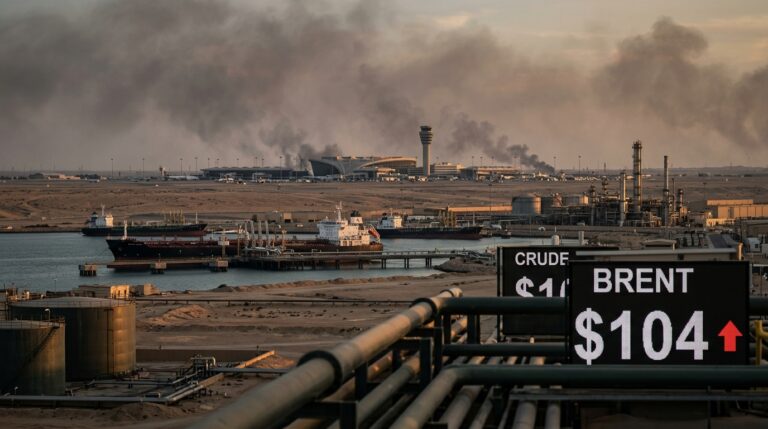
Earlier this spring, Brent crude spiked to $138 per barrel on April 7 as the de facto closure of the Strait of Hormuz choked global supply. The EIA estimates that Iraq, Saudi Arabia, Kuwait, the UAE, Qatar, and Bahrain collectively shut in 10.5 million barrels per day of production in April alone. Jet fuel, which nearly tripled after Middle Eastern exports were cut off per the IEA, became an existential cost conversation for airlines and cruise operators overnight. NCLH’s own 2026 EPS guidance was slashed — from a $2.38 prior forecast to a range of $1.45–$1.79 — partly due to $0.25 per share in higher fuel assumptions.
What shifted the tone: Brent is now projected at roughly $106/bbl for May and June, down meaningfully from that April peak, as Atlantic Basin supply ramps, strategic reserves flow into markets, and the Strait is expected to gradually reopen. The global average jet fuel price fell 1.7% week-over-week to $159.85/bbl per IATA’s most recent monitor — a second consecutive weekly decline after the prior week’s 10.1% drop. That sequential easing matters more than the absolute level.
Slight tangent, but it’s worth noting: NCLH’s move wasn’t purely a fuel story. Elliott Management quietly built a sizable new position in Norwegian during Q1 2026 — one of only two new equity buys for the fund that quarter. Q1 adjusted EPS of $0.23 beat the $0.14 consensus on $2.33B in revenue, and management outlined $125M in SG&A run-rate savings. Analysts at Wells Fargo, Truist, and TD Cowen trimmed targets but largely held Buy or Overweight ratings, with consensus price targets clustering in the low-to-mid $20s — well above the mid-$15s where shares traded entering the week.
UAL’s catalyst was different in texture. Summer travel demand is running hot — the airline anticipates over 53 million passengers from June through August, with bookings for international events showing double-digit growth. UAL’s 52-week range runs $71.55 to $119.21, and as of May 26 shares were around $105, reflecting a roughly 49% gain over the prior 12 months. UBS raised its price target to $148 from $139 with a Buy rating. The consensus among 26 analysts sits at a 12-month target of $129.83 — a 40%+ premium to current levels.
Foldable Houses That Ship Anywhere
Imagine a future where homes are mass produced like cars – one every minute.
That’s the vision of BOXABL Inc. (“BOXABL”), with factory-made, foldable houses that ship anywhere and unpack in one hour.
BOXABL announced plans for a potential SPAC merger with FG Merger II Corp. (“FGMC”) (NASDAQ: FGMC). Investors holding $FGMC shares will automatically convert to $BXBL upon closing.
Learn more about the proposed merger and Nasdaq plans
Disclosure: Investing in a SPAC can introduce unique risks, including but not limited to regulatory and compliance risks, liquidity risks, structure and complexity. Review the latest filings https://www.sec.gov/edgar/browse/?CIK=1816937
The risk hasn’t disappeared. UAL itself said explicitly: if fuel re-escalates, the company expects to land in the lower half of its EPS guidance range for both Q2 and full-year 2026. The Strait of Hormuz isn’t fully open. The EIA still projects global inventories falling by 2.6 million b/d this year. NCLH faces a 3.6% net yield decline in Q2 on a constant-currency basis, and cruise cost ex-fuel per capacity day is ticking up 1.0%. The relief is real — but it’s fragile.
What the move tells you is simpler than the geopolitics: when the single largest variable cost for an entire category of operator starts pulling back, even modestly, institutional money doesn’t wait for confirmation. It moves early. Whether this holds depends entirely on what the Strait looks like in June — and that’s the level every active trader in these names should have marked right now.
For informational and educational purposes only. Not investment advice. Trading involves risk, including loss of principal.