May 27, 2026
First Solar Is Moving Again
Yields ease. AI power demand rises. FSLR catches a bid.
Key Takeaways
- FSLR surged approximately 6.1–6.5% in a single session, with the move driven by a combination of easing Treasury yields and rising corporate clean energy procurement demand.
- The 10-year Treasury yield has pulled back to the 4.48%–4.50% range, relieving pressure on rate-sensitive renewable infrastructure equities.
- First Solar reported record Q1 2026 revenue of $1.04 billion — up 24% year-over-year — with diluted EPS of $3.22, a 65% increase versus Q1 2025.
- Gross margin expanded to 47% in Q1 2026, up six percentage points from 2025, driven by higher Section 45X qualifying volumes and reduced freight costs.
- The company’s contracted sales backlog stood at 47.9 GW as of March 31, 2026, representing an aggregate transaction price of $14.4 billion, with deliveries extending through 2030.
- Full-year 2026 guidance was reaffirmed: net sales of $4.9B–$5.2B, Adjusted EBITDA of $2.6B–$2.8B, and volume sold of 17.0–18.2 GW.
- Data centers now consume roughly 6% of U.S. electricity, with annual global data center spending approaching $1 trillion — a structural demand driver that directly benefits utility-scale solar providers like First Solar.
The real reason Musk, Huang, Cook, and Fink just flew to Beijing
Last week, the CEOs of Nvidia, Apple, SpaceX, BlackRock, Goldman Sachs, Visa, Boeing, and more boarded Air Force One with President Trump to visit China. A U.S.-China trade deal would ignite a Melt Up in U.S. stocks, sending the market into a frenzy.
Learn the exact moves one Florida millionaire says to make today – before this window closes
Market Context: Yields Pull Back, Sentiment Shifts
There’s a reason renewable infrastructure stocks have been sensitive to every tick in the bond market this year. When yields rise, discount rates climb, long-duration project economics compress, and capital flows out of sectors where future cash flows are the whole story. First Solar felt exactly that pressure weeks ago — falling roughly 5% in a single session as rising yields weighed on the name.
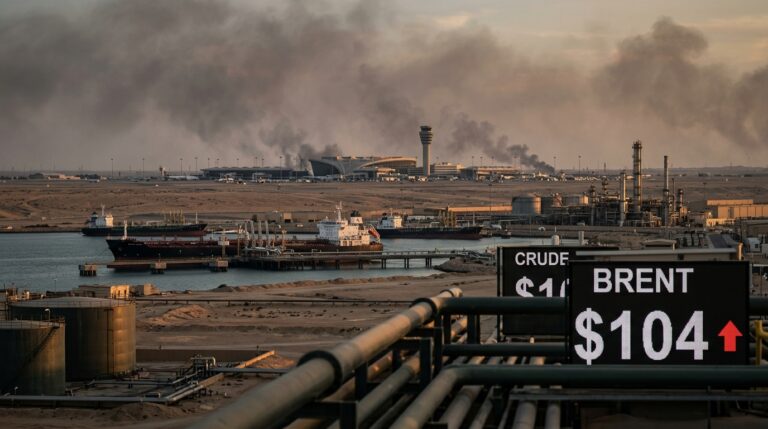
What’s changed now is worth paying attention to. The 10-year Treasury yield has pulled back to approximately 4.48%–4.50%, down meaningfully from recent highs near 4.57%, as investors have reduced near-term Fed rate hike expectations. Progress in U.S.–Iran diplomatic talks has helped cool oil prices, easing inflation concerns that had been building into the bond market. Investors are now watching upcoming PCE inflation data for the next policy signal, but for the moment, the pressure on rate-sensitive sectors has moderated — and FSLR moved with it.
The broader market provided a tailwind too. The S&P 500 gained close to 1%, the Dow added over 1%, and the Nasdaq rose more than 1% during the session, lifting risk appetite across growth and clean-energy names. That kind of broad-based move tends to amplify momentum in high-beta sectors, and solar names have a beta profile that rewards that environment. FSLR’s beta sits around 1.26 — it moves faster than the index in both directions.
The Data Center Factor — and Why It’s Different This Time
Here’s where the longer thesis comes in. Data centers now consume roughly 6% of all U.S. electricity — a 36% jump in total global data center power draw over just two years, with the total now hitting 67.7 gigawatts worldwide. The U.S. alone accounts for 29.2 GW of that figure, or roughly 43% of global consumption. Annual global data center spending is approaching $1 trillion, with up to $700 billion anticipated in the U.S. in 2026 alone.
The Electric Power Research Institute has estimated that data centers could grow to consume up to 9% of U.S. electricity generation annually by 2030, up from 4% in 2023. The load growth this implies is, by historical standards, extraordinary — comparable in scale to what the grid experienced in the 1980s. S&P Global notes that U.S. generation could need to rise from approximately 4,400 TWh in 2026 to 5,200 TWh by 2030, a nearly 24% increase.
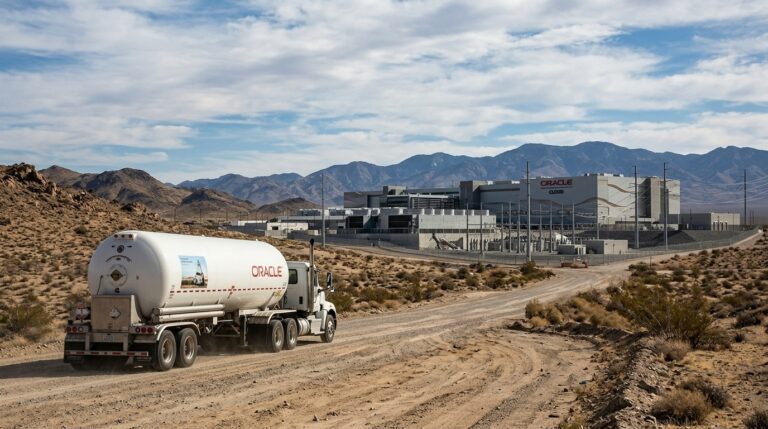
The part people sometimes skip over: tech companies have become the largest corporate purchasers of renewable energy on the planet. Amazon has announced over 20 GW of capacity across more than 500 projects globally. Google and Microsoft each carry substantial power purchase agreement portfolios spanning wind, solar, and emerging technologies. The share of data center power sourced from renewables has already climbed to an estimated 58%, up from roughly 50% just a year prior. Power purchase agreements — long-term contracts that provide financing certainty for clean energy developers — remain the primary procurement mechanism. That’s a direct offtake pipeline that benefits companies like First Solar.
Slight tangent, but it matters: earlier in 2026, Alphabet announced a collaboration with Intersect Power — a developer focused on solar-and-storage projects specifically designed to power data centers. Intersect’s model integrates generation and storage on-site, reducing grid dependence and accelerating deployment timelines. That announcement lit up First Solar’s thin-film module business, which constitutes a major share of its utility-scale sales, and sent FSLR up 5% in a single session. The same structural logic is now playing out again at a broader scale.
BOXABL Moves Closer to Becoming Publicly Traded
BOXABL Inc. (“BOXABL”) announced plans for a potential SPAC merger with FG Merger II Corp. (“FGMC”) (NASDAQ: FGMC).
Currently trading on Nasdaq, $FGMC will be the surviving entity following the proposed merger’s closing.
The combined company will then be renamed BOXABL Inc., with the anticipated ticker $BXBL. BOXABL has raised $230M from over 60,000 investors since 2020.
View important merger details and follow $FGMC on Yahoo Finance
Disclosure: Investing in a SPAC can introduce unique risks, including but not limited to regulatory and compliance risks, liquidity risks, structure and complexity. Review the latest filings https://www.sec.gov/edgar/browse/?CIK=1816937
Financials: The Numbers Behind the Move
The fundamental case is not thin. Full-year 2025 revenue came in at $5.22 billion, a 24.1% increase from 2024’s $4.21 billion. Net income for fiscal 2025 was $1.53 billion, up 18.3% year-over-year. Diluted EPS came in at $14.21, also up approximately 18%. The company’s EBITDA for fiscal 2025 was $2.1 billion, with a gross margin profile of 40.6%.
Q1 2026 was stronger still. Net sales of $1.04 billion — a record for a first quarter — came in at 24% growth year-over-year, driven by a 31% increase in module volume. Gross margin expanded to 47%, up six percentage points from the year-ago quarter, supported by higher qualifying Section 45X volumes and reduced freight costs. Adjusted EBITDA hit $520 million, representing a 50% adjusted EBITDA margin and coming in above the upper end of preview guidance. Net income was $347 million, and diluted EPS of $3.22 represented a 65% increase versus Q1 2025.
The balance sheet is clean. Gross cash stands at $2.4 billion, net cash at $2.0 billion. U.S. manufacturing facilities ran at approximately 96% utilization in Q1. The South Carolina finishing facility — which management expects to improve freight, tariff, and domestic content outcomes — is on track for production start in 2026.
Full-year 2026 guidance was reaffirmed in April: net sales of $4.9B–$5.2B, Adjusted EBITDA of $2.6B–$2.8B, volume sold of 17.0–18.2 GW, and capex of $0.8B–$1.0B. The contracted backlog as of March 31, 2026 stands at 47.9 GW, representing $14.4 billion in aggregate transaction price with deliveries through 2030. Management described the U.S. backlog through 2028 as “substantially committed,” providing pricing clarity even as the company exercises booking selectivity in a policy-uncertain domestic market.
One area worth watching: EPS in Q1 beat analyst expectations by approximately 9.95%, but revenue came in just 1.3% below consensus. That minor revenue miss is less alarming in context — it reflects higher India deliveries at lower average selling prices (~$0.20/watt), not softening U.S. demand. The U.S. business remains the core margin engine.
Analyst coverage is broadly constructive. Of 34 analysts tracked, the average rating is “Buy.” Price targets range from Jefferies at $187 (Hold) to UBS at $290 (Buy), with Freedom Broker recently upgrading to Buy with a $260 target following the Q1 report. The consensus 12-month target is approximately $244–$247, implying modest upside from current trading levels near $219–$249.
Sector Context: Solar Peers and Capital Flows
FSLR isn’t moving in isolation. Sector-wide sentiment has been picking up. In prior sessions tied to similar catalysts, Enphase Energy rose 5.3%, SolarEdge Technologies climbed 8.6%, and Sunrun gained 5.6%. These moves reflect something broader than single-stock momentum — they point to a market-wide reassessment of demand expectations for U.S.-manufactured solar infrastructure.
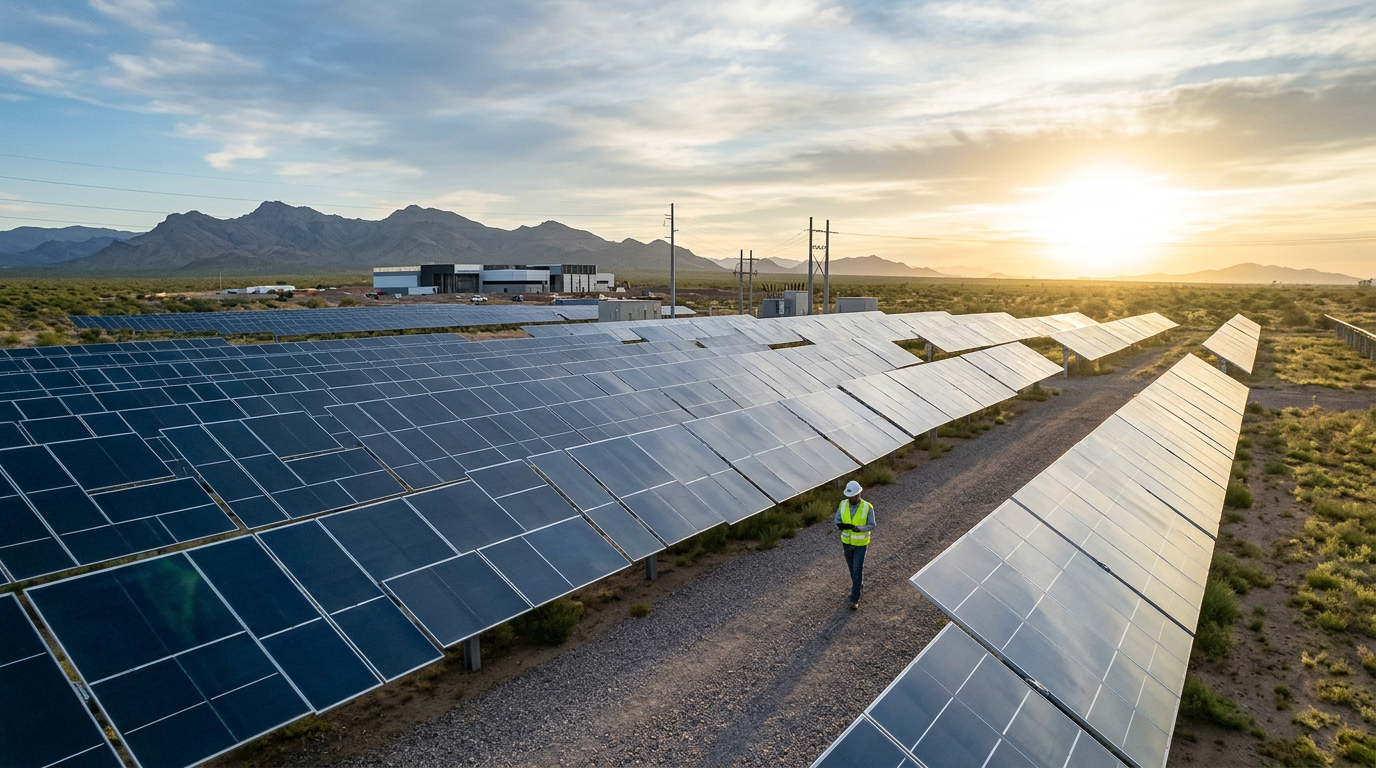
What distinguishes First Solar from most peers is its domestic manufacturing footprint. As America’s only major U.S.-headquartered solar manufacturer among the world’s largest, First Solar’s thin-film cadmium telluride technology and American supply chain give it a structural advantage under current tariff and trade conditions. Its Section 45X Advanced Manufacturing Production Tax Credit monetization — including a 2024 transaction worth $857 million sold at $0.955 per dollar of credit — reinforces the cash flow profile in ways that most solar names can’t replicate. Each of its U.S. factories employs upwards of 800 people at an average manufacturing salary of $80,000 annually, grounding its domestic content advantage in real operational terms.
That said, the company faces real headwinds at the international level. In Q3 2025, First Solar terminated 6.6 GW of bookings following defaults by affiliates of BP, and has reduced utilization at its Malaysia and Vietnam facilities. The company is actively pursuing $324 million in termination payments from BP Solar Holding LLC for breach of contract. These aren’t existential issues, but they create noise around near-term volume cadence and underutilization charges — particularly in Q2 2026, which management has flagged as carrying “a little bit of headwind.”
Wall Street is calling it the “Warsh Shock.” Here’s how to profit from it…
Nearly half of the world’s biggest money allocators are scrambling to reposition for what they expect to be the most volatile market in years.
Larry Benedict isn’t scrambling. He’s seen this before.
He says the Warsh Shock is setting up the most predictable wealth-building window he’s seen in 20 years… and there’s one ticker right at the center of it.
Technical Framework
From a structural standpoint, FSLR has been working through a wide trading range. The 52-week range runs from $119.09 to $285.99 — a roughly 140% spread that reflects both the policy volatility this sector has absorbed and the episodic nature of momentum in clean energy names. The stock recently traded in the $190–$250 zone, with near-term resistance in the $250–$260 area and support building around the $200–$210 level.
Volume patterns around major move days are worth tracking. On sessions where FSLR prints large percentage moves, confirming volume adds credibility to the directional move — flat or declining volume on up-days is a yellow flag. Given the stock’s beta of approximately 1.26 and implied volatility that recently ran around 62.87%, traders should expect continued wide intraday ranges.
Moving average structure deserves attention heading into the next few weeks. The stock has been recovering from a deep correction that brought it from the $285 range to the $135–$190 band earlier this year. A sustained hold above $210–$220 — combined with continued macro tailwinds — would signal that the medium-term structure is stabilizing. A break below $190 would likely invite renewed selling pressure and test the lower end of the established range. VWAP on high-volume days has been acting as a short-term pivot — traders watching for entries should pay attention to how price closes relative to daily VWAP on any continued follow-through sessions.
Scenario Modeling
Bull Case — Continued macro tailwind + policy clarity
If the 10-year yield continues to moderate toward 4.20%–4.30%, clean energy discount rates ease further and institutional capital rotates back into renewable infrastructure at scale. Concurrent clarity on Section 232 tariffs creates a new booking cycle — management has explicitly noted it is “awaiting clarity” before adding incremental U.S. contracts. A resolution there, combined with Q2 2026 results that hold the 45%+ gross margin line, could push FSLR toward the $270–$285 range and challenge the 52-week high. Large-scale corporate PPA activity from tech hyperscalers would add additional offtake visibility to the thesis.
Base Case — Range-bound recovery with episodic momentum
Most probable near-term path. FSLR continues trading in the $210–$255 zone as yield volatility keeps rate-sensitive sectors choppy. Q2 2026 results reflect the underutilization headwinds management flagged — modest pressure on EPS relative to Q1’s record pace. Full-year guidance holds, the backlog remains intact, and the stock trades at a modest discount to intrinsic value (GF Value pegged at $268, with the stock near $249). No dramatic re-rating, but fundamental accumulation continues at these levels as the data center demand story builds credibility over multiple quarters.
Bear Case — Policy reversal + yield spike
The real risk for FSLR is not operational — it’s macro and policy. A meaningful rollback of Section 45X Advanced Manufacturing Production Tax Credits would structurally alter First Solar’s profitability model, which depends heavily on tax credit monetization (the 2024 sale alone netted $857 million). Separately, if PCE inflation data disappoints and the market begins pricing in a rate hike cycle rather than cuts, the 10-year could revisit the 4.70%–4.90% range — a level that historically drives significant selling in solar names. In a worst-case scenario combining policy erosion and yield pressure, FSLR could revisit the $135–$150 range, consistent with the historical downside pattern the stock exhibited in 2022 when it fell roughly 49% from peak to trough.
Active Trader Strategy Framework
For traders already in the name, the question is whether this move has legs or if it’s front-running a catalyst that already partially priced. Given FSLR’s historical tendency to mean-revert after sharp single-session moves, chasing on the open the day after a 6%+ session requires caution. Pullbacks to VWAP or the $210–$215 zone would offer a more defined risk entry for those looking to add.
Key levels to monitor: $200 (psychological and structural support), $220 (recent range resistance, now potential support), $250–$260 (near-term resistance zone, aligns with several analyst targets), and $285 (52-week high and medium-term bull case trigger). Position sizing should reflect the stock’s beta of 1.26 and its documented tendency toward outsized drawdowns — a 30–40% correction within a calendar year is not anomalous for this name.
Volatility-aware traders should note that implied vol has run elevated — near 62.87% on recent high-activity sessions — which makes option premium expensive. Spread strategies that define risk while maintaining directional exposure may be more capital-efficient than outright long positions in this environment. The next earnings date is July 23, 2026, which means traders have approximately eight weeks of runway before the next fundamental reset point.
The Stock-Picking AI That Could Triple Your Money This Year
Early users could have already tripled their money every single year this AI has been live, based on the average winning trade spotted – WITHOUT having to check the news, WITHOUT watching the Fed, and WITHOUT all the stress most traders have to deal with. For now, you can try this AI yourself, completely free of charge – no email, no credit card.
What’s interesting here is that FSLR is no longer just a policy story. It’s becoming an infrastructure story — one tied to a structural shift in where corporate America sources its power. Whether that story compounds at the pace the bull case requires depends on factors that go well beyond First Solar’s manufacturing execution. It depends on Treasury yields, Fed policy, geopolitical oil dynamics, and whether hyperscalers translate their renewable procurement commitments into actionable utility-scale contracts.
The fundamentals are genuinely strong — record Q1 revenue, 47% gross margins, a $14.4 billion backlog, and a balance sheet carrying $2.0 billion in net cash. The macro environment, for now, has turned less hostile. But the rate sensitivity this sector carries means the trade is never just about the company. It’s always partly about the bond market. And the bond market is not done moving.
Preparation over prediction. Know your levels. Manage the risk.
For informational and educational purposes only. Not investment advice. Trading involves risk, including loss of principal.