May 30, 2026
SpaceX Filed Its S-1. June 12 Is Now the Countdown
First a message from Oxford Club
A lot of people are still looking at this the wrong way.
They see a big-name IPO story.
They see Elon.
They see headlines.
But they do not yet see where the real opportunity may be hiding.
And that matters.
Because the best opportunities rarely feel obvious at the beginning.
They feel easy to ignore.
Easy to delay.
Easy to come back to later.
Until suddenly everyone is talking about them…
And the chance to get there before the crowd is gone.
That’s why I’m bringing this to you now.
Not at the last second.
Not after the story has been fully picked apart.
But while there’s still time to understand what may be developing behind the SpaceX narrative.
In my view, that’s where the real intrigue is.
Most investors are still focused on the surface.
They have not yet connected the deeper Starlink angle, the broader AI buildout, and the related plays that could benefit if this story keeps accelerating.
That disconnect may not last long.
And once it closes, you may not be looking at the same kind of upside.
You may just be looking at a trade everybody else already discovered before you did.
That’s the part I don’t want you to miss.
Because if this unfolds the way I think it could, the people who moved early may have a very different experience from the people who waited for more confirmation.
Click here and you’ll also get my FREE “SpaceX” pre-IPO recommendation now.
Better to be a little early on something important than a little late to something everyone else already sees.
Yours for peace, prosperity, and liberty, AEIOU,
Dr. Mark Skousen
Macroeconomic Strategist, The Oxford Club
FEATURED
SpaceX Filed Its S-1. June 12 Is Now the Countdown
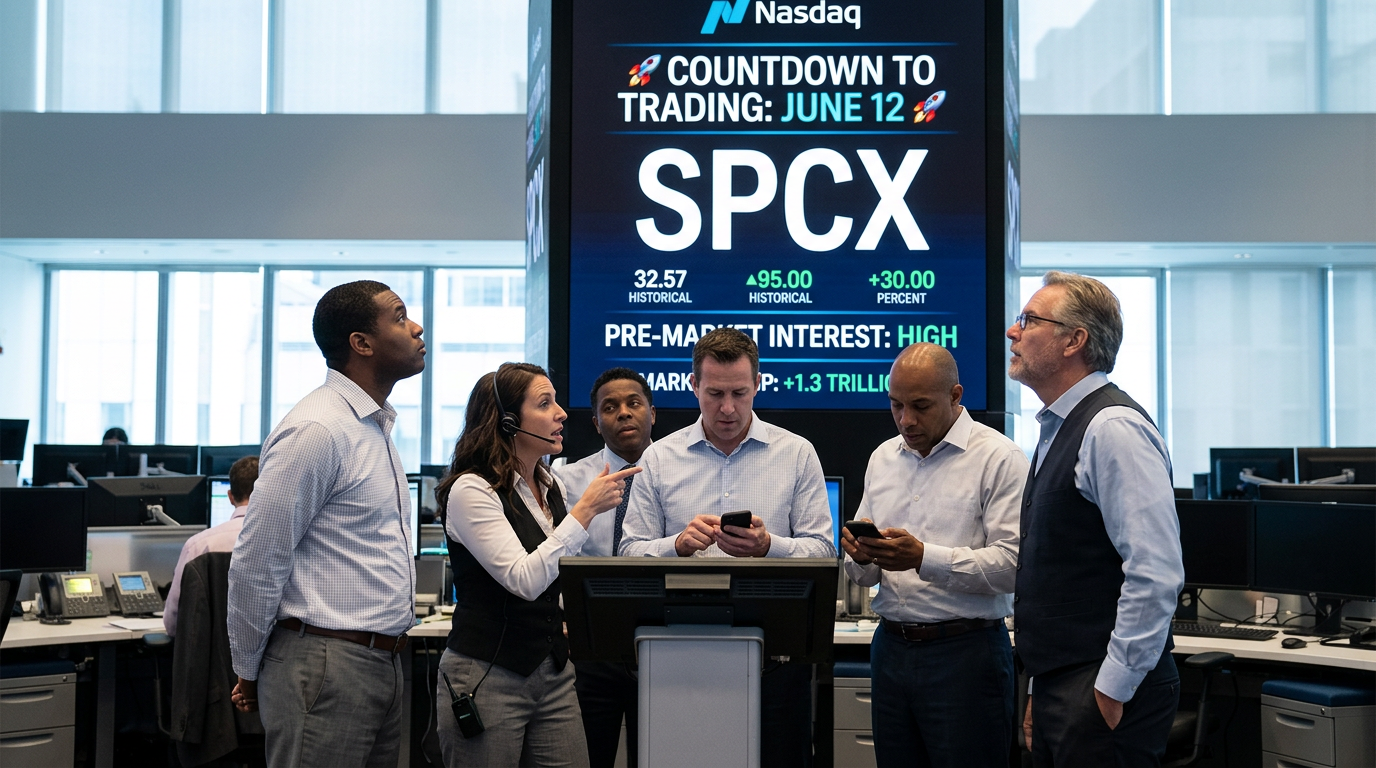
SpaceX is no longer a “maybe someday” story. The company publicly filed an S-1 with the SEC on May 20, 2026 and is targeting a Nasdaq debut under SPCX with pricing expected June 11 and first trading day expected June 12, 2026.
That calendar matters because deals of this size do not stay contained inside one ticker. The IPO window, the allocation process, and the week around pricing can change how real money behaves across tech, defense, industrials, and anything sitting in the “high-duration growth” bucket.
Slight tangent, but it matters: we just watched Blue Origin’s New Glenn rocket explode during a launch pad engine test on May 28, 2026 in Florida. Space and launch names sold off in sympathy right after, even though the incident was not a SpaceX event. That is a reminder of how tightly this corner of the market trades on headlines and confidence, not just fundamentals.
What we can confirm right now
- Filing: SpaceX publicly filed its S-1 on May 20, 2026.
- Exchange and ticker: Nasdaq, SPCX.
- Timing: Most reporting and trackers point to pricing on June 11 and trading starting June 12, 2026.
- Deal framing: Broad consensus has centered around a ~$1.75T valuation target and up to ~$75B raised, which would be historically large.
From here, the most important thing for traders is not debating whether the deal is “big.” It is. The practical question is where the stress shows up first: index liquidity, factor exposures (momentum vs value), and the crowded parts of the market that funds may trim to make room.
President Trump’s 3,642 stock trades REVEALED
President Trump just filed a form showing he personally bought millions’ worth of Nvidia, Apple, Microsoft, and more. The man has access to more economic intelligence than anyone alive, and he’s aggressively buying U.S. stocks. Brett Eversole – who helped predict the Dow would hit 50,000 – says this signals a once-in-a-generation “Melt Up.”
Key company numbers that keep showing up
Private companies do not give you the same clean, long public history you get with an S&P 500 name, so you have to be careful about which numbers are truly sourced and which are stitched together from estimates. Here is what looks consistent across multiple independent sources discussing the filing and pre-IPO financial picture:
- 2025 revenue (estimate used by several research trackers): about $18.7B.
- Starlink FY2025 revenue: about $11.4B.
- Starlink FY2025 operating profit: about $4.4B, implying an operating margin near 39%.
- Starlink subscribers: around 10.3M globally (figures vary by source and update cadence).
Important correction versus the prior draft: the claim that SpaceX has an “AI segment – xAI” with a merger tied to X, plus multi-billion quarterly burn numbers, does not line up with credible reporting around the SpaceX S-1. xAI is typically discussed as a separate Musk-linked entity, and those specific loss figures should not be stated as SpaceX financials unless they are explicitly in the filing. So those lines have been removed.
Also, the earlier comparison point “Saudi Aramco’s $29.4B raise in 2019” is commonly cited, but the exact amount raised in Aramco’s IPO and follow-on offerings is easy to misstate depending on whether you include the greenshoe and later secondary. Instead of leaning on one number, the cleaner point for traders is this: if SPCX raises anywhere near $75B, it would sit at the extreme end of IPO history by proceeds. That is the market impact driver.
Why traders should care beyond the headline
A deal this large is a liquidity event and a positioning event. If you run a long-only book with benchmarks, you are thinking about weight. If you run a hedge fund book, you are thinking about what you sell to fund it, and what you hedge against it. If you trade vol, you are thinking about how the options market will reprice single-name risk once a real float exists.
Here is where I am at: in the days leading into pricing, secondary market moves often look “random” to casual observers. They are not random. They are portfolio math, and the biggest distortions usually show up in stocks that share the same investor base or the same factor exposures. You will often see it first in the most crowded longs.
Sector ripple map
Space and launch: Rocket Lab (RKLB) and AST SpaceMobile (ASTS) are obvious sympathy names. They can move on perception of “space risk” and funding conditions, not only on their own quarterly results. The New Glenn incident on May 28 was a clean example of how quickly sentiment can swing in this group.
Defense and aerospace: If institutional investors decide to think about SpaceX as infrastructure plus national security exposure, you can see attention rotate toward primes and suppliers. The market will also try to separate “launch capacity” from “defense budgets,” which do not trade the same way day-to-day.
Big Tech and high-duration growth: If you get a serious allocation pull, it tends to show up as pressure in high-multiple software and semis first, because that is where many growth funds already have size. Not because the businesses are suddenly worse. Because capital is finite and risk limits are real.
Payment rails and prime brokers: This is a smaller angle, but worth keeping in the back of your mind. Mega events stress settlement, financing, and inventory management. You do not trade it directly, but you may feel it in spreads and intraday liquidity.
Elon’s audacious plan to double U.S. energy, without building a single new power plant…
People think he’s crazy.
But Adam O’Dell says he’s already deployed 4,000 units of his solution across 14 states – and used them to power the largest supercomputer on the planet.
With Microsoft, Amazon, Google and Facebook set to spend $680 billion this year on AI data centers that can’t get enough power to run, Elon’s solution is about to be in extraordinary demand.
Valuation math, kept honest
If you take $1.75T against roughly $18.7B of estimated 2025 revenue, you get a trailing price-to-sales multiple around 94x. At $1.8T, it is about 96x. Even if forward revenue is meaningfully higher, you are still looking at a multiple that requires investors to underwrite very long-dated growth and margin expansion.
That does not make it “wrong.” It makes it sensitive. When you have a large multiple and an enormous spotlight, small disappointments can matter, and small positive surprises can matter. The first few weeks of public trading are often less about intrinsic value and more about who got stock, who did not, and how quickly supply shows up.
Trading framework (no heroics)
IPO sessions tend to have wide spreads and fast moving liquidity. For something this large, the first hour can be violent even if the day ends “fine.” The part people skip is that you do not need to be first. You need to be consistent.
- Day 1 and Day 2: Treat them as discovery sessions. The initial range often becomes the reference band for weeks.
- Anchors that usually matter: the IPO open, the first hour high and low, and the first close. If the stock holds above the first close after a couple sessions, that is often a sign supply is being absorbed.
- Volume clues: watch for a surge early, a lull midday, then a second wave late. If late-day participation fades quickly, it can hint at “event tourists” leaving rather than longer-horizon money stepping in.
- Sympathy trades: monitor RKLB, ASTS, and other space-adjacent names for overreactions. These are where short-term opportunities tend to show up because liquidity is thinner.
One more thing: if you are using options when they become available, respect that implied volatility can be expensive right after a major listing. A lot of people learn that lesson the hard way. It is not a moral judgment, it is just how markets price uncertainty when everybody is watching the same screen.
Three scenarios to plan around
- Upside scenario: Strong institutional demand into pricing, limited early supply, and the stock holds above its first close through the first week. In this case, the risk is not missing the first move. The risk is chasing extended strength and getting caught when lock-up dynamics become the next topic.
- Middle scenario: Prices near the marketed range, then spends several sessions chopping inside the first two-day range while allocations settle. This is the most common path for large, high-profile deals. It can feel boring, then suddenly it is not.
- Downside scenario: Early volatility plus heavy supply as holders and fast money reduce exposure quickly. In this case, the key is patience. The cleanest opportunities often come after a few sessions when the market shows where demand is actually willing to defend price.
The dates are close enough that you can plan your week now. June 11 is the expected pricing date. June 12, 2026 is the expected first day of trading. If you trade actively, treat that stretch as a volatility window that can spill into other parts of the market.
Worth a look: build a short watchlist today, decide what you will and will not trade, and define the levels you care about before the crowd does. If nothing else, you will avoid the worst mistake in weeks like this, which is improvising under pressure.