July 17, 2026
Kroger Just Bought Giant Eagle. The Grocery War Is Accelerating.
A $1.65 billion deal launched this morning. The real question is what Walmart does next.
Dear Reader,
Let me show you some napkin math that’ll make your blood boil.
You deposit $10,000 in your savings account.
Your bank pays you 0.4%.
That’s $40 a year. Forty bucks.
Now here’s what they do with YOUR $10,000…
They turn around and park it in something called “The 29% Account.”
It was started as a private “trust fund” for the wealthy elite and America’s largest banks and financial institutions.
At 29%, your $10,000 earns them $2,900.
They keep $2,860. You get $40.
That’s the game.
Bank of America does it. Wells Fargo does it. JPMorgan does it. BlackRock has billions parked here.
They’ve been doing it for decades. Eating financial caviar… while offering you sardines.
Since 2000, “The 29% Account” has turned $1,000 into $556,454.
That’s not a typo. That’s 25 years of 29% returns… compounding year after year.
And it’s available to any American.
Click here to see how “The 29% Account” works – and how to cut out the middleman.
Good investing,
Marc Lichtenfeld
Chief Income Strategist, The Oxford Club
P.S. $40 for you. $2,860 for them. Same $10,000. Click here to flip the script.
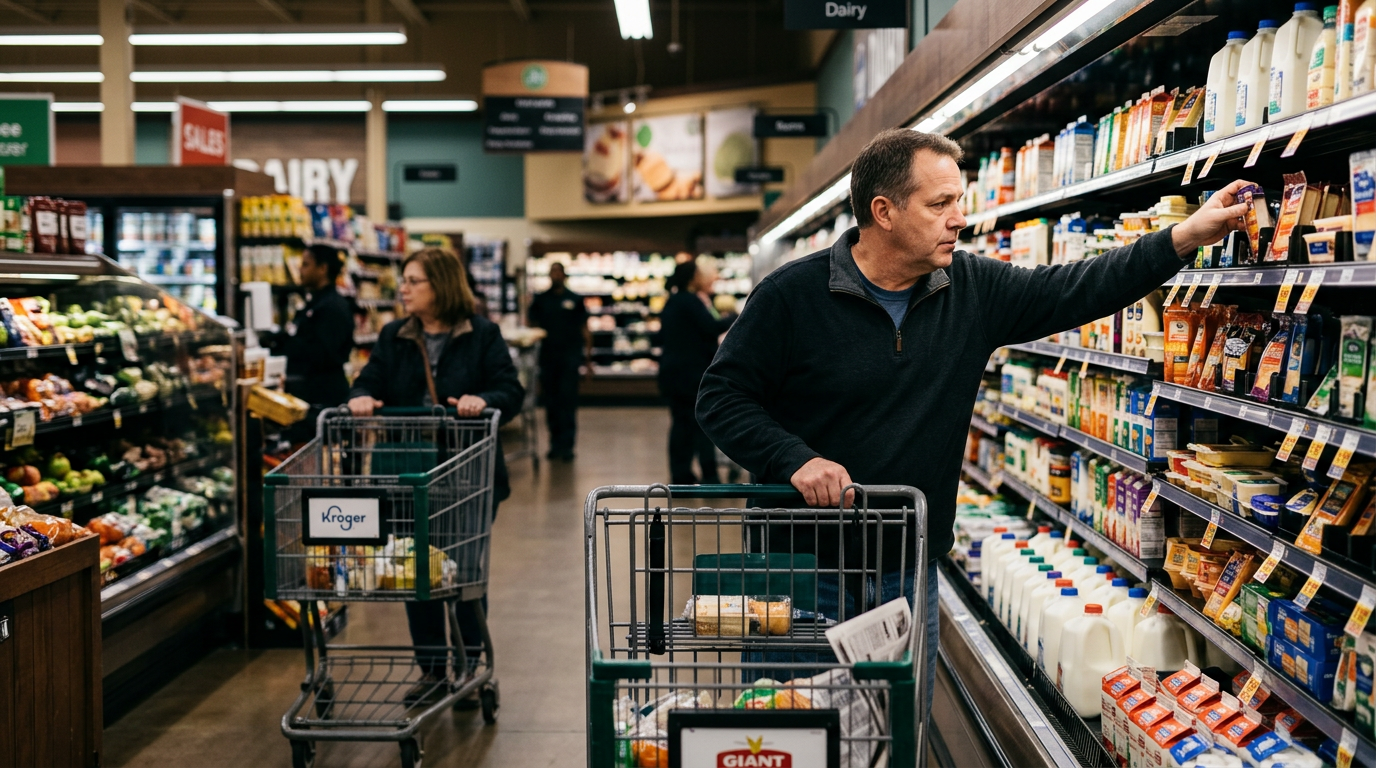
Kroger announced this morning that it’s acquiring Giant Eagle for $1.65 billion. The market moved on, mostly focused on chip stocks. That’s probably the wrong call.
This deal is the opening move in something bigger.
What Happened
Kroger will acquire Giant Eagle, a leading family-owned food and pharmacy retailer with approximately $9 billion in annual sales and 197 supermarkets and 11 standalone pharmacies across northern Ohio, western Pennsylvania, West Virginia, Maryland, and Indiana. The purchase price is $1.65 billion, comprised of $1.25 billion in cash consideration and the assumption of approximately $400 million in outstanding liabilities.
The deal expands Kroger’s geographic reach and marks the first acquisition under recently appointed CEO Greg Foran. That timing matters. A new CEO making a $1.65 billion move on Day One of his tenure is not a cautious operator. It’s a signal about where this company is going.
The context makes the deal feel even more pointed: this is Kroger’s first major acquisition following its failed mega-merger with top rival Albertsons. That deal, worth nearly $25 billion, fell apart in 2024 after the two largest U.S. supermarket chains failed to convince multiple courts that they should be allowed to merge.
So Kroger is back. Smaller deal, easier regulatory path, regional focus. Smarter playbook.
Why This Matters Beyond the Headline
The U.S. grocery industry is in the middle of a consolidation wave that the Albertsons collapse temporarily paused. Closely held Giant Eagle generated about $9 billion in sales in 2025, representing roughly 6% of Kroger’s $147.6 billion in revenue during its last fiscal year. That’s a meaningful bolt-on — not transformative on its own, but it establishes a pattern.
What’s interesting is the geography. Ohio, Pennsylvania, West Virginia, Maryland, Indiana. This is exactly the Midwest and mid-Atlantic corridor where Walmart has been aggressively expanding its grocery footprint through its supercenter model and its digital delivery buildout. Kroger is planting a flag in contested territory.
The pharmacy angle deserves attention too. Kroger will acquire the retailer, which operates 197 supermarkets and 11 standalone pharmacies. Grocery-pharmacy integration is one of the few defensive moats left in traditional retail. It drives loyalty, frequency, and data — all things Kroger needs to compete against Amazon Fresh and Walmart+.
Sector Implications
A few stocks and angles worth watching.
First, the divestiture play. Kroger said it will finance the acquisition with cash, and the companies said they expect to make a limited number of Giant Eagle store divestitures as part of the regulatory approval process. Those divested stores will go somewhere. Regional chains and private equity-backed grocery operators in the mid-Atlantic are the most likely buyers. Watch SpartanNash (SPTN) and Grocery Outlet (GO) as potential consolidators of whatever gets shed.
Second, the private label acceleration. Giant Eagle has a strong private label program. Kroger’s private label margins are structurally higher than branded products. Integration of Giant Eagle’s SKU base into Kroger’s Our Brands umbrella could add meaningful margin lift over a 24-month integration window.
Third, the loyalty data play. Kroger plans to keep Giant Eagle’s myPerks loyalty program while exploring additional opportunities to expand its reach. Loyalty programs in grocery are effectively data collection infrastructure. The scale of Kroger’s combined customer database post-acquisition becomes one of the largest consumer datasets in U.S. retail.
Scenario Framework
Bull Case: Regulatory approval comes quickly. Integration costs track below Kroger’s guidance. Private label margin expansion arrives earlier than expected. The stock re-rates toward a premium multiple as investors recognize that Foran is executing a smarter acquisition strategy than the Albertsons disaster. Analyst targets on KR push toward $75–$80.
Base Case: Regulatory review runs through late 2026 into early 2027. Limited divestitures reduce earnings dilution. Kroger demonstrates integration discipline. The deal proves accretive in year two. The stock trades sideways to modestly higher as the deal closes.
Bear Case: Regulators demand broader divestitures than expected, reducing the strategic value of the deal. Integration costs surprise to the upside. Meanwhile, Walmart accelerates its grocery delivery buildout and takes share in the exact markets Kroger just paid a premium to enter. KR underperforms the consumer staples sector through 2027.
Technical and Trading Framework
KR has been a frustratingly range-bound stock for most of 2026. The Albertsons failure left a hangover. But there’s a technical base forming around the $56–$58 zone, and a confirmed close above $62 would suggest institutional accumulation ahead of what’s shaping up to be an M&A-driven re-rating cycle.
For options traders: the implied volatility on KR is low relative to the event risk embedded in this deal. A longer-dated call spread — targeting the close above $62 with a January 2027 expiry — captures the potential re-rating window without requiring precision on timing. Sizing matters here. This is a patient trade.
The broader point is this: grocery is not a sleepy sector anymore. Consumer Discretionary fundamentals have weakened recently with softer revenue and free-cash-flow trends relative to other sectors. Low consumer confidence is also likely to impact the group. That context makes the defensive, high-frequency nature of grocery more attractive, not less. And Kroger just bought 197 more doors.
For informational and educational purposes only. Not investment advice. Trading involves risk, including loss of principal.